REVIEW · AMSTERDAM
Small Group Walking Tour – Hello Amsterdam
Book on Viator →Operated by Who Is Amsterdam Tours · Bookable on Viator
Amsterdam makes sense on foot. This 2-hour walk threads major sights from Dam Square to the Westerkerk while your guide keeps things moving with stories and quick games. It’s one of the easiest ways to get your bearings fast in central Amsterdam.
I especially love the small group setup (up to 15), because it stays interactive without feeling like a herd. And I like that the tour mixes classic landmarks with practical local takes, including food and shopping recommendations from your guide.
One possible drawback: it covers a lot in a short window, so if you’re craving a long sit-down kind of tour, you might wish it lasted longer than two hours. Also, the meeting point can feel a little tricky at first if your ticket instructions don’t clearly match the operator name—plan to arrive a few minutes early.
In This Review
- Key highlights worth your time
- Dam Square to Damrak: a strong orientation loop for first-time Amsterdam
- Beurs van Berlage: the money story behind Amsterdam’s Golden Age
- Damrak’s quiz + the dancing houses: learn street-level Amsterdam fast
- Haarlemmersluis and Singel: bike culture and classic canal-belt views
- Torensluis and the UNESCO canal belt: beauty with real context
- Keizersgracht and Westerkerk: Dutch identity ending near the Anne Frank area
- Guides, games, and why the route works in only two hours
- Price and value: what $35.07 buys you (and what it doesn’t)
- Getting the most out of your walk (without overplanning)
- Should you book Hello Amsterdam?
- FAQ
- How long is the Small Group Walking Tour – Hello Amsterdam?
- How much does the tour cost?
- How many people are in the group?
- Where does the tour start and end?
- Is the tour offered in English?
- Do I get a mobile ticket?
- Is admission required for the stops?
- What happens if the weather is poor?
- Are service animals allowed?
- Is free cancellation available?
Key highlights worth your time
- Dam Square start at the National Monument, right where most visitors want orientation
- Game-based learning like a true-or-false quiz on Dutch culture near Damrak
- Canal-belt views on the route, including Singel and multiple classic canal perspectives
- Bike culture explained at Haarlemmersluis, with the city’s two-wheeled obsession in context
- Important history included at Torensluis, including Amsterdam’s connection to slavery
- A strong finish near major landmarks, ending at the Homomonument by Westerchurch
Dam Square to Damrak: a strong orientation loop for first-time Amsterdam
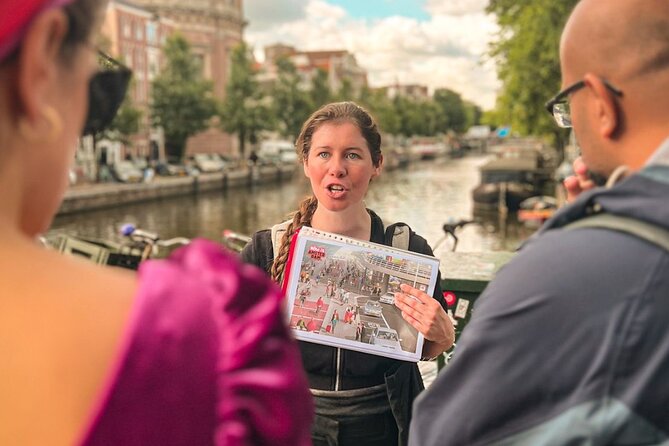
If you only have a day (or even half a day) in Amsterdam, you want a route that creates order. This tour does that by starting you at Dam Square and then moving through central streets toward the canal belt and west-side highlights. You end up with a mental map instead of just a list of photos to take.
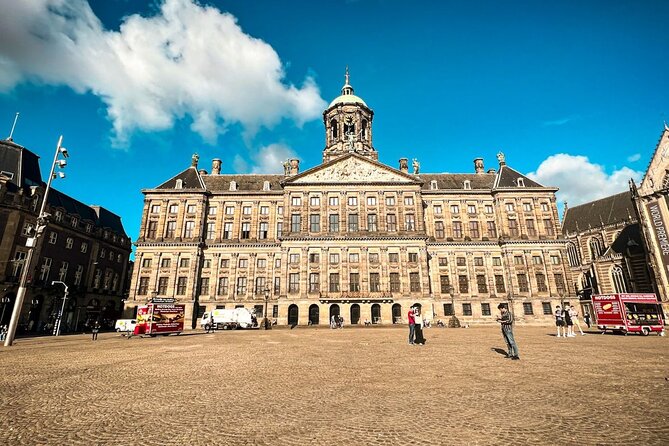
Dam Square is where the city’s “center of gravity” shows up fast. Your walk begins by the National Monument, with close views of landmarks like the Royal Palace, the National Monument itself, and the nearby New Church. The point here isn’t to memorize dates. It’s to see the big architectural anchors that shape how Amsterdam feels.
From there, you head into the Damstraat area and onward toward Damrak, which sits just a short walk from the Red Light District. You’ll get a playful true-or-false game that keeps cultural topics grounded and simple. The focus is on ideas like tolerance and coffeeshops, plus a few surprises about Dutch everyday life. Even if you’ve never studied Dutch culture before, the game format keeps it low-stress and fun.
A practical note: this is a walking tour, and the pacing is brisk by design. You’ll cover key sights without getting stuck at any one photo spot for too long. Wear comfortable shoes, and expect short stretches where you’re just moving and listening.
You can also read our reviews of more tours and experiences in Amsterdam.


Beurs van Berlage: the money story behind Amsterdam’s Golden Age
Stop 2 is Beurs van Berlage, and it’s a smart choice for anyone who wants more than postcard Amsterdam. This building connects to the origins of the city’s stock exchange, which helped Amsterdam punch above its weight during the 17th century. In other words: it’s not just pretty architecture—it’s tied to how the city grew.
The tour frames this stop as “financial wizardry,” but in plain terms. You learn how trade and investment ideas helped Amsterdam become a major force. And because the stop is short, you don’t risk turning your day into a history lecture marathon.
If you like understanding why things are the way they are, this stop works well. Amsterdam’s streets, canals, and neighborhoods didn’t appear randomly. They’re connected to commerce, migration, and the systems that shaped wealth and growth.
Damrak’s quiz + the dancing houses: learn street-level Amsterdam fast
Damrak is where the tour shifts from official monuments to street-level culture. You’re close to the Red Light District, but the experience stays focused on facts, attitudes, and the everyday culture behind the headlines.
You’ll play a fast true-or-false quiz about Dutch tolerance and coffeeshop culture, with no prior knowledge needed. The best part of this kind of activity is that it turns “I’ve heard stuff” into something you can repeat later—without getting preachy.
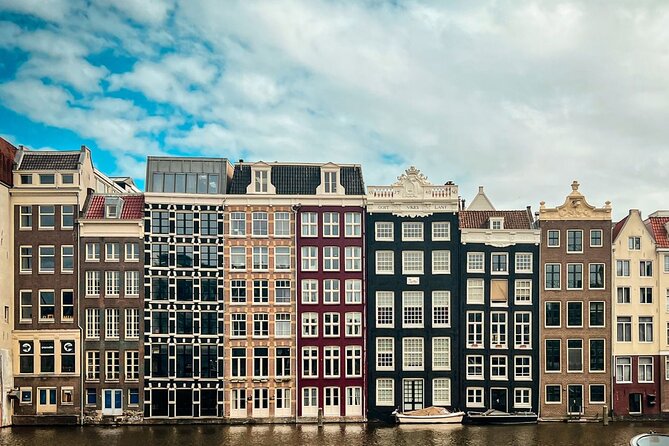
Also, as you move along Damrak, you get views of the Dancing Houses. These are the tilted canal-side buildings that look like they’re leaning into conversation. Your guide uses them as a visual prompt, pointing out what makes them unusual and why they’re remembered.
This section is ideal if you enjoy learning through motion. You’re not stuck sitting while someone talks. You’re walking, looking, and checking your answers in your head.
Haarlemmersluis and Singel: bike culture and classic canal-belt views
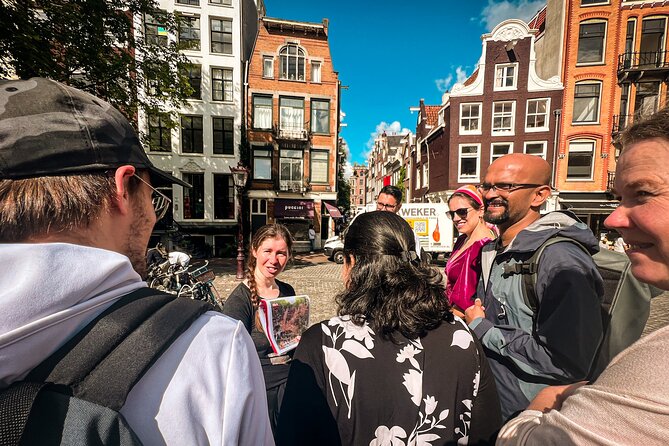
At Haarlemmersluis, you get one of Amsterdam’s favorite themes explained: biking as a daily system, not a tourist accessory. The tour spotlights how bike culture shapes the city, including the idea that Amsterdam has more bikes than people. It’s a small fact, but it lands because you can see it immediately in the streets and near the canals.
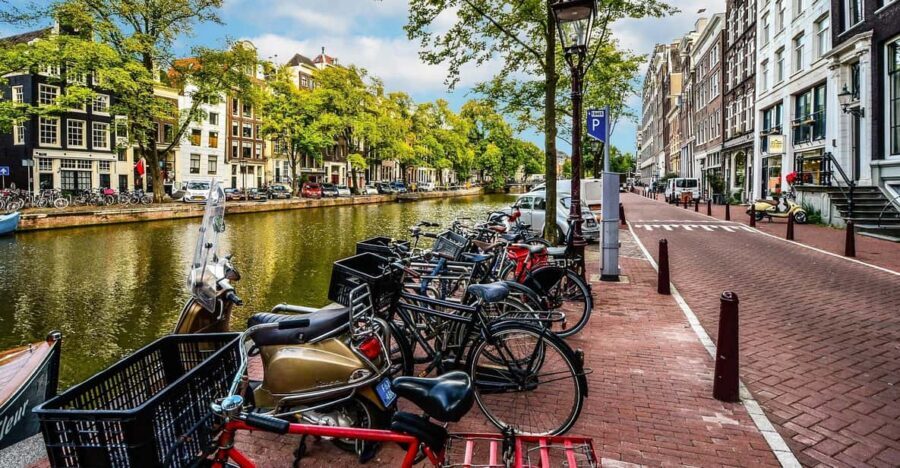
Then you move into Singel, one of the best-feeling canal stretches for photos and atmosphere. Here, you focus on the Dancing Houses again, this time from a canal-side perspective that makes their tilt look even more dramatic. This is the part of the tour where you’ll likely pause for a few extra seconds just to take in the geometry—water, buildings, and street-level life lining up in one view.
What I like about pairing these stops (bike culture and canal views) is that it creates balance. You get the practical Amsterdam—how people actually move around—plus the look-and-feel that makes people fall in love with the city.
Torensluis and the UNESCO canal belt: beauty with real context
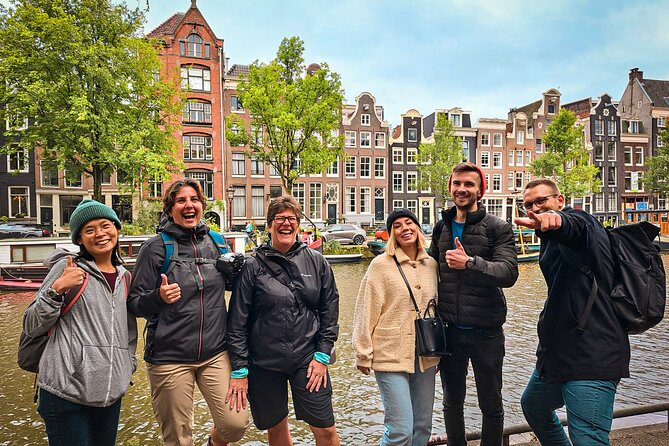
Torensluis is a key checkpoint because it connects Amsterdam’s canal belt to UNESCO recognition and to the city’s creation story. You also get more detail about how the canal belt is understood as a major historical feature, not just scenery.
But the tour doesn’t stop at postcard views. This is also where it brings up Amsterdam’s shadowed past, including slavery, as part of the city’s legacy. That matters, because it’s the kind of context you often miss when you only do quick “photo stops.” The guide frames it as something you should know alongside the beauty, not as an afterthought.
If you’re the type who appreciates “see it, then understand it,” this is one of the strongest sections of the route. It gives you a more complete Amsterdam—one that can hold both architectural charm and hard history.


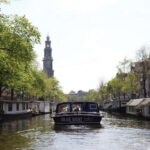

Keizersgracht and Westerkerk: Dutch identity ending near the Anne Frank area
As you reach Emperor’s Canal, also known by Keizersgracht, the tour moves from buildings to people. This section focuses on Dutch culture through family life and everyday identity. You’ll also hear an idea tied to UNICEF’s 2017 research about kids being among the happiest in the world, and how that connects to what Dutch life emphasizes.
Even if you don’t remember every statistic, you’ll come away with a clearer sense of what shapes daily behavior in the Netherlands—especially the practical, family-centered way many locals talk about normal life.
Then the tour finishes at the Westerkerk area, with key nearby references including the Anne Frank House and the Gay Monument. The ending centers on the “live and let live” mindset and Amsterdam’s reputation for acceptance, including an explicit conversation about diversity and people’s mentality.
There’s also a line referenced from Geert Mak about Amsterdam’s monumentality being tied to its people’s mentality. It’s the sort of thought that sticks because it’s less about buildings and more about attitude—what makes Amsterdam feel like Amsterdam even when the architecture is only part of the story.
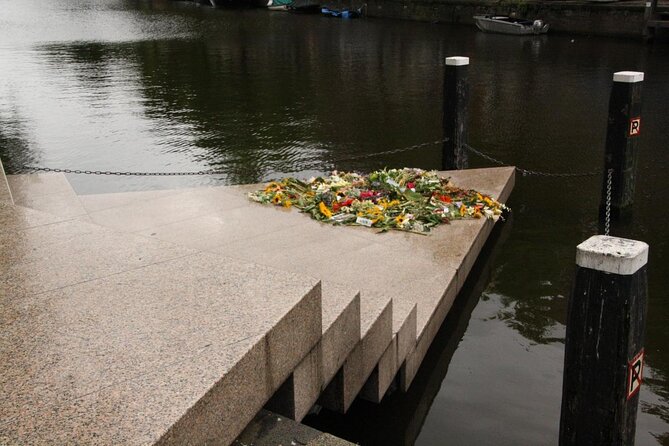
The final stop at the Homomonument is a convenient landing point, too. You end in central west, with the Anne Frank House area and Westerchurch close by, so you can keep exploring without backtracking.
Guides, games, and why the route works in only two hours
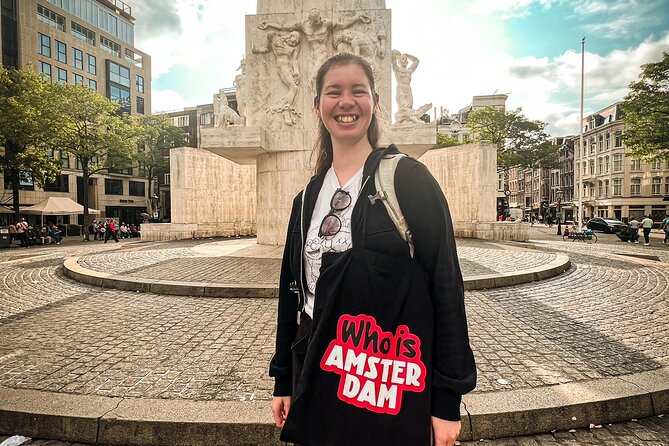
A lot of walking tours can be the same: monuments, photos, and a monotone script. This one tries to fix that with a more energetic guide style and frequent interaction.
In the feedback you provided, guides like Dani/Danni, Jonas, and Adam stand out for storytelling and energy, plus the use of games. That matches the structure of the walk: short stops, short explanations, and quick activities so the tour doesn’t drag.
The game element is more than entertainment. It’s how you remember. When your brain is solving something (like the true-or-false questions), the facts actually stick. And when you leave with a few memorables—tolerance, coffeeshop culture context, bike culture basics—you’ll be able to connect what you see later that day.
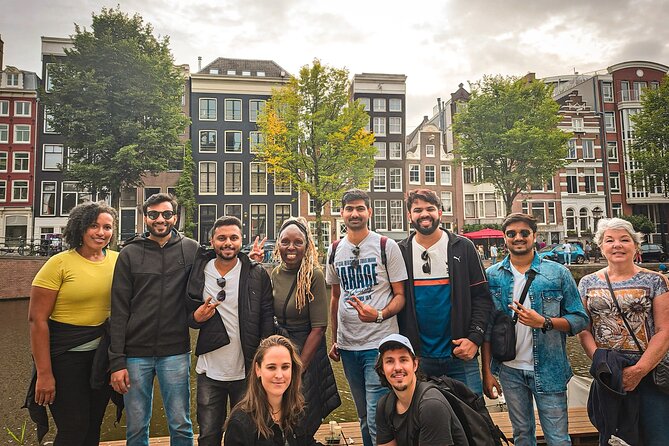
The small group size also helps here. With a maximum of 15 people, you can ask questions and get personal recommendations. Your guide is set up to share practical suggestions for where to eat and shop, which is usually the stuff you wish you knew on day one.
Price and value: what $35.07 buys you (and what it doesn’t)
At $35.07 per person for about two hours, the price is in the “reasonable day-one orientation” range. You’re not paying for museum entry or long-duration transportation. You’re paying for a guide-led route that hits major anchors of central Amsterdam and gives you context fast.
Here’s how I’d judge the value:
- You get a compact route across Dam Square, canal-belt viewpoints, and west-side landmarks without needing to plan.
- You get learning tools, like quick games, not just lectures.
- You get local recommendations, which can save you time and money later.
What the price does not promise is a slow, deep, all-day experience. If you want long explanations at every stop, or you plan to do multiple museums the same day, this tour is best as a first-step orientation rather than the only activity.
Since it’s offered in English and uses a mobile ticket, it’s also easy to fit into a schedule with minimal friction. Just remember that the tour time depends on staying comfortably mobile for a couple hours.
Getting the most out of your walk (without overplanning)
This tour works best when you treat it like a guided street map.
Arrive a few minutes early at the start near the National Monument on Dam (1012 JS Amsterdam). The meeting point is clear on paper, but you can still lose time searching at first glance. If your ticket doesn’t clearly state how to recognize the local operator, don’t hesitate to message or email the provider ahead of time. That kind of prep saves stress on a busy street.
Bring:
- Comfortable walking shoes
- A light layer (Amsterdam weather can shift)
- Your curiosity for both fun facts and harder history
Also, plan your rest of the day with the ending in mind. Since you finish near Homomonument and Westerchurch, it makes sense to keep exploring that area right after, especially if you’re planning to see sites around the Anne Frank House area.
Should you book Hello Amsterdam?
I’d book this if you want a 2-hour plan that covers central highlights and helps you understand Amsterdam beyond the first glance. It’s especially good for first-timers who like interactive learning and want solid local tips for where to eat and shop next.
Skip it only if you want a longer, slower tour, or if you dislike games and prefer a strictly historical, quiet format. In that case, you might find the pacing a bit quick.
For most people, though, it’s a smart starting move. You’ll leave with a clearer map, a handful of memorable facts, and a route that points you toward what to explore next.
FAQ
How long is the Small Group Walking Tour – Hello Amsterdam?
The tour runs for approximately 2 hours.
How much does the tour cost?
The price is $35.07 per person.
How many people are in the group?
The tour has a maximum of 15 travelers.
Where does the tour start and end?
It starts at the National Monument on Dam (1012 JS Amsterdam) and ends at the Homomonument at Westermarkt (1016 DW Amsterdam).
Is the tour offered in English?
Yes, the tour is offered in English.
Do I get a mobile ticket?
Yes, the tour uses a mobile ticket.
Is admission required for the stops?
The stops are marked as free admissions on the itinerary.
What happens if the weather is poor?
The experience requires good weather. If it’s canceled due to poor weather, you’ll be offered a different date or a full refund.
Are service animals allowed?
Yes, service animals are allowed.
Is free cancellation available?
Yes, you can cancel for a full refund if you cancel up to 24 hours in advance of the experience start time.