REVIEW · AMSTERDAM
Amsterdam in World War Two Cycle Tour
Book on Viator →Operated by Slagveldreizen.nl · Bookable on Viator
Cycling Amsterdam tells WWII in street-level detail. This Amsterdam South cycle tour lets you ride where cars can’t, with wartime photos matched to modern streets so you can see how the occupation shaped real neighborhoods. The focus is intense and the stories deal directly with arrests, deportations, and reprisals, so you should be ready for heavy subject matter.
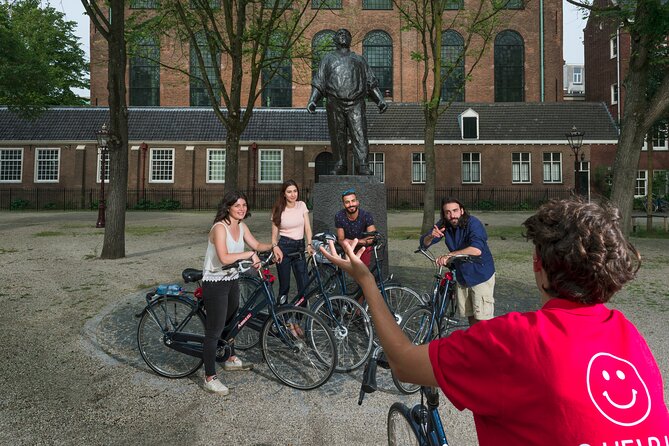
I also like the size of the group. With a max of six people, you get real back-and-forth as your guide (often Rudy, sometimes with Peter) points out what to look for and why it mattered. If you want more than a museum wall text experience, this is the kind of tour where the city becomes the exhibit.
In This Review
- Key highlights (what makes this tour special)
- Price and logistics: is it good value for a 2.5–3.2 hour bike tour?
- How the bike route changes what you notice in Amsterdam
- Starting at Tesselschadestraat and rolling into Victorieplein (Daniël Willinkplein)
- June 20, 1943 momentum: Olympiaplein and how registration worked
- Merwedeplein 37-II: the Frank family’s doorstep
- Waalstraat 48 (Tilex Bar) and the chilling story of Lex van Weren
- Cornelis Troostplein 23 and the PBA baracks: occupation logistics made visible
- Museumplein’s wartime stronghold: offices, flak batteries, and NSB HQ
- Roelof Hartplein coffee stop and the resistance photo shop
- Beethovenstraat / Apollolaan: executions, retaliation, and Euterpestraat
- Memlingstraat / Rubensstraat: SD HQ, stolen property, and a RAF Typhoon strike
- Valeriusplein (Amsterdam Lyceum) and Luftwaffe command
- Queen Emma’s statue and the first defiance moments of 1940
- The final day: May 7, 1945 and why the route matters
- Should you book this Amsterdam WWII cycle tour?
- FAQ
- How long is the Amsterdam in World War Two Cycle Tour?
- What does it cost?
- Where do I meet for the tour?
- What time does the tour start?
- How many people are in the group?
- Is the tour offered in English?
- Will I get a ticket on my phone?
- Do you stop for coffee and a restroom break?
- Will you see WWII photos tied to the exact locations?
- Is free cancellation available?
Key highlights (what makes this tour special)
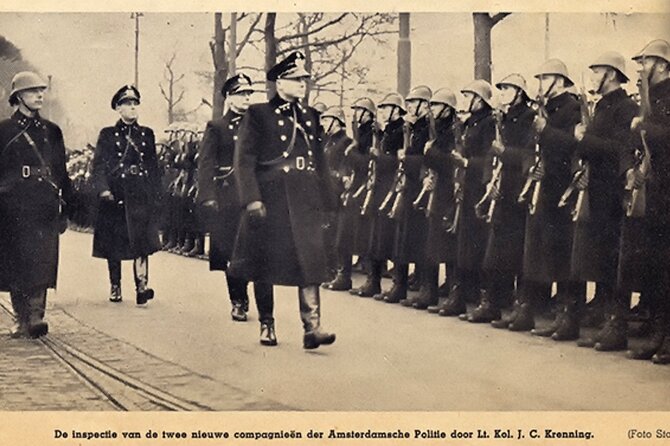
- WWII photos then-and-now: you’ll stand in the same spots while seeing what was there during the occupation
- Bike access to quieter streets: you cover more ground than walking without getting funneled into crowds
- Small group feel: max six riders means less waiting and more focus
- Fast context-building storytelling: each stop ties to a bigger occupation/resistance pattern
- A clearly planned route: from roundups and registration to resistance networks and final-day violence
Price and logistics: is it good value for a 2.5–3.2 hour bike tour?
The price here is $66.09 per person for a tour that runs about 2 hours 30 minutes to 3 hours 10 minutes. That’s not a bargain-sale rate, but it also isn’t a “pay extra for a scarf” situation. The value comes from three things you can’t get as easily on your own: (1) the guided connections between sites, (2) the wartime photo matching, and (3) the ability to move through Amsterdam South quickly on bike instead of losing time walking between dispersed locations.
You start at Tesselschadestraat 1 (1054 ET) at 11:00 am, and the tour ends back at the same meeting point. It’s offered in English, and you’ll receive a mobile ticket. Most people can participate, and reviews specifically call out the tour as safe—still, you’re cycling, so you’ll want to feel comfortable on city bike routes and keep attention on traffic and junctions.
Tip: check how your day fits. This tour is history-heavy. It’s ideal if you want to learn something real, not just “see the highlights.” Plan some quiet time afterward, especially if the WWII stories hit close to home.
You can also read our reviews of more tours and experiences in Amsterdam.
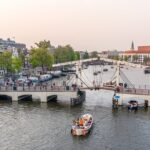
How the bike route changes what you notice in Amsterdam
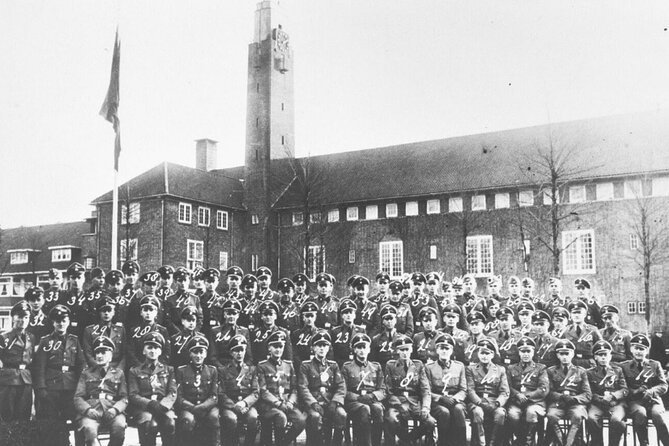
Amsterdam is famously walkable, but that also means you can spend a lot of time shuffling past the same tourist blocks. This tour’s biggest advantage is that cycling gives you a different kind of city reading. You glide along streets long enough to recognize building layouts, corners, and sight lines—then your guide layers in the wartime details: offices housed in everyday façades, meeting places tucked into side streets, and small memorials that you’d otherwise miss.
Another smart touch is the emphasis on Amsterdam South rather than staying locked into the center. The route is planned so you can reach significant locations without constantly fighting crowds. That means better concentration at each stop. And it also means the tour feels like moving through lived-in neighborhoods, not just hopping between “must-see” plaques.
On a group level, max six riders matters more than it sounds. When everyone can hear the explanation and the guide isn’t rushing to keep a big pack together, you get to ask practical questions—like why a particular building served an occupation purpose, or how resistance networks used ordinary businesses and streets.
Starting at Tesselschadestraat and rolling into Victorieplein (Daniël Willinkplein)
You begin near Tesselschadestraat and soon head toward Victorieplein, which was known back then as Daniël Willinkplein. The first stop sets the tone fast: on June 20, 1943, a major raid hit Amsterdam. At the foot of the skyscraper—still part of the local skyline today—large groups of Jewish citizens were arrested during what the Nazis called a Judenaktion.
Your guide connects the occupation machinery to visible geography. The raid wasn’t just a German operation. Dutch police units (the PBA, Police Battalion Amsterdam) and police volunteers connected to the far-right NSB were involved, too. The arrested people were then transported to Olympiaplein and other places for registration, and from there many were sent to Westerbork in the east of the Netherlands.
What to watch for here: the way the area functions as a public space. These raids unfolded in places where people had everyday routines. That’s one reason this bike tour hits so hard. It shows you that war didn’t stay behind fortress walls.
Possible drawback to plan for: the tour is emotionally direct. If you prefer a lighter format—like focusing only on architecture and not on what happened to real people—this may feel heavier than you want.
June 20, 1943 momentum: Olympiaplein and how registration worked
Later, you’ll return to the theme of roundup and registration at Olympiaplein / Parnassusweg. This stop explains what happened after arrests. Jewish people taken during the June 1943 raid were registered by the SD/Gestapo, with help from Jewish camp police sent from Westerbork.
That “help” detail is important context. It doesn’t excuse anything. It shows how the system used different hands and forced impossible choices inside already broken lives. It also helps you understand why the occupation’s paperwork and processing were as important as the violence itself.
When you’re standing at Olympiaplein, don’t look only for a single memorial. Look at the idea of a square as a sorting point—somewhere people could be controlled, organized, and moved onward. Your guide’s job is to connect that everyday urban logic to the historical process.
Merwedeplein 37-II: the Frank family’s doorstep
One of the most meaningful sections comes around Merwedeplein 37-II (the listing notes the building is on the “3rd floor by American counting”). This address was home to the Frank family. In summer 1942, Otto Frank took his family and some acquaintances to the Secret Annex, known as Het Achterhuis, located on the Prinsengracht—above and behind Otto’s company offices.
What makes this stop more than a photo-op is how your guide connects family life, business life, and the hiding situation. You don’t just hear names—you hear the web of decisions that got people from one part of the city to another.
There’s also a statue commemorating Anne Frank on Merwedeplein. Nearby, your route passes a book-related landmark that adds a concrete publishing thread to the story. Around the corner is the Waalstraat bookstore, Jimmink (still active), where the first edition of Het Achterhuis—Anne Frank’s diary published after the war—was sold.
And here’s a detail that tends to stick: it was at that bookshop that Otto Frank bought the diary for his daughter. That turns the location into something more personal than a memorial. It becomes a bridge from hiding to aftermath.
Waalstraat 48 (Tilex Bar) and the chilling story of Lex van Weren
Across from Merwedeplein, at Waalstraat 48 (now Café Blek), the tour points out a former Tilex Bar. The name connects to Tilly and Lex van Weren.
Lex van Weren survived Auschwitz because he had to play his trumpet at executions. It’s one of those facts that’s so grim it almost feels hard to process. But it matters. It shows how survival could depend on small skills, brutal coercion, and moments of forced usefulness inside a system designed to destroy people.
This stop also makes a practical point for your sightseeing: lots of occupation-era sites aren’t obvious. They lived inside ordinary street life—bars, shops, offices. That’s why the photo matching and the guided narration work so well here. Without that, you’d probably bike right past the building and miss the story attached to it.
Cornelis Troostplein 23 and the PBA baracks: occupation logistics made visible
At Cornelis Troostplein 23, your guide shifts the focus to how occupation forces were housed and organized. The area once held PBA baracks. Before WWII, it was called the peace parish, a Catholic complex that held two convents and a school.
In spring 1942, the chief of the Sicherheitsdienst (SD) / Gestapo, Rauter, inspected the PBA and met Heinrich Himmler at Museumplein. This is one of those stops where you start seeing the occupation as a network—people, command structure, inspections, and infrastructure.
If you’re the kind of person who likes to understand systems rather than just dates, you’ll enjoy this section. It gives the “how” behind the “what.” The buildings you see today helped serve roles inside that machinery at the time.
Museumplein’s wartime stronghold: offices, flak batteries, and NSB HQ
Then you move to Museumplein, and the tour really turns cinematic—though you’re still in the real world, rolling past real buildings. Your guide explains how the Germans transformed Museumplein during the war into a stronghold.
From the concert hall viewpoint, houses on your left were occupied by German offices. One example mentioned: the former United States consulate building once housed the Zentralstelle für Jüdische Auswanderung (Central Jewish “Emigration” office). Nearby were the Ortskommandantur (town major) and the Feldgendarmerie (military police) building. Other buildings housed Nazi party offices and German services.
On the square itself, the Germans built bunkers and installed anti-aircraft (Flak) batteries, including an IJsclubterrein (Amsterdam skating club) site turned into military infrastructure. Next to the concert hall, you find the NSB HQ Amsterdam. After WWII, bunkers were blown up.
A quick practical note: in this area, it can be easy to look at the big open square and forget how much could be packed into it. Your guide keeps you focused on the specific buildings and roles, so you’re not just staring at modern museum façades.
Roelof Hartplein coffee stop and the resistance photo shop
After the heavier stretches, there’s a breather: Roelof Hartplein, with a short stop at Café Wildschut for coffee and a restroom. The tour notes 10 minutes and that admission is free for that pause.
Then it gets interesting again at Roelof Hartstraat, where there used to be a photo shop next to the library building. During the war, the Dutch resistance used the store and developed unique photos—including images connected to the first roundup of Jews in Amsterdam by the SD/Gestapo and German police.
Your guide points out a small monument remembering Jews taken from this neighborhood. It’s easy to miss, and that’s exactly why the stop helps. The tour doesn’t only cover major names. It also teaches you what “evidence” looks like on the street.
Beethovenstraat / Apollolaan: executions, retaliation, and Euterpestraat
Next comes a street corner where the story is brutally direct: at Beethovenstraat / Apollolaan (with house numbers still noted as similar to wartime), around the end of October 1944, Herbert Oelschlägel, an SS officer and SD/Gestapo agent, was executed by a Dutch resistance member in front of what was no. 6.
In retaliation, the Sicherheitsdienst/Gestapo burned down two houses and executed 29 resistance fighters.
The tour also clarifies that at the time this street was called Euterpestraat, and it connects the neighborhood to Gerrit van der Veen, leader of an important Dutch resistance group.
What I like about these stops is the cause-and-effect framing. It helps you understand resistance wasn’t just heroic speeches. It led to immediate danger for neighbors and families.
Memlingstraat / Rubensstraat: SD HQ, stolen property, and a RAF Typhoon strike
At the corner of Memlingstraat / Rubensstraat, you get two occupation functions in one area—part of why this stop feels like the war condensed into a few streets. The tour identifies offices of major Nazi oppression organizations: the SD-HQ Amsterdam (described as SD Außenstelle under Willy Lages) and the Hausraterfassungsstelle, which was part of the Central Jewish “Emigration” framework and involved stealing possessions of deported Jews. The leader mentioned is a Dutch collaborator named Henneicke.
Then your guide brings in the resistance’s counter-move. In November 1944, the resistance requested a Royal Air Force attack using a secret radio message, aiming to hit these headquarters and mainly destroy SD/Gestapo files. The job was carried out by Group Captain Denys Gillam DSO, DFC, AFC, leader of 149 (Typhoon) wing.
There’s also a safehouse detail tied to Stolperstein (stumbling stones), mentioned at the corner of Rubensstraat / Gerrit van der Veenstraat. The tour notes that in June 1944, the address was betrayed to the SD/Gestapo by a female informant, referred to as V-Frau.
This is one of the most absorbing sections because it shows the war as a struggle over information—files, records, inventory of people, and the logistics of confiscation. It also makes clear how much risk resistance networks carried, even when they were trying to strike key targets.
Valeriusplein (Amsterdam Lyceum) and Luftwaffe command
At Valeriusplein / Amsterdam Lyceum, you learn that the school building served as headquarters of the Luftwaffe at the end of the occupation. That kind of repurposing is a recurring theme in the tour: education buildings, offices, and public spaces all became part of the occupation machine.
Even if you don’t love war stories, you’ll probably enjoy this stop because it forces you to see a familiar civic building in an unfamiliar role. It also keeps the tour balanced: it covers oppression, yes, but also how everyday institutions got turned into tools of control.
Queen Emma’s statue and the first defiance moments of 1940
The tour ends this major stretch at the statue of Queen Emma on Emmalaan / Prins Hendriklaan. In summer 1940, people placed flowers at the statue as a quiet act of defiance against the German occupiers.
That matters because it breaks up the nonstop “occupation process” mood. It reminds you that resistance wasn’t only raids and headquarters. Sometimes it was a gesture in public that said no, without waiting for permission.
Your guide adds another wartime photo connection, mentioning resistance photographer Charles Breijer, who took a photo of a guard at the headquarters of the Kriegsmarine in 1944. That brings the narration back to the power of images—how evidence survives when buildings and people are under threat.
The final day: May 7, 1945 and why the route matters
On May 7, 1945, when the Germans surrendered, dangerous situations arose between frustrated German troops and resistance fighters. The tour points to a monument remembering victims of one of the shootings on the last day.
Then you roll through Vondelpark and head toward Leidseplein, where you started. Ending this way is smart. It gives your brain a visual decompression before you step back out into normal Amsterdam life.
If you want to make the most of the ending: slow down your observation near the monument area. Don’t rush past it. This last stop is your reminder that liberation didn’t automatically mean safety overnight.
Should you book this Amsterdam WWII cycle tour?
Book it if you want a practical, street-level way to understand WWII in Amsterdam, especially in the south neighborhoods you’d likely skip. The wartime photo matching is the standout feature. It turns the city into a timeline you can ride through, and the small group format keeps the experience focused.
Don’t book it if you’re seeking a light sightseeing loop. This tour is about arrests, deportation systems, resistance operations, and retaliation. You’ll be cycling through locations tied to real human suffering, not just absorbing neat trivia.
One more decision helper: if you already plan to see Anne Frank-related sites and you want the story to spill into the surrounding streets—past bars, offices, schools, and side corners—this tour is a strong match. It’s the difference between reading about the war and seeing how it sat inside daily life.
FAQ
How long is the Amsterdam in World War Two Cycle Tour?
The tour lasts about 2 hours 30 minutes to 3 hours 10 minutes.
What does it cost?
The price is $66.09 per person.
Where do I meet for the tour?
The meeting point is Tesselschadestraat 1, 1054 ET Amsterdam, Netherlands.
What time does the tour start?
The tour starts at 11:00 am.
How many people are in the group?
The tour has a maximum of six travelers.
Is the tour offered in English?
Yes, it’s offered in English.
Will I get a ticket on my phone?
Yes. You’ll receive a mobile ticket.
Do you stop for coffee and a restroom break?
Yes. There is a short stop at Roelof Hartplein at Café Wildschut for coffee and restroom use (noted as 10 minutes).
Will you see WWII photos tied to the exact locations?
Yes. The tour includes historical photos from WWII matched to the present-day places you visit.
Is free cancellation available?
Yes. You can cancel up to 24 hours in advance for a full refund. If you cancel less than 24 hours before the start time, the amount paid is not refunded.