REVIEW · AMSTERDAM
Rotterdam, Delft, The Hague Day Tour Incl. Madurodam/Royal Delft
Book on Viator →Operated by K7 Travel · Bookable on Viator
Rotterdam to Delft to The Hague in one day is a smart shortcut. You’ll ride in comfort through South Holland’s different moods, from modern port energy to royal blue pottery and the Netherlands’ legal core. The small group size and air-conditioned vehicle make it realistic to hit a lot of iconic spots without turning your day into a sprint.
I especially like how the day balances “wow architecture” with hands-on Dutch culture. The Markthal in Rotterdam is an instant hit, and the included stop at either Royal Delft or Madurodam gives you something you can’t easily replicate on your own. Plus, guides such as Leidse and Reinier are repeatedly praised for making the history feel clear and usable.
One possible drawback: the schedule moves fast, and several stops are mostly photo time. If you’re a slow walker, or you want long, unstructured exploring, you may feel squeezed.
In This Review
- Key things to know before you go
- Hitting Rotterdam, Delft, and The Hague in one 10-hour sweep
- Price and what $156.07 buys you (and what it doesn’t)
- Rotterdam’s contrast: markets, medieval leftovers, and bold architecture
- Delft’s Markt, City Hall, and the Royal Blue factory choice
- Royal Delft (the real factory experience)
- Madurodam (the miniature city)
- The Hague’s royal and legal center: Peace Palace to Binnenhof
- Comfort, timing, and the small-group van reality
- When guides make the difference: what to look for on the day
- Lunch timing and how to avoid decision fatigue in Delft
- Who this day tour suits best (and who should look elsewhere)
- Should you book this Rotterdam, Delft, and The Hague day tour?
- FAQ
- Is lunch included on the tour?
- What’s included in the price?
- Do I visit both Royal Delft and Madurodam?
- How long is the tour?
- What time does the tour start and when is pickup?
- Where does pickup happen in Amsterdam?
- How large is the group?
- Is the tour suitable for slow walkers?
- What weather conditions does the tour need?
- Can I cancel for a full refund?
- Are the churches and some architecture stops included in the ticket price?
Key things to know before you go
- Small group max of 8 means less waiting and easier conversation with the guide
- Either Royal Delft or Madurodam is included, so choose the style you care about most
- Many quick stops (often 10–30 minutes) favor efficient sightseeing over lingering
- Lunch is on your own in Delft, so plan on picking a spot quickly when you’re there
- Pickup is offered only in a defined area of Amsterdam (Ring A10, with a noted exception)
Hitting Rotterdam, Delft, and The Hague in one 10-hour sweep
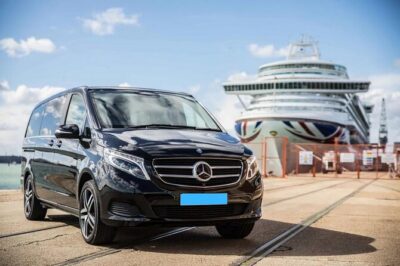
This is a classic South Holland highlights day: modern Rotterdam, photogenic Delft, and The Hague’s political and royal sights. The tour runs about 10 hours and is designed to cover a big geographic distance with minimal fuss, using a comfortable, air-conditioned vehicle to connect the dots fast.
The best way to think about this day: it’s not a deep study of one city. It’s a “get your bearings fast” tour. You’ll see a lot of famous places, and then you’ll know which city you’ll want to return to for a slower, more detailed visit.
The group is capped at 8 people, which matters. It’s easier for the van to maneuver, easier for the guide to point things out, and you’ll generally get more attention than on bigger tours. That said, the tradeoff is that you may feel the pace—this is a schedule-heavy day.
You can also read our reviews of more tours and experiences in Amsterdam.
Price and what $156.07 buys you (and what it doesn’t)
At about $156.07 per person, this isn’t a budget bargain. But it also isn’t just a “drive-by” for that money. What you’re paying for is logistics plus guided structure: hotel pickup (for eligible areas), a/c transport, bottled water, all fees/taxes, and admission to one major attraction in the schedule (either Madurodam or the Royal Delft factory).
Two big value notes:
- The included admission is the kind of ticket you’d otherwise pay separately. You’re also getting time that’s planned around where you’ll want to stand, look, and photograph.
- The small-group format tends to keep the day smoother, especially when traffic or weather slows things down.
What you should not expect: lunch is not included. You’ll be given time in Delft for your own meal choice, so the day can feel a little “you’re on your own” right there.
If you hate tight timing, compare this cost to train tickets plus independent touring. If you’d rather outsource planning and just enjoy the day, this price often feels fair.
Rotterdam’s contrast: markets, medieval leftovers, and bold architecture
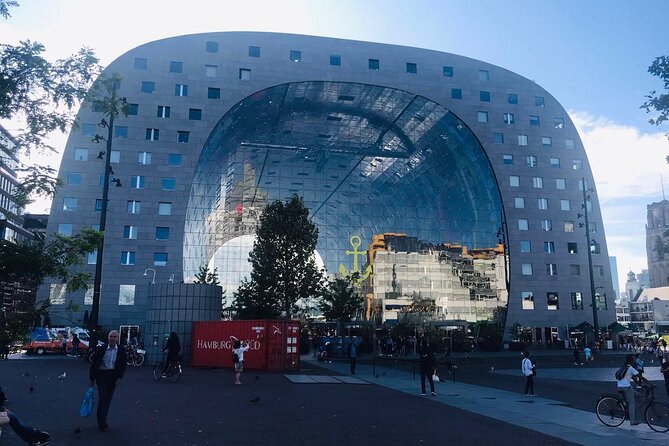
Rotterdam starts the day with a bang. Your first big stop is Markthal, an enormous indoor market hall with wall art covering nearly 11,000 m². It’s one of those places where the building itself becomes part of the story. You’ll find classic Dutch food options around there—cheese, herring (haring), and stroopwafel—so even if you don’t buy much, you’ll get a real sense of local taste.
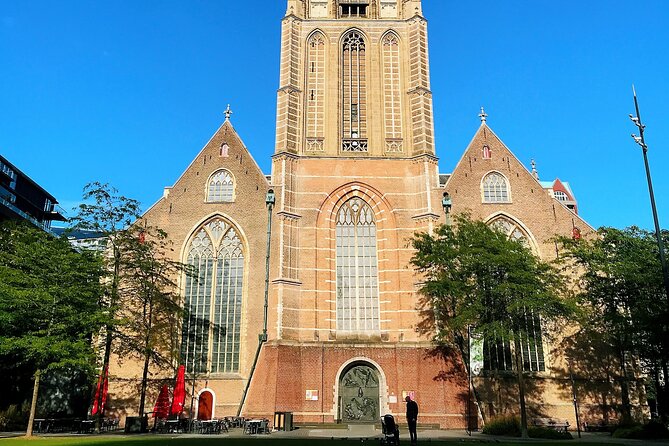
After that, you’ll step into “what survived” history at Grote of Sint-Laurenskerk. This church is the only remnant of medieval Rotterdam, and it’s tied to war history too. It has a current stone building that remained after destruction and later repairs, and today it also hosts exhibitions and other events. The stop is short, so come with the expectation: quick context, then photos.
Then comes the relaxed, old-port vibe at Oudehaven. Built in 1350, this is Rotterdam’s oldest harbor area, now surrounded by bars and restaurants. It’s a perfect breather—part walkable, part view time—especially after the heavier architecture of Markthal.
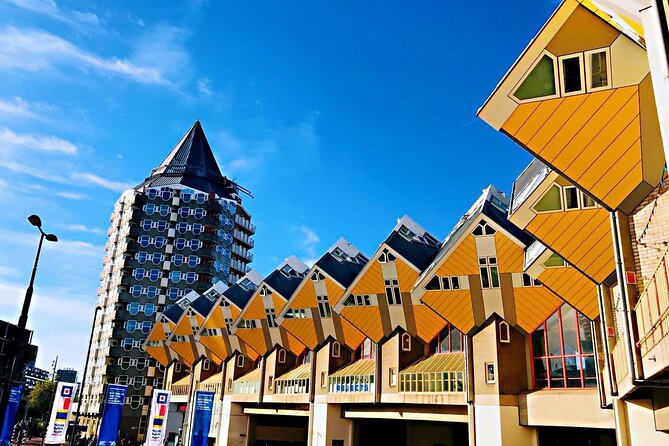
Next, you’ll get the city’s design imagination at Kijk-Kubus (Cube Houses). The idea is about space efficiency: rotate the cube of a conventional house 45 degrees and set it onto a hexagon-shaped pylon. Even if you don’t go inside, you’ll understand why Rotterdam earned a reputation for experimental urban design.
You’ll also spot Erasmus Bridge, a combined cable-stayed and bascule bridge crossing the Nieuwe Maas. It’s a central landmark and even shows up in the city’s logo. Again, timing is tight here, so focus on photos from the outside and use the guide’s explanation to “read” the structure.
The day also includes Euromast, an observation tower built for the 1960 Floriade Flower Expo, listed since 2010. It’s described as the highest building in the Netherlands and tied to a global tower federation. If you’re coming for skyline views, this is the kind of stop that makes the whole Rotterdam section feel complete.
Potential pitfall in Rotterdam: some of these are brief, and the city is spread out. If you’re hoping to wander into multiple neighborhoods on your own, you won’t have that freedom today.
Delft’s Markt, City Hall, and the Royal Blue factory choice
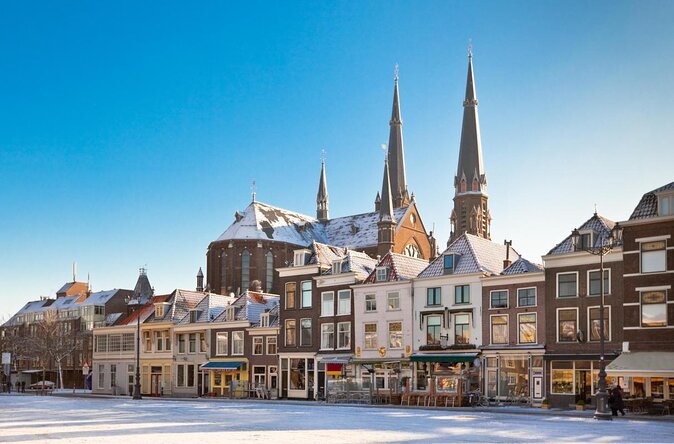
Delft is where the pace often feels nicer. The tour stops at Stadhuis Delft (City Hall) on the Markt, opposite the Nieuwe Kerk. It’s a Renaissance-style building and still matters for civic life, including weddings. One practical detail: much of the day-to-day admin work has shifted, with offices in the Delft railway station building—so Delft’s city center blends old symbols and modern systems.
You’ll also have time at the Markt itself, which is where most people naturally want to eat. This is also where Delft’s “small city charm” shows up: shops, bars, and easy pedestrian strolling.
Then you hit the big decision point: Royal Delft vs Madurodam.
Royal Delft (the real factory experience)
If you choose Royal Delft, you’re stepping into the long-running Delft Blue story. Royal Delft is described as the only remaining factory out of 32 established in 17th-century Delft. It’s been active for over 360 years, and you’ll see live painting there. Even if you’re not a “ceramics person,” watching a maker work turns Delft Blue from a souvenir into something with a process and craft behind it.

Madurodam (the miniature city)
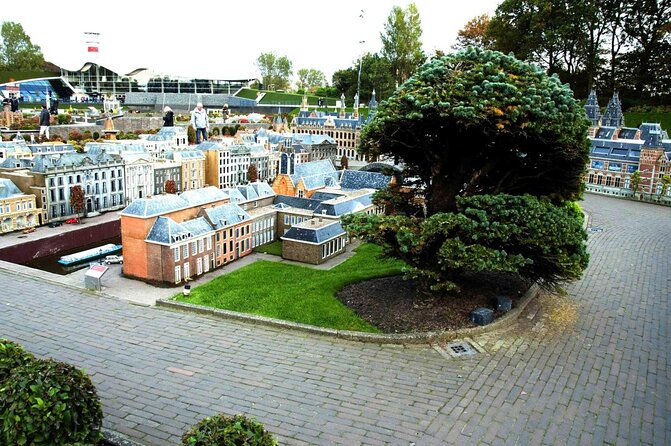
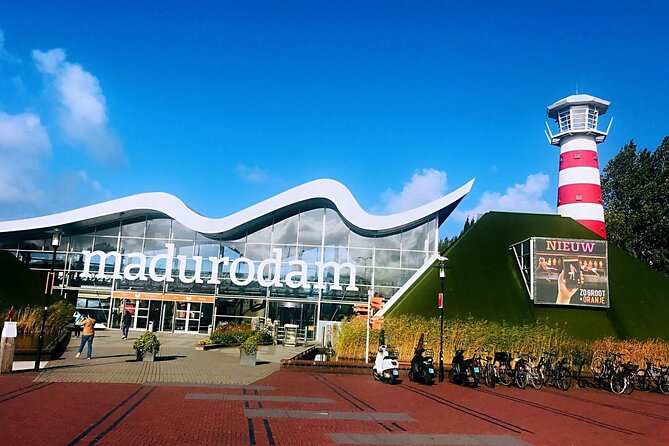
If you choose Madurodam, you’ll go to a 1.8 km² park in The Hague filled with 1:25 scale replicas of Dutch landmarks. It’s famous for bringing together more than 120 buildings and sites, and it’s described as becoming the smallest city in the world in 1972. This one is especially good if you like visual storytelling, quick sightseeing, or traveling with kids.
A smart way to choose:
- Pick Royal Delft if you want hands-on craft and real Delft Blue.
- Pick Madurodam if you want a fast, playful “greatest hits” tour of the Netherlands in one place.
Either way, this choice is a major part of what makes the day feel “worth it,” because you’re including admission to one major attraction instead of just walking past things.
The Hague’s royal and legal center: Peace Palace to Binnenhof
The Hague is the calm, official side of Dutch life. You’ll visit a series of sites tied to international law, parliament, and the royal family’s public presence.
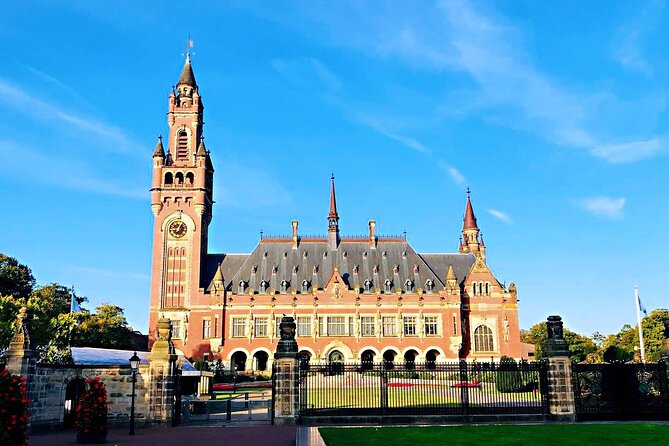
First up is the Peace Palace, an international law administrative building that houses institutions including the International Court of Justice and the Permanent Court of Arbitration, plus The Hague Academy of International Law and the Peace Palace Library. The stop is short, but the building’s purpose is the point: you’re seeing where international disputes and legal education are centered.
Then the tour continues with Noordeinde Palace, described as one of the three official royal palaces and the official workplace of King Willem-Alexander since 2013. It’s more about understanding how the monarchy functions in the Netherlands today than about grand interior touring.
You also stop at the House of Representatives, part of the parliament system that drafts laws and monitors the government. Nearby, you’ll reach the historical heart of Dutch governance at Binnenhof & Ridderzaal. Binnenhof dates back primarily to the 13th century and became the political center of the Dutch Republic in 1584. The Ridderzaal is part of that same complex, and it’s described as the oldest Parliament building in the world still in use.
How this section feels: it can be a lot of institutional “big picture” info in a short time. If you like politics, law, and how governments actually work, you’ll enjoy the payoff. If you prefer purely visual sightseeing, focus on the architecture and let the guide’s explanations do the heavy lifting.
Comfort, timing, and the small-group van reality
This tour is built for efficiency, which means the schedule can feel tight. Many stops are 10–30 minutes, and you’ll spend the day moving between city centers rather than relaxing in one neighborhood for hours.
There are two sides to the comfort story:
- Strong side: several guides (including Leidse, Reinier, and Pete) are praised for promptness, smooth driving, and keeping people informed. One consistent theme is that you’re not left guessing what happens next.
- Tight side: because the group is small but still has up to 8 people, some seating can feel close, especially if you end up sitting near the driver area. If you’re sensitive to cramped vehicle space, keep that in mind.
You’ll also want practical footwear. Walking is required, and it’s explicitly noted as not recommended for slow walkers. You’re on and off the van often, standing for brief photo moments, and moving through busy market or city-square areas.
Weather matters too. The tour requires good weather, so if rain or poor conditions hit, the operator may offer a different date or a full refund.
When guides make the difference: what to look for on the day
In the feedback patterns here, the guide role comes through clearly. People frequently mention guides like Leidse, Reinier, and Pete as big reasons the day works well. The praised themes are practical: clear explanations, good timing, and the ability to adjust when traffic or crowds change the plan.
One useful takeaway for your expectations: a great guide can turn short stops into real understanding. A weaker moment can feel like a quick drop-off and a lot of wandering with limited context. So choose your mindset accordingly:
- Go in ready to learn something in small bites.
- Ask questions at stops rather than saving all curiosity for the end of the day.
If you tend to get impatient when schedules are tight, this kind of tour can still be enjoyable—but only if you treat it like a guided highlights sampler, not a slow museum day.
Lunch timing and how to avoid decision fatigue in Delft
Lunch isn’t included, but you do get time in Delft’s central area (around the Markt). That’s convenient because you’re not searching all over a city after being dropped off.
The trick is to decide quickly once you arrive. On busy days (weekends especially), places can feel crowded and menu choices can feel stressful when you’re watching the clock. If you’re picky about timing, bring a small plan:
- Know what kind of food you want (Dutch basics, casual café, or something quick).
- Have a backup option nearby so you can commit fast.
If you do this, lunch stays a pleasant reset instead of a drain.
Who this day tour suits best (and who should look elsewhere)
This tour is a good fit if you:
- Want an organized way to see three major Dutch cities from Amsterdam without planning each leg.
- Love mixing modern city design (Rotterdam) with a quieter classic center (Delft) and the Netherlands’ governing institutions (The Hague).
- Prefer a guided structure where you learn what you’re looking at, even if it’s in time-limited doses.
You might want a different plan if you:
- Want long, open-ended wandering in each city.
- Need minimal walking or a relaxed pace.
- Really hate cramped vehicle seating.
Should you book this Rotterdam, Delft, and The Hague day tour?
I’d book it if you’re spending just a few days in Amsterdam and want a high-value “sense of place” day trip. The included choice between Royal Delft and Madurodam is a smart way to tailor the experience—one focuses on real craft, the other on a miniature overview of Dutch landmarks. Add in the small-group max of 8, pickup within the Amsterdam Ring A10 area, and AC transport, and the tour is built to prevent typical day-trip chaos.
I’d think twice if you’re the type who needs lots of downtime or wants deep time in one city. This schedule is tight on purpose, and that’s exactly why it can feel great—or rushed—depending on your travel style.
If you’re flexible, comfortable with walking, and you’re happy to let a guide stitch the day together, this is a strong way to get your Dutch bearings fast.
FAQ
Is lunch included on the tour?
No. Lunch is not included. You’ll have time around Delft’s Markt to choose where to eat on your own.
What’s included in the price?
The tour includes an air-conditioned vehicle, bottled water, all fees and taxes, and entrance to either Madurodam or the Royal Delft factory (you choose one).
Do I visit both Royal Delft and Madurodam?
No. The tour includes one or the other. You’ll be offered a choice, and the tour goes to only one of those two attractions.
How long is the tour?
The duration is about 10 hours.
What time does the tour start and when is pickup?
Start time is 8:00 am. Pickup is offered between 7:45–8:30, and you’ll get confirmation one day before the tour.
Where does pickup happen in Amsterdam?
Pickup is offered for locations in the Ring A10 area, excluding the north part of the IJ river (Het IJ). Airport-area pickups are not offered.
How large is the group?
The tour has a maximum group size of 8 travelers.
Is the tour suitable for slow walkers?
Walking is required, and it is not recommended for slow walkers.
What weather conditions does the tour need?
The experience requires good weather. If it’s canceled due to poor weather, you’ll be offered a different date or a full refund.
Can I cancel for a full refund?
Yes. You can cancel up to 24 hours in advance for a full refund.
Are the churches and some architecture stops included in the ticket price?
Not all stops include admission. The tour includes admission for Madurodam or Royal Delft, while some other stops (like the Grote of Sint-Laurenskerk and Cube Houses) are listed as not included.