REVIEW · ROTTERDAM
Rotterdam Must Do Tour: Highlights, History, WW2 and Architecture
Book on Viator →Operated by Trigger Tours · Bookable on Viator
Rotterdam tells its story on your feet. I love how this tour stays small and personal in a group that won’t get too big, and I love the way the guide connects WWII rebuilding to what you see today, from station-area architecture to the food-and-fabric of the Markthal.
I will flag one possible drawback: it’s a high-coverage walk, so each stop gets a short window. If you want extra time inside buildings like Markthal or Sint-Laurenskerk, plan to continue on your own right after the tour.
You’ll meet at Stationsplein 10, explore on foot with a local guide in English, and end back at the start. With mobile tickets and free admission at the listed stops, it’s a straightforward way to get oriented without turning your day into a scavenger hunt.
In This Review
- Key highlights at a glance
- What this Rotterdam walk is really about
- Meeting at Stationsplein 10 and getting your bearings
- Rotterdam Centraal Station: architecture as your compass
- Postwar rebuilding in plain sight: Groot Handelsgebouw and beyond
- Shopping streets with WWII in their backstory: West-Kruiskade and Lijnbaan
- Luchtsingel: a wooden bridge that reconnects forgotten space
- Nieuwe Delftse Poort: a city gate rebuilt in steel
- Sint-Laurenskerk: the medieval remnant you can actually step into
- Markthal: modern form, large-scale food hall energy
- Oude Haven and the Cube Houses: where Rotterdam looks most like itself
- Price and value: why this works at $29.41
- Pace, comfort, and who this suits best
- Notes from real-world guide quality (and why it matters)
- Should you book this Rotterdam Must Do Tour?
- FAQ
- How long is the Rotterdam Must Do Tour?
- Where do I meet the guide?
- What is the price per person?
- Is the tour offered in English?
- What’s included in the price?
- Are food and drinks included?
- How big is the group?
- Is the tour mostly walking?
- Are service animals allowed?
- Can I get a full refund if I cancel?
Key highlights at a glance
- Max 15 travelers keeps the guide’s attention on your group
- WWII-to-today architecture connects the city’s rebuild to real landmarks
- Markthal + Oude Haven mix modern design with older harbor life
- Luchtsingel pedestrian bridge shows how Rotterdam reactivated a forgotten area
- Cube Houses sightings give you that instant Rotterdam wow factor
What this Rotterdam walk is really about
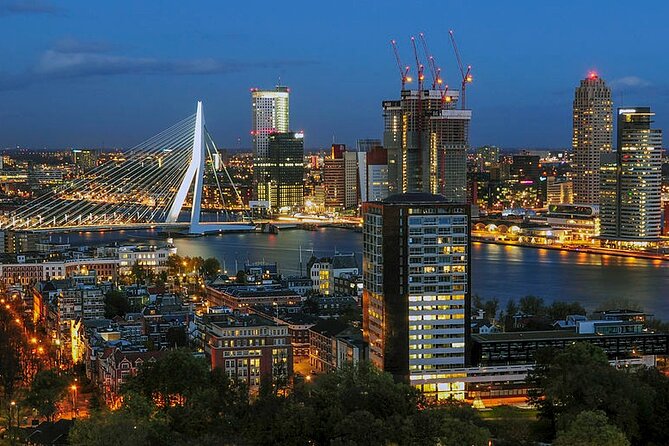
This is not a random sightseeing stroll. The focus is Rotterdam’s rebuild story—how a city that was heavily damaged after WWII turned that rupture into bold architecture, practical urban design, and new public spaces.
You’ll walk between major sights at a pace meant for first-time orientation. The payoff is that you come away with context: not just what buildings look like, but why Rotterdam looks the way it does.
And for a price like $29.41 per person for about 2 hours, it’s strong value because you’re paying mainly for a local guide and interpretation. The listed stops have free admission, and the tour includes a meeting plan that brings you back to the start.
You can also read our reviews of more tours and experiences in Rotterdam.


Meeting at Stationsplein 10 and getting your bearings
The tour begins at Stationsplein 10 (3013 AJ Rotterdam). If you’re arriving by train, you’ll appreciate that this whole area is built for movement—so you don’t waste your first minutes hunting for where to stand.
Right off the bat, you’ll spend time at Rotterdam Centraal Station, where the guide sets the stage. This early orientation matters because it’s hard to understand Rotterdam’s architecture if you only see it in fragments.
The group setup is also simple: you get a mobile ticket, meet your guide, and the walk ends back at the meeting point. That loop is especially helpful if you have limited time between transport connections.
Rotterdam Centraal Station: architecture as your compass
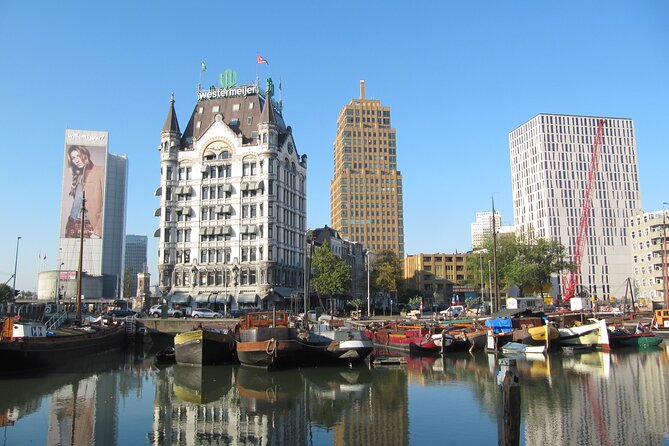
One of the smartest parts is the stop at Rotterdam Centraal Station. Here, your guide introduces the story of the city through its architecture, so you can start “reading” the skyline instead of just looking at it.
Even though this is only about 30 minutes, it functions like a map. After this, landmarks like the postwar buildings and redeveloped streets make more sense.
If you tend to lose track when you’re walking in a new city, this is the kind of start that helps. You learn what to notice as you move.
Postwar rebuilding in plain sight: Groot Handelsgebouw and beyond
A key stop is the Groot Handelsgebouw, completed in 1953. It’s one of the first major buildings constructed after the WWII bombing—so it acts like a timestamp you can see.
This is where Rotterdam’s story turns from tragedy into design choices. You’re not just hearing about history; you’re standing in a city block where rebuilding happened quickly and with ambition.
A short stop here (about 10 minutes) means you get the main idea, but not a long architectural debate. If that’s what you want, you can use your guide’s points as a checklist for a return visit later.
Shopping streets with WWII in their backstory: West-Kruiskade and Lijnbaan
Next up you’ll head through the center’s shopping streets, including West-Kruiskade and Lijnbaan. The tour frames these areas as more than retail corridors—Lijnbaan is described as opened in 1953 as a main pedestrian street in the new shopping district after the old one was destroyed by bombing.
That detail changes how you see what’s around you. Suddenly, the sidewalks feel intentional, not accidental. These are urban spaces built for everyday life—and rebuilt with the future in mind.
Because these segments are brief (each around 10 minutes), treat them as “context stops.” If you want to linger for shopping or photos, you’ll likely need extra time after the tour ends.



Luchtsingel: a wooden bridge that reconnects forgotten space
One stop that tends to click with people is Luchtsingel, a 390-meter wooden pedestrian bridge connecting Rotterdam North and Rotterdam Center. The tour explains it as a way to bring new life to an area that had been abandoned for years, marked by vacancy and neglect.
This is a great example of Rotterdam’s practical creativity. The bridge isn’t just a fun walk; it’s also an urban fix—relinking parts of the city and turning foot traffic into momentum.
It’s only about 10 minutes on the schedule, so you won’t have time to do a long stroll across. But you’ll get the main point fast: infrastructure can be a form of care.
Nieuwe Delftse Poort: a city gate rebuilt in steel
The tour also includes Nieuwe Delftse Poort (the Delft gate area). The historical note is specific: a city gate existed, the last built in 1764, and then a reconstruction in steel was erected on virtually the original site of the Delft gate on Pompenburg.
The designer detail you’re given—artist Cor Kraat—is exactly the kind of nugget that makes a short stop worthwhile. You get a sense of how Rotterdam handles memory: not by freezing the past, but by reinterpreting location and meaning.
As with other quick stops, the benefit is orientation and narrative. If you’re the type who loves repeating history with your own eyes, take note and return later for a slower read.
Sint-Laurenskerk: the medieval remnant you can actually step into
Another meaningful stop is Grote of Sint-Laurenskerk, described as a Protestant church and the only remnant of medieval Rotterdam. The good part: you can also go inside for free.
This is where the tour becomes more than architecture lecture. You see a physical survival from earlier Rotterdam while everything around it reflects the later rebuild era.
Time here is short (about 10 minutes), so my advice is to treat it like a quick reset. If you want more quiet time inside, plan to add that afterward on your own.
Markthal: modern form, large-scale food hall energy
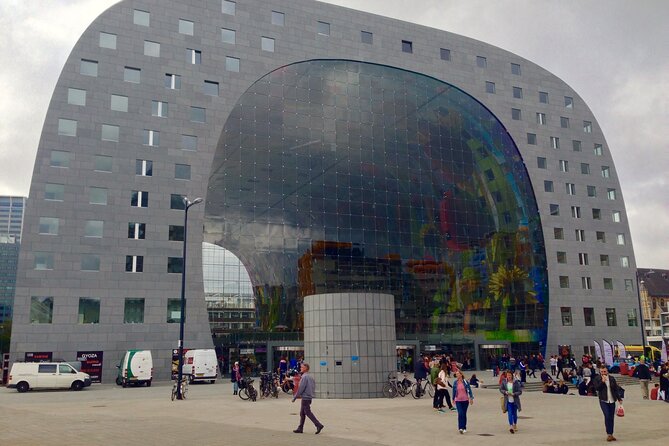
The centerpiece for many people is Markthal. The tour highlights its architecture by mentioning the firm MVRDV and a horseshoe-like archwise structure made of grey nature stone.
Then it goes deeper on what makes the building feel alive: inside you’ll find restaurants and an impressive artwork featuring enlarged fruits, vegetables, seeds, fish, flowers, and insects.
This is the kind of stop that pays off visually even if you only get part of it. Because it’s about 30 minutes, you can actually spend real time inside rather than just passing by.
Potential drawback: it’s popular by nature, so if you’re hoping for a calm, slow photo session, you may need to manage expectations. Use the guide’s route and then decide whether to come back after the tour.
Oude Haven and the Cube Houses: where Rotterdam looks most like itself
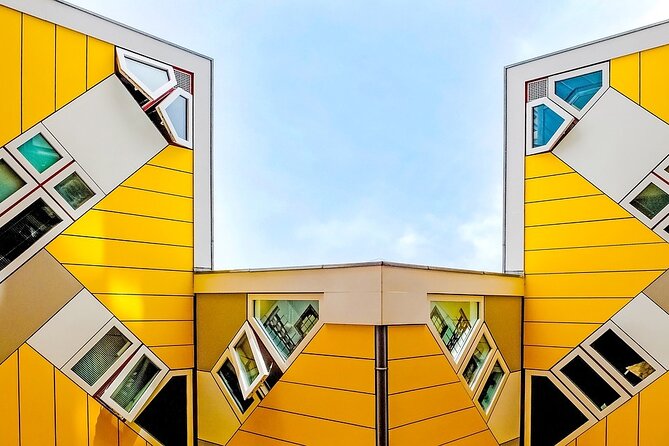
The last major area on the walk is Oude Haven (Old Harbour), described as a historical hotspot near the north of the Maas river. This area is where the tour connects “old harbor energy” with modern icon shots, including the Cube Houses.
The Cube Houses are the kind of Rotterdam landmark that helps you remember the whole city: the architecture is playful, but it’s also grounded in Rotterdam’s rebuild mindset—bold ideas turned into livable neighborhoods.
You’ll get about 20 minutes here, which is enough time to understand the setting and catch the classic views. After that, the tour ends back at the meeting point, so this is your best place to linger briefly if you want one more photo round.
Price and value: why this works at $29.41
At $29.41 per person, you’re not paying for museum tickets or big attraction fees—at least not for the listed stops, which are noted as free admission.
What you are paying for is the guide, plus the way the route is structured. A local guide can save you time by pointing out what to notice: WWII reconstruction cues, design reasoning, and the “why” behind the city’s layout.
Also, the tour includes group discounts and runs in English, with mobile tickets. Those details might sound small, but they reduce friction when you’re trying to plan a tight itinerary.
In short: if you want a guided framework for Rotterdam’s architecture and history without spending your day in ticket lines, this is priced like a practical choice.
Pace, comfort, and who this suits best
This is a walking tour with multiple stops, so you should expect an efficient route. The schedule includes short visits at several landmarks plus longer time at Markthal and the Oude Haven/Cube Houses area.
This is ideal if you:
- have limited time in Rotterdam and want a high-signal overview
- love architecture, city design, and how history shapes what you see
- prefer a small group instead of a crowded coach vibe
It’s less ideal if you want a slow, sit-down tour with deep time at each building. A couple of stops—like Sint-Laurenskerk or Markthal—could easily be expanded on in a longer format, but here they’re designed as highlights.
If your day includes other plans, this tour structure is helpful. It gives you a clear “base layer” so your remaining time in Rotterdam feels easier.
Notes from real-world guide quality (and why it matters)
The best part of a walking tour isn’t the map—it’s the guide’s angle. The tour’s guides are described as people who explain what you’re seeing in a way that feels personal to Rotterdam, with strong attention to WWII and architecture.
Names that come up include guides like Edwin, Michel, Susan, John, Ed, Stephan, and a local contact figure Tony. The common thread: they focus on connections—how rebuilding changed the city and how design choices show up in daily life.
That flexibility also matters. One account describes a tight timing problem where Tony helped solve the meeting issue by arranging a car pickup when a ride option would have taken too long. I like knowing there’s a human element in the operation, not just a rigid meet-and-go script.
Should you book this Rotterdam Must Do Tour?
Book it if you want a quick, guided orientation to Rotterdam’s architecture with a clear WWII thread. For the money, the value is in the interpretation plus the fact that many of the stops have free admission, letting you focus on the walk and the story instead of add-on costs.
Skip it (or pair it with a longer follow-up) if you hate fast transitions between sights. Because it’s a highlight-focused route, you’ll likely want extra time after the tour at Markthal, Oude Haven/Cube Houses, or inside Sint-Laurenskerk.
If you’re visiting Rotterdam for the first time and you want your day to feel organized but not stiff, this tour is a strong fit.
FAQ
How long is the Rotterdam Must Do Tour?
The tour lasts about 2 hours.
Where do I meet the guide?
You meet at Stationsplein 10, 3013 AJ Rotterdam, Netherlands.
What is the price per person?
The price is $29.41 per person.
Is the tour offered in English?
Yes, it is offered in English.
What’s included in the price?
The local guide is included. Admission tickets at the listed stops are noted as free.
Are food and drinks included?
No. Food and drinks are not included.
How big is the group?
The tour has a maximum of 15 travelers.
Is the tour mostly walking?
Yes. It’s a walking tour with multiple stops around the city center.
Are service animals allowed?
Yes, service animals are allowed.
Can I get a full refund if I cancel?
Yes, you can cancel for a full refund if you cancel at least 24 hours before the experience start time.