REVIEW · ROTTERDAM
Private Pedicab/Rickshaw Tour of Rotterdam With a Local Guide
Book on Viator →Operated by TourGuys · Bookable on Viator
Rotterdam rolls by faster than you expect. This private pedicab/rickshaw tour lets you skim the highlights your way while your guide explains the city’s rebuild story. I especially like the customizable pace and the way the ride keeps you moving on bike-friendly streets without getting lost. I also love the door-to-door hotel or cruise pickup, which makes this easy even if you only have a short visit.
The only real catch is time: it’s designed for about 1 to 1.5 hours, so you’ll see a tight set of stops (great for orientation, less ideal if you want to linger everywhere). If your cruise arrival is late or your schedule is tight, build in buffer and communicate early so you don’t miss the start window.
In This Review
- Key things to know before you go
- Why a private pedicab/rickshaw works so well in Rotterdam
- Price and what you’re really paying for (up to 2 people)
- Pickup and timing: how to make the start painless
- Stop-by-stop: Rotterdam Centraal and the city’s station reset
- A pause for citizen energy: Rotterdam’s city initiative idea
- Nieuwe Delftse Poort: a gate moved, then ruined, then saved in pieces
- Rotterdam City Hall and the wartime survivor story
- The Meent: cafes, shops, and Mr. Meent Robin von Weiler
- Grote of Sint-Laurenskerk: the medieval center still holding strong
- Markthal under its arch: the food market stop you’ll actually use
- Kijk-Kubus Museum-house: cube houses and the ideas behind them
- The guide makes the whole thing: Izzy, Ali, Mo, Boy, and more
- What to bring (and how to get more than you paid for)
- Who should book this Rotterdam pedicab tour?
- Should you book this Rotterdam private pedicab/rickshaw tour?
- FAQ
- How long is the private pedicab/rickshaw tour in Rotterdam?
- What is the group size for this private tour?
- Is hotel pickup or cruise port pickup included?
- What language is the tour offered in?
- Are there any included admissions during the tour?
- Does the tour include snacks and water?
- Are service animals allowed?
- Is there a weight limit for the combined passengers?
- Is free cancellation available?
Key things to know before you go
- Private ride for up to 2 people: you get a focused route instead of weaving through groups
- Hotel or cruise pickup included: easy start, low-stress logistics
- Stops with clear payoffs: Rotterdam Centraal, Sint-Laurenskerk, Markthal, and the Cube Houses area
- Tickets included for 2 big sights: Grote of Sint-Laurenskerk and Kijk-Kubus Museum-house
- Snacks and bottled water included: small comfort, big help on a short day
- Service animals allowed: for many visitors, that matters as much as the itinerary
Why a private pedicab/rickshaw works so well in Rotterdam
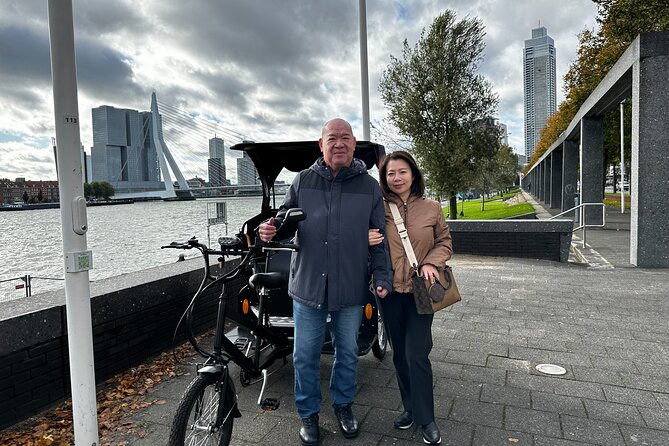
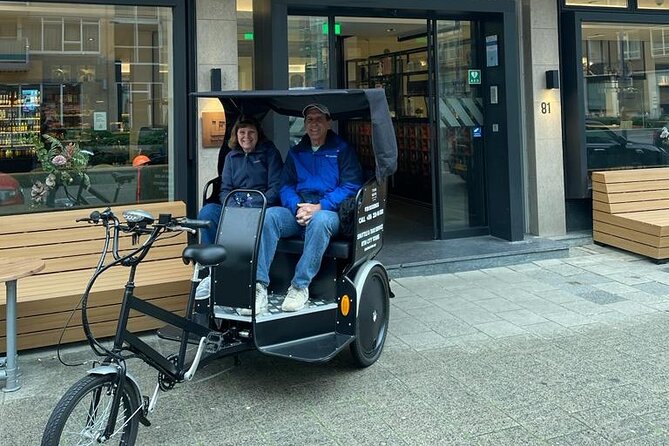
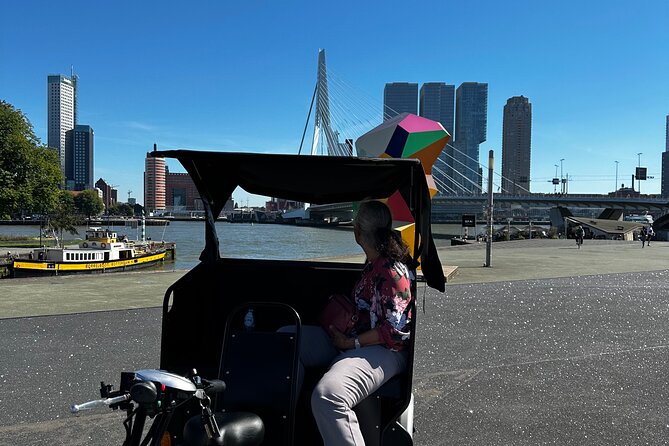
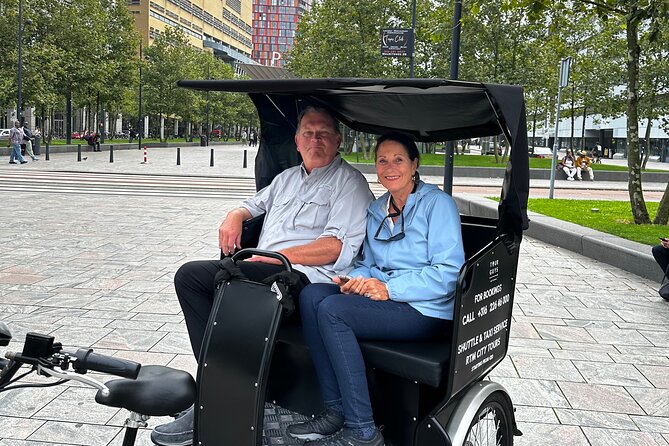
Rotterdam is built for motion. The city is full of bike paths and street layouts that feel made for rolling around. A pedicab or rickshaw tour fits perfectly because you get to move like a local without tiring yourself out.
What you’ll enjoy most is the feel of the trip. You’re not just checking boxes from a bus window. Instead, you pause at the places that actually make the city click—stations, churches, markets, and postwar landmarks—while your guide adds context as you go. Many guests also mention the guides were energetic and good at pointing out details you’d miss on your own.
It’s also private, so you can ask for small adjustments. Want more time outside a building? Want an extra photo stop? In this setup, you’re not asking permission from 20 people ahead of you.
You can also read our reviews of more tours and experiences in Rotterdam.

Price and what you’re really paying for (up to 2 people)
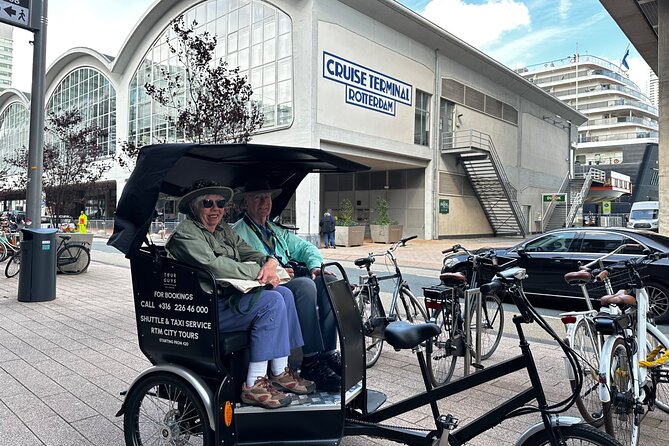
It costs $150.18 per group for up to two people, for about 1 to 1.5 hours. That price can sound steep if you’re thinking like a ticket buyer. But think like a short-trip strategist.
Here’s what you’re buying with your money:
- Private transportation (not shared)
- Hotel pickup (and cruise terminal pickup at common docks)
- Bottled water and snacks
- A local guide who steers your route and explains what you’re seeing
- Some included admissions (important: at least two of the stops have tickets included)
For couples, a small family, or anyone with limited time, the math usually works. If you’re paying per person for a group tour, you quickly lose the “can go anywhere at the moment” advantage. This one keeps your time tight and your decisions simple.
Pickup and timing: how to make the start painless
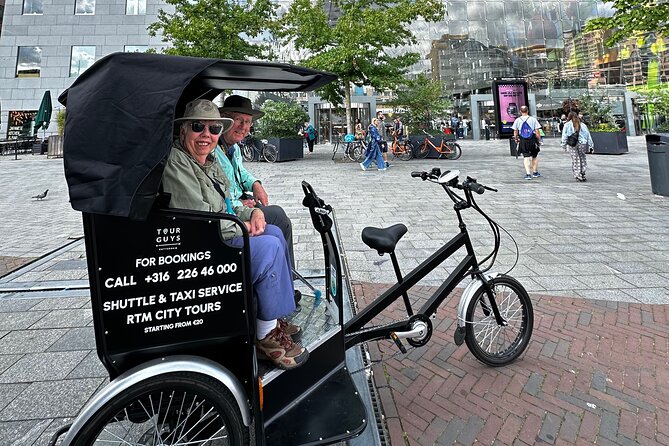
Pickup is part of the deal, and that’s the smartest reason to book this rather than trying to stitch together taxis and buses.
When you book, you’re asked to tell them your hotel if possible. They pick up from hotels in and around central Rotterdam, and they also offer pickup at most common cruise docking locations. In practice, that means:
- Sea cruises often dock at the Rotterdam Cruise Terminal
- Many river cruises use Boompjeskade
If you’re staying outside central Rotterdam, they’ll suggest meeting points. The key practical tip is simple: confirm where you’ll be standing. With rickshaw/pedicab tours, a few minutes of confusion can snowball.
Also, Rotterdam days can be schedule-sensitive for cruise passengers. One thing to keep in mind: if your ship arrives late and you miss the planned start, you may not be able to squeeze it in later the same day. That’s not unique to this tour—private guided capacity is real. So give yourself buffer.
Stop-by-stop: Rotterdam Centraal and the city’s station reset
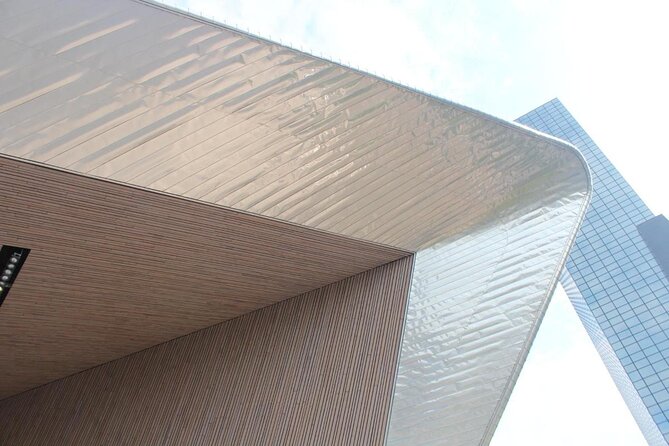
Your first major stop is Rotterdam Centraal Station. Even if you just want a good orientation point, this stop pays off because it tells a story about the city’s growth.
Rotterdam didn’t always have the current central station. Before World War II, there were four stations around the center. In 1957, the central station opened at its present location. Later, a big renovation cycle started in 2004, and the final result was delivered in 2014. The point is not just dates. It explains why Rotterdam kept changing its infrastructure as passenger demand surged.
What I like about starting here: it anchors everything else. Once you’ve seen the station area and heard the context, other parts of the city feel less random.
Time at the stop is about 10 minutes, and that’s enough for photos and a quick reset before you move on.
A pause for citizen energy: Rotterdam’s city initiative idea
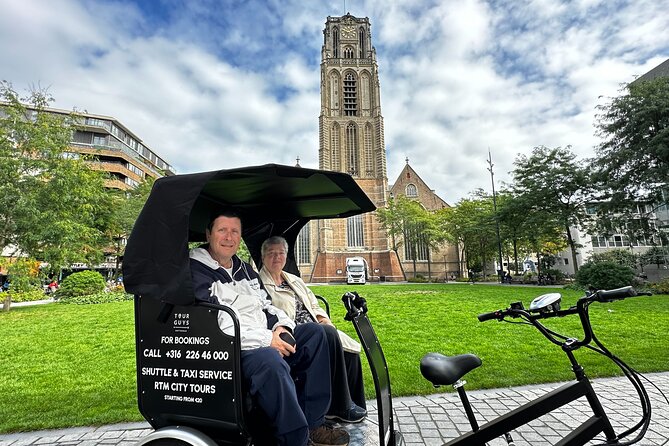
Between the big landmarks, there’s time for a story about how Rotterdam gets people involved. In 2011, the municipality launched a city initiative—an administrative tool designed to spark innovation and encourage citizen participation. The city set aside 4 million for projects submitted by residents.
This is the kind of stop that seems small on paper, but it’s useful on the ground. Rotterdam often gets summarized as postwar concrete and modern design. Hearing how residents helped shape initiatives adds a more human layer: the city isn’t only rebuilding buildings. It’s also rebuilding decision-making.
If you like understanding how a place thinks, this segment is worth it. If you want only photo heavy stops, you can still listen and look at the surrounding city planning shapes the guide points out.


Nieuwe Delftse Poort: a gate moved, then ruined, then saved in pieces
Next comes Nieuwe Delftse Poort, a former city gate with a history tied to traffic and war damage. In the Middle Ages, Rotterdam had 10 city gates, and this one mattered.
In the 1930s, Rotterdam grew quickly and the gate was in the way of a smoother flow for increasing traffic. The decision was made to move it about 100 meters. That sounds straightforward until you remember: demolishing major structures often triggers resistance. In this case, the demolition faced pushback.
Then World War II hit. During the bombardment, the gate was severely damaged. A year later, it was demolished because it couldn’t be finished to a usable end. The good news: some of the ornamental pieces survived and were incorporated into the walls at buildings around town hall square.
This stop gives you a rare thing: a sense of continuity. Rotterdam didn’t just erase history. It salvaged fragments and reused them. That’s a pattern you’ll keep noticing as you ride.
Time here is about 10 minutes, so expect a focused storytelling stop rather than a long museum-style visit.
Rotterdam City Hall and the wartime survivor story
Your next landmark is Rotterdam City Hall. Built between 1914 and 1920 by Henri Evers, it’s also one of the few central buildings that survived the May 14, 1940 bombardment.
This is where the tour’s tone becomes clear. Rotterdam isn’t presented as a single aesthetic. It’s presented as change under pressure—what survived, what got rebuilt, and how design choices came from necessity.
If you’re a detail person, this stop is a win because your guide can point out what to notice on the facade and why survival mattered. If you’re not, you’ll still leave with an easier mental map of what parts of the city represent prewar continuity versus postwar reinvention.
You’ll spend about 10 minutes here.
The Meent: cafes, shops, and Mr. Meent Robin von Weiler
After City Hall, you’ll hit the Meent, one of those streets where the vibe feels very Rotterdam: practical, local, and social.
The story here isn’t just about shops. The Meent has moved through phases. In the 1990s it was described as a street with mainly temporary employment and travel agencies. Over time, that kind of street activity faded and it became less lively, with vacancies.
Then there’s Robin von Weiler—often referred to as Mr. Meent—whose nickname comes from what he’s done for the street and why he’s still connected to it today.
This part matters because it shows the difference between a city with famous sights and a city that keeps functioning for everyday people. Markthal is great for food. The Meent is great for atmosphere in between.
In the time window of the tour, you won’t wander for hours. But you’ll get a useful sense of where you’d want to return later on your own.
Grote of Sint-Laurenskerk: the medieval center still holding strong
The tour includes Grote of Sint-Laurenskerk, Rotterdam’s key medieval survivor. It’s described as the only remnant of the medieval center of Rotterdam.
Architecturally, it’s interesting because it’s a hybrid: part hall church (where the building spaces share similar heights) and part cruciform basilica (with a cross-shaped plan). The guide can help you see that the side towers are lower than the main tower. Construction dates are 1449 to 1525.
This is also one of the stops with admission included, so you’re not just standing outside. Inside, you can usually take a breath and reset your sense of time in a city that often feels future-forward.
Time on this stop is about 10 minutes, which is short but manageable if your guide keeps things focused.
Markthal under its arch: the food market stop you’ll actually use
Then you reach Markthal, Rotterdam’s covered market complex with restaurants inside and under an arch of apartments above. You’ll spend about 30 minutes here, and that extra time is a big deal.
A market stop is where a short tour can pay off beyond sightseeing. You’ll see where you want to eat next, what’s worth trying, and what kinds of stalls you might hunt down later. Even if you don’t buy anything, you’ll walk away with practical info about local food culture.
Because it’s covered, Markthal is also often a good hedge if the weather is changeable. Just remember you’ll have limited time—so if there’s a dish or snack that catches your eye, decide quickly.
This stop’s listed admission is free, so you’re not paying extra once you’re there.
Kijk-Kubus Museum-house: cube houses and the ideas behind them
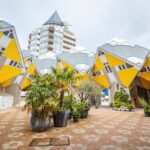
One of the most visual stops is the Kijk-Kubus Museum-house, the famous cube houses area. You’ll have about 15 minutes here, and admission is included.
In the 1970s, architects wanted residential areas that felt more hospitable and designed with participation from residents and other users. Piet Blom is central to this story. His approach used the idea that large buildings should relate to the human scale, using small-scale recognizable elements.
The structure is also key: the concept of the cube houses is tied to being built on columns, so that space under the buildings can remain public. That public-underneath idea is said to be inspired by Le Corbusier.
Here’s what I think makes this stop worth it: it turns architecture from something you see into something you understand. Even with 15 minutes, you’ll get the core idea and be able to explain it later, at least to yourself.
If you love design, it’s the stop you’ll remember most clearly when you walk away.
The guide makes the whole thing: Izzy, Ali, Mo, Boy, and more
This tour’s biggest strength, consistently, is the human piece. Multiple guides are mentioned by name in different trips, including Izzy, Ali, Mo, and Boy (and also Said on at least one tour). The pattern across these guides is energy plus context.
What you should look for when you meet your guide:
- Whether they point out small details as you roll along (street-level clues)
- Whether they tailor the timing to your interests, especially if you’re trying to fit key places in a short window
- Whether they build in time for photos rather than rushing past the good angles
From the way guests describe their experiences, the ride feels comfortable and it often turns into a storytelling walk that just happens while you’re pedaling past Rotterdam’s mix of old and new.
If you’re the type who likes questions—why is this here, what changed, what survived—you’ll likely enjoy the back-and-forth.
What to bring (and how to get more than you paid for)
Because this is a pedicab/rickshaw ride, your best strategy is to travel light and be ready to stop quickly.
Bring:
- A camera or phone with enough storage for photos
- A light layer. Even with good weather, you’ll often feel airflow while moving
- Comfortable shoes for a bit of walking at each stop
Do this once you’re seated:
- Tell your guide what you care about most: war history, architecture, food, or simply the best photo spots
- Ask for a couple of adjustments if one stop is a must-see for you
Also, service animals are allowed, and that’s a practical inclusion if you need it.
Who should book this Rotterdam pedicab tour?
This tour is a strong fit if:
- You have limited time and want a guided orientation
- You’re traveling as a couple or small group (it’s up to 2)
- You want pickup so you don’t waste your day figuring out transport
- You like your city history told in plain language, not in a lecture hall
You might want to choose something else if you’re the type who needs hours at a time in a single place. This is about selection and rhythm. You’ll see key hits, not every street worth street-level exploring.
Should you book this Rotterdam private pedicab/rickshaw tour?
I’d book it if you want a fast, high-value introduction to Rotterdam that feels personal. The combination of private transportation, hotel/cruise pickup, snacks and water, and included entry at Sint-Laurenskerk and the Cube Houses makes it easier than cobbling together your own day.
One smart caution: if you’re on a cruise, pay attention to arrival timing. Your tour only works well if you start when planned.
If you’re flexible, curious, and want the city’s story explained as you ride, this tour is one of the cleaner ways to use a short Rotterdam stop.
FAQ
How long is the private pedicab/rickshaw tour in Rotterdam?
The tour lasts about 1 hour to 1 hour 30 minutes.
What is the group size for this private tour?
It’s a private tour/activity, and the group size is up to 2 people per booking.
Is hotel pickup or cruise port pickup included?
Yes. Traveler pickup and drop-off are offered, including hotel pickup in and around central Rotterdam and pickup at common cruise docking locations.
What language is the tour offered in?
The tour is offered in English.
Are there any included admissions during the tour?
Yes. Admission tickets are included for Grote of Sint-Laurenskerk and Kijk-Kubus Museum-house. Other listed stops are free.
Does the tour include snacks and water?
Yes. Bottled water and snacks are included.
Are service animals allowed?
Yes, service animals are allowed.
Is there a weight limit for the combined passengers?
Yes. For safety reasons, the combined passenger weight must not exceed 200 kg / 440 lbs.
Is free cancellation available?
Free cancellation is available up to 24 hours in advance for a full refund. If you cancel less than 24 hours before the experience start time, the amount paid is not refunded. The tour may also be canceled due to poor weather, with an offer of a different date or a full refund.