REVIEW · ROTTERDAM
Rotterdam & Delft Private Offshore Daily Walking Tour
Book on Viator →Bookable on Viator
Two cities in one careful walking loop.
This private day links Rotterdam’s modern punch with Delft’s calm old-town details, and you get a plan that moves at human speed. I especially like the small group limit (up to 4) and the way the guide can adjust the pacing when someone needs it, with examples including Alex being praised for exactly that kind of flexibility. A second big plus for me is that you’re not just looking at buildings from the curb; you get meaningful stops at places tied to water management, shipping, and major Delft figures like Erasmus and William of Orange. One thing to watch: several of the most famous Delft interiors cost extra, so your final spend depends on what you choose to enter.
You’ll start in the middle of Rotterdam’s action, then work your way through markets, bridges, ship history, and back into Delft’s church towers and ceramic workshops. This is the kind of tour where the details matter: the Cube Houses ticket is included, and the day is built to give you multiple photo-and-story moments without turning it into a sprint. The main drawback is simple math: the base price is for the whole group, and paid entrances plus local transit can add up if you decide to go inside many sites.
In This Review
- Key highlights worth your attention
- Why Rotterdam and Delft work so well together in one day
- Price and what you’re really paying for (up to 4 people)
- Getting started: pickup in Rotterdam or Delft and how the day flows
- Rotterdam Centraal and the city’s architecture mood
- Erasmus, markets, and Cube Houses: the Rotterdam stops that feel most human
- The ports and bridges section: where Rotterdam shows its muscles
- Crossing into Delft: the calm city that remembers
- Prinsenhof, Beguines, and the paid-entry choices that shape your day
- Market square anchors: Stadhuis and the New Church experience
- Catholic stop and the Delft-blue payoff at Royal Delft
- Included breaks and a smart way to handle optional interiors
- Guide quality that can actually change your day
- Should you book this Rotterdam and Delft private walking tour?
- FAQ
- What is the duration of the Rotterdam & Delft private walking tour?
- How many people are in the group?
- Where do we meet, and do you offer pickup?
- What attractions have entrance fees, and which ones are included?
- Is public transportation included in the price?
- What are the cancellation terms?
Key highlights worth your attention

- Private max of 4 people for a less rushed, more tailored walk.
- Alex-style problem solving shows up in feedback, including real help when life goes sideways.
- Cube Houses entry included, so you get one of the day’s most interactive sights without extra payment.
- Rotterdam’s engineering landmarks (De Hef, Erasmus Bridge, Leuvehaven) blend city views with working-machine stories.
- Delft’s famous figures on the route, from Erasmus-linked places to William of Orange sites and Vermeer context.
Why Rotterdam and Delft work so well together in one day
Rotterdam and Delft are close enough to connect easily, but they feel like different planets. Rotterdam hits you with modern scale: big stations, big bridges, and water-and-industry architecture. Delft, a short move away, trades that for tighter streets, church towers, and the kind of historical storytelling where a single building can explain a whole era.
This tour is designed for that contrast. Instead of only doing the obvious postcard spots, it threads in theme anchors: water management buildings in Rotterdam, shipping and memorials along the New Meuse, then Delft’s civic and religious landmarks around the market and old courtyards. If you like your cities with context, you’ll get it here.
I also like how the route stays readable. You’re not hopping across town randomly. You’re walking through meaningful clusters, which means you can slow down at the spots that catch your eye and keep moving without constantly checking where you are.
You can also read our reviews of more tours and experiences in Rotterdam.


Price and what you’re really paying for (up to 4 people)
The listed price is $5,683.71 per group, for up to 4 travelers, for about 7 hours 30 minutes including travel time. That’s not a budget-friendly tour if you’re traveling solo or as a couple. But the value story changes fast when you split it:
- 4 people share it: about $1,420 per person
- 2 people share it: about $2,842 per person
So who is it good for? Families, small groups of friends, or anyone who wants control over pace. This is the kind of day where being private matters, because you can spend more time outside when the weather is good and adjust quickly if legs get tired.
Also note what’s actually included versus not. You get coffee and/or tea around the walk, and entry to the Cube Houses. Most other stops are free from the outside, but several Delft interiors have set entrance fees. If you want multiple paid entries, budget ahead so there are no surprises at checkout.
Getting started: pickup in Rotterdam or Delft and how the day flows
The tour meets at the Port of Rotterdam, Wilhelminakade 909, 3072 AP Rotterdam. Pickup is available from any hotel in Rotterdam or Delft, which is a big deal if you’re arriving by cruise, train, or don’t want to wrestle with local transit right at the start.
The day runs in the provider’s operating window of 9:00 AM to 6:00 PM (Monday through Sunday). Given the total time of roughly 7.5 hours, you’ll want to plan your arrival and departure timings so you’re not rushing into or out of it. The tour also offers a custom option where Amsterdam could be a departure point by agreement, but in the standard format you’ll be based in Rotterdam and Delft.
Practical tip: wear shoes you’re comfortable walking in for a long stretch. Even when many stops are short photo pauses, you’re still moving through two compact city centers and along waterfront areas.
Rotterdam Centraal and the city’s architecture mood
You’ll begin at Rotterdam Centraal Station, the city’s main railway hub with heavy daily passenger flow. The focus here isn’t just transit—it’s how modern Rotterdam signals itself with architecture. It’s worth a few minutes because the station gives you a quick sense of Rotterdam’s scale and design confidence before you start walking into quieter corners.
Right after, the route turns toward water governance with Hoogheemraadschap Schieland and Krimpenerwaard, a 17th-century building tied to managing water policy in the South Holland region. This is one of those stops that changes how you see Rotterdam. Instead of thinking of the city as simply built on the ground, you start thinking of it as built in response to water. The building is also historically linked as a temporary location connected to Napoleon Bonaparte, which adds a surprising layer.
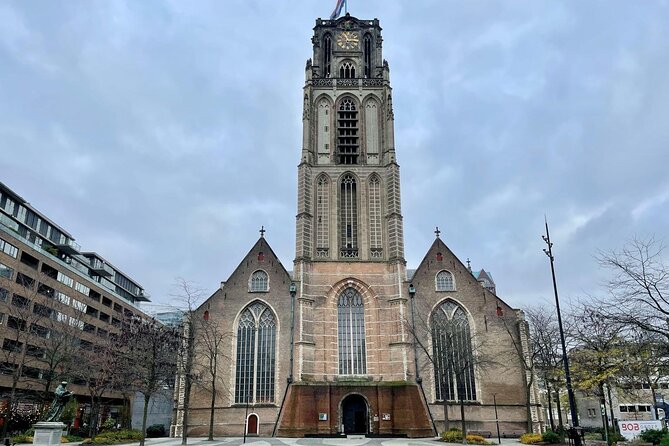
Then you hit one of the city’s oldest survivals: Grote of Sint-Laurenskerk. This late Gothic church dates to the 1500s and is noted as the oldest building in Rotterdam. It’s also remembered for surviving Nazi bombing on May 15, 1940. If you care about how cities rebuild and what remains, this is a stop where the exterior matters, and the meaning sits in the brickwork and survival story.
Erasmus, markets, and Cube Houses: the Rotterdam stops that feel most human
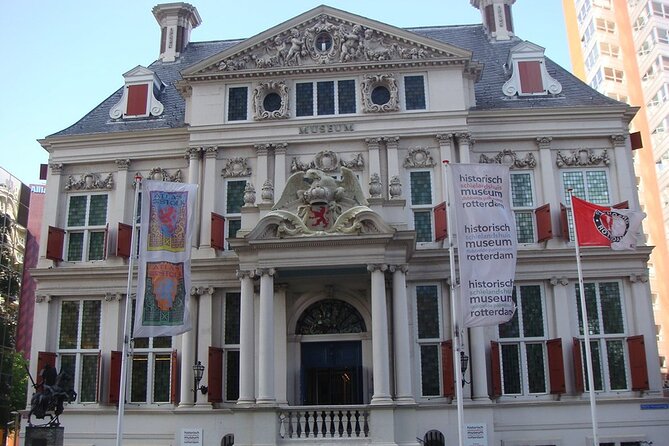
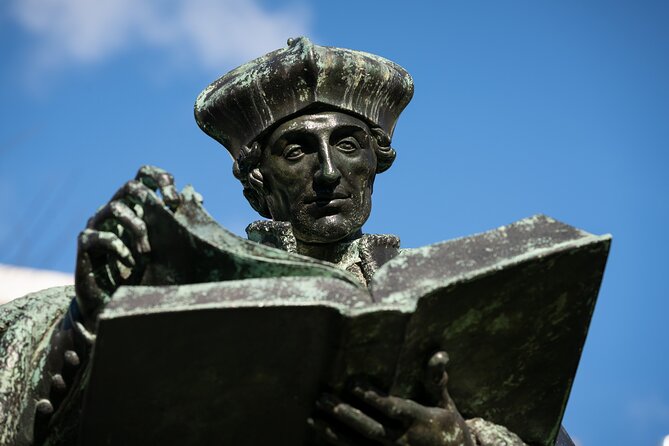
Erasmus Monument brings the philosopher Desiderius Erasmus of Rotterdam into the conversation. The route uses him as a thread: you’ll see public institutions and buildings named after Erasmus, which makes the city’s identity feel more personal than industrial.
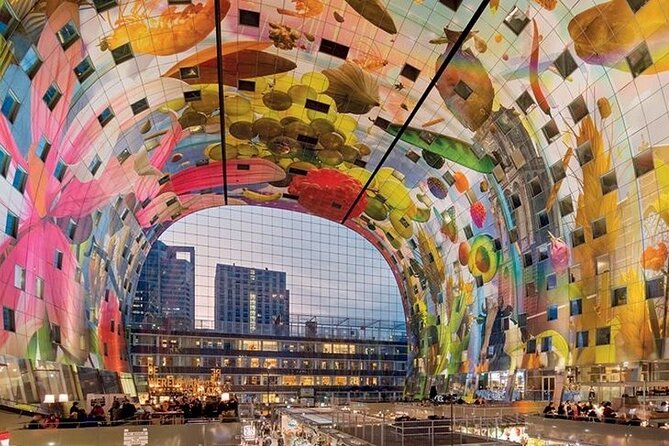
Then comes Markthal, the horse-shoe shaped market hall that combines shopping with living space. It’s nicknamed the Sistine Chapel of Rotterdam, and even if you don’t treat it like art-on-purpose, the point is clear: Rotterdam can make daily life feel like a designed experience.
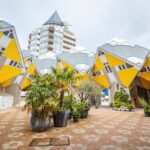
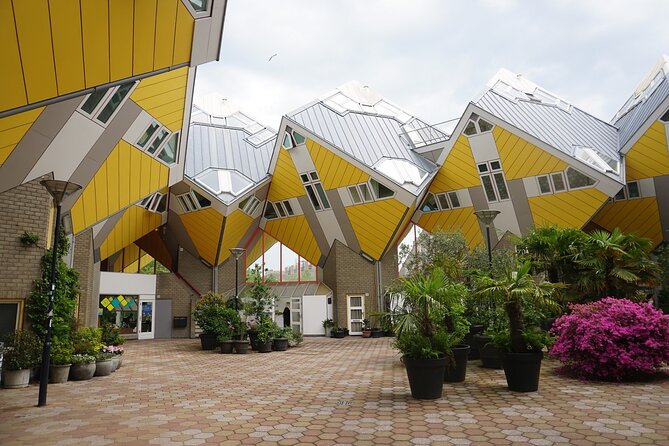
Next is the highlight with an included ticket: Kijk-Kubus (Cube Houses). The key practical detail is how the space works. Because the apartments sit in cube form on supporting columns, only part of the interior is usable as a standard living layout. That “why” makes the building much more interesting than a quick photo. You’re paying for the entry value here without needing to decide on a separate fee.
If you’re traveling with anyone who likes design experiments—this stop is for you. Just don’t expect a big museum visit; think of it as architecture you can understand.



The ports and bridges section: where Rotterdam shows its muscles
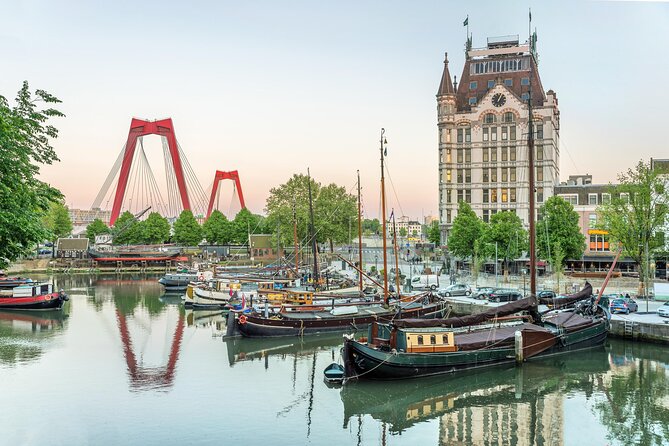
As the route moves along the water, you’ll get Oude Haven, one of Rotterdam’s oldest ports (not the very oldest) and a former river mouth connection from the Rotte to the New Meuse. Today it’s a social zone with coffee bars, restaurants, taverns, and nightlife. This stop is useful because it adds a modern Rotterdam vibe: yes, it’s historic, but people are actively using the space.
Then you’ll see Witte Huis, once the highest European skyscraper and another notable structure that survived the May 14, 1940 bombing. It’s one of those skyline anchors that helps you picture Rotterdam’s pre-war ambitions.
After that, the walk targets bridges and engineering identity:
- Willemsbrug (Red Bridge): a major connector between central/northern and southern districts.
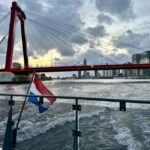
- De Hef (The Lift): a huge steel structure once used as a train lift bridge over the New Meuse, working before the rail tunnel existed.
- De Boeg: a war memorial on the river embankment for 3,500 Dutch merchant sailors lost in World War II.
- Leuvehaven: an open-air maritime museum with steamships, cargo equipment, ship engines, and related artifacts from the mid-1800s through the 1970s.
This cluster is where the tour earns its name as more than just sightseeing. You’re learning what keeps a port city alive: transport, shipping tech, and the human stories tied to it.
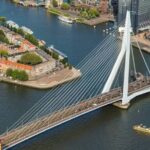
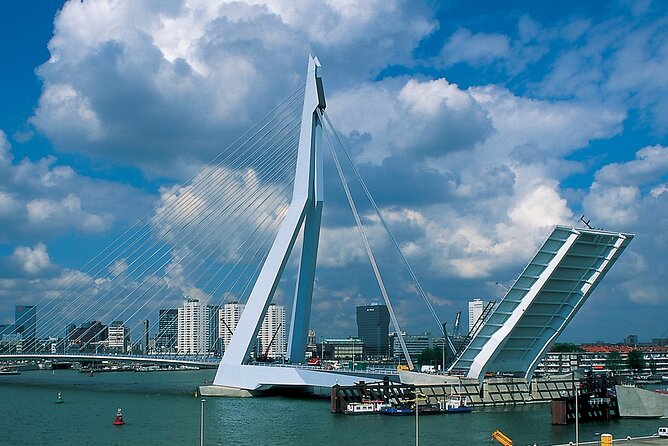
The last Rotterdam image maker is Erasmus Bridge, often photographed as a swan or harp. It’s a major symbol crossing the New Meuse, and the route emphasizes its dramatic scale and iconic shape. Even if you only have a brief pause, the bridge is one of those moments where you immediately understand why Rotterdam uses it as its calling card.
Crossing into Delft: the calm city that remembers
Delft begins with the modern approach: Station Delft, an underground station integrated with the city’s hall above. It also incorporates Delftware ceramic artwork and history themes. This is a good transition because it tells you Delft isn’t stuck in the past; it folds heritage into newer infrastructure.
From there the route moves through smaller, story-rich stops:
- Sociëteit het Meisjeshuis: a girls’ orphanage dating to 1578, operating until the 1950s.
- The Netherlands Cancer Institute (NKI): a monument tied to a Delft citizen connected to microscope foundations and scientific legacy (the tour also frames it alongside painter Johannes Vermeer as a key Delft figure).
- Gemeenlandshuis van Delfland: a 16th-century building used as a headquarters for water management in Delftland since 1645.
- Stadsarchief Delft: formerly a Latin school and military barracks, now the city archive.
Notice what’s happening: you keep circling back to institutions. That gives the day coherence. Delft isn’t just churches and canals; it’s where civic learning and water management meet.
Prinsenhof, Beguines, and the paid-entry choices that shape your day
One of the Delft stops is Museum Prinsenhof Delft. You’re told it’s tied to Geertruyie van Oosten, a 14th-century beguine figure, and also associated with the residence and place of death of Willem the Orange. The admission fee is listed as €14 per person, so you’ll likely decide on the spot whether to go inside based on your interests and energy level.
Near it, you’ll reach Bagijnhofpoort, the port-and-memorial area dedicated to beguines—semi-closed sister communities similar to nuns. This is the kind of place where the exterior can be quietly powerful, even if you choose not to add paid museum time.
Then comes a classic Delft tower moment: the Old Church. The route highlights its leaning tower, likened to Dutch Pisa, and notes it as the oldest church in Delft from 1246 with a 75 m tower leaning about two meters from vertical. Admission is listed as €8 per person. If you like unusual physics in old masonry, this is one to consider entering; if you’re simply chasing the best views with less cost, you can still enjoy it from outside.
Market square anchors: Stadhuis and the New Church experience
You’ll pass Stadhuis Delft (City Hall), a former city hall from 1620 and one of two main buildings on the Delft market. The emphasis here is on how the city’s civic life was organized around the square.
Next, Vermeer Centrum Delft is a dedicated information point about Johannes Vermeer—his style, painting meaning, and personal life context. It has an admission fee of €12 per person. If you want your Vermeer understanding to go beyond recognizing his name, this can be worth it, especially on a day that already includes multiple historical threads.
Then you’ll see Hugo de Groot Monument, dedicated to jurist and humanist Hugo Grotius, described as a founder of international law. It’s a short stop but meaningful if you like intellectual history.
The grand church moment is the New Church, described as the second-highest sacral building in the Netherlands at 108 m. It’s the funeral place of Willem The Orange and members of the Dutch royal family. Admission is listed as €15 per person. This is the kind of paid entry that often justifies itself if you want the interiors and the royal funerary story explained in place. If you’re trying to keep costs down, you can still appreciate the exterior and move on.
Catholic stop and the Delft-blue payoff at Royal Delft
Maria van Jessekerk is a 19th-century Catholic church stop, with no entrance fee listed for that stop. This works well as a reset after the big Protestant-era names.
Finally, the tour reaches the shopping and craft powerhouse: Royal Delft – Koninklijke Porceleyne Fles. This is framed as the worldwide famous majolica pottery workshop, known for thousands shades of blue color art, with history, workshop, exhibition, and selling. The stop indicates admission is not included, so you’d be looking at the cost on arrival (the tour details don’t list a specific price for this one). If you’re the type who wants a real ceramic connection, this is where your day clicks. If you’re not into buying or watching ceramics made, you might use this time for photos and decide how much time to spend inside.
Included breaks and a smart way to handle optional interiors
You get coffee and/or tea included, served within or after the tour. In practice, this is your built-in chance to refuel without searching for a café at the exact moment you’re hungry. Use that pause strategically: if you plan to enter the New Church (€15), Old Church (€8), Vermeer Centrum (€12), or Museum Prinsenhof (€14), decide how many interiors you can handle before the paid time adds up.
Remember: these paid entrances are per person. If you’re with others, a quick group decision helps a lot.
Guide quality that can actually change your day
This is one of the most praised parts of the experience. Alex is singled out for being friendly and very knowledgeable about both Rotterdam and Delft, and for adjusting the tour based on the interests and mobility limitations of a party member. That kind of flexibility matters in a long day with many stops that are mostly short external views.
The other reason the guide matters is problem solving. There’s an example where a lost suitcase issue turned into on-the-spot help: Alex reportedly escorted a guest personally by train to the airport to retrieve luggage, then continued the tour plan and even handled picking up family members on the way back to the cruise ship. Even if you don’t expect disruptions, this tells you the guide takes responsibility seriously, not just sightseeing time.
Should you book this Rotterdam and Delft private walking tour?
If you want a private day that mixes Rotterdam’s engineering identity with Delft’s church-tower storytelling, this tour fits. I’d book it if:
- you’re traveling with up to 4 people and want one guide to manage the flow
- you care about meaning behind landmarks (water management, ports, civic buildings)
- you’re comfortable paying extra for a few Delft interiors you truly want to see
I might skip it if:
- you’re traveling solo or as a couple and the group price doesn’t fit your budget
- you’re determined to see every paid site inside Delft, because the add-ons can stack quickly
FAQ
What is the duration of the Rotterdam & Delft private walking tour?
It runs for about 7 hours 30 minutes, and travel time is included in the total duration.
How many people are in the group?
The tour has a maximum of 4 travelers.
Where do we meet, and do you offer pickup?
You meet at Port of Rotterdam, Wilhelminakade 909, 3072 AP Rotterdam. Pickup is offered from any hotel in Rotterdam or Delft.
What attractions have entrance fees, and which ones are included?
Included: Cube Houses entry (plus coffee and/or tea).
Not included: Nieuwe Kerk (€15), Museum Prinsenhof Delft (€14), Old Church (€8), Vermeer Centrum Delft (€12).
Is public transportation included in the price?
No. Public transportation is listed as €10.00 per person (not included).
What are the cancellation terms?
You can cancel for a full refund up to 24 hours in advance. If you cancel less than 24 hours before the experience starts, the amount paid is not refunded.