A port city by day, a cheese town by afternoon. This private Rotterdam and Gouda walking tour strings together famous landmarks and lesser-visited corners, with just enough paid access to make it feel like a real day out instead of a slideshow. Two things I especially like: the guide-style storytelling (lots of names, dates, and why places matter) and the smart mix of modern design and older survival—Rotterdam’s got scars, and you see them.
You also get built-in value because the tour includes coffee or tea plus an entrance ticket to the Red Lion windmill, which is a rare “actually go inside” moment. The main drawback to keep in mind: several highlights are not included (notably the Gouda Cheese Experience and Saint-John Church), so your total day budget can rise fast if you add everything.
In This Review
- Key Highlights You’ll Notice Fast
- What You’re Really Buying: A Private 7-Hour Day, Not a Checklist
- Your Day Flow: Rotterdam’s Icons, Then Gouda’s Old Streets
- Rotterdam Highlights: From Centraal’s Modern Shape to the River Bridges
- Rotterdam Centraal Station: A Modern “Pearl” for 170,000 Daily Passengers
- Hoogheemraadschap Schieland and Krimpenerwaard: Water Management With Napoleon Footnotes
- Grote of Sint-Laurenskerk: A Gothic Survivor From 1940
- Erasmus Monument: The City’s Brains Behind the Name
- Markthal: The Market Hall Called The Sistine Chapel of Rotterdam
- Kijk-Kubus: Cube Apartments on Columns (And Why Only 3/4 Fits)
- Oude Haven: Medieval Port Life Meets Modern Coffee Stops
- Witte Huis: Europe’s Former “Skyscraper” Moment
- Willemsbrug and De Hef: Red Bridge and the Steel Lift Bridge
- War Memorials and Maritime Tools: de Boeg and Leuvehaven
- Erasmus Bridge: The Swan/Harp Shape Over the New Meuse
- Gouda Highlights: Cheese Time, Stadhuis, Stained Glass, and Old Guild Corners
- Gouda Cheese Experience: The Big Paid Block (Plan for the cost)
- Stadhuis Gouda: The Old City Hall (From 1459)
- VVV Gouda and Arti Legi: Commerce and Civic Thought in Brick Form
- Saint-John Church: The 72 Stained Glass Windows Stop
- Museum Gouda: St. Catherine Gasthuis (Former Prison, Hospital, and More)
- Tapijthuis and the Street-Workshop Story
- Houses With Names: Willem Vroesen, Orphans, and a Yard You Can See
- Lazaruspoortje: The Leper Gateway Detail
- De Visbanken and the Fish-Market Foundation
- Two More Churches, an Ash Warehouse, and Then the Windmill
- Red Lion Windmill: Molen De Roode Leeuw (Ticket Included)
- Price, Pacing, and Practical Comfort on a Day Like This
- Should You Book This Rotterdam & Gouda Private Walking Tour?
- FAQ
- How long is the Rotterdam & Gouda Private Daily Walking Tour?
- How many people are in the group?
- Where does the tour start and end?
- Is pickup available?
- What’s included in the price?
- What entrance fees are not included?
- Is public transportation included?
- What time does the tour start?
- What is the cancellation policy?
Key Highlights You’ll Notice Fast
- Up to 4 people: private feel without turning the day into a crowd-control exercise.
- Windmill entrance included: Molen De Roode Leeuw, with time to actually see the mill experience.
- Big architecture stops in both cities: Rotterdam’s Centraal, Markthal, Kijk-Kubus, and Gouda’s Stadhuis plus church interiors with extra cost.
- Coffee/tea included: a small thing that helps on a long, mostly-walking day (about 7 hours).
- Photo-friendly river and bridge sequence: Rotterdam’s New Meuse crossings make this day easy to visualize.
What You’re Really Buying: A Private 7-Hour Day, Not a Checklist
This tour is priced per group, up to 4 travelers, and runs about 7 hours. At $592.56 per group, it roughly works out to about $148 each if you’re 4, or $296 each if you’re 2. That’s the key value math: the price makes most sense when you can share it.
You’re also not just paying for walking. You’re paying for someone to connect the dots between places: how Rotterdam’s city planning, architecture, and war history show up block after block; and how Gouda’s guild life and cheese economy still shape the streets. The itinerary is packed with quick orientation stops (many are around 10 minutes), but that’s also why it works as a private day. Your guide can keep momentum and help you understand what you’re looking at before you move on.
The tour offers pickup, and that matters. Starting at Port of Rotterdam, Wilhelminakade 909, but being able to be collected from a Rotterdam or Gouda hotel—or even Amsterdam Central Train Station / Amsterdam Passenger Terminal (APT) / Dam Square—can save you time and stress.
You can also read our reviews of more tours and experiences in Rotterdam.

Your Day Flow: Rotterdam’s Icons, Then Gouda’s Old Streets
The day starts in Rotterdam and follows a very natural theme: modern city form, water and trade, and then the big “jump” into Gouda’s medieval core.
Because the schedule mixes exterior viewing with a few paid interior moments, you should expect:
- short stops where photos happen quickly,
- longer moments where you go inside (Kijk-Kubus and the Red Lion windmill),
- and paid add-ons in Gouda if you want the full effect.
Also, don’t assume there’s a full sit-down lunch built in. Coffee and/or tea is included, but the rest of the day is on your feet. If you’re the kind of traveler who gets grumpy when your snacks run out, plan for that.
Rotterdam Highlights: From Centraal’s Modern Shape to the River Bridges
Rotterdam Centraal Station: A Modern “Pearl” for 170,000 Daily Passengers
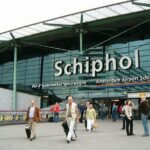
You begin at Rotterdam Centraal Station, described as a modern architectural highlight and the main rail hub with about 170,000 passengers daily. Even if you’ve never studied station design, this is a smart start point because it orients you instantly. Rotterdam’s “new city” attitude is visible before you even step into the older quarters.
Best tip: treat this as your warm-up. Let the guide explain what you’re seeing, then you’ll spot the same logic later at the bridges and market hall.
Hoogheemraadschap Schieland and Krimpenerwaard: Water Management With Napoleon Footnotes
Next is the former headquarters of a water authority—Hoogheemraadschap Schieland and Krimpenerwaard. It’s a 17th-century building tied to water policy and management in South Holland, and it even served as temporary accommodation for Napoleon Bonaparte at one point. That’s an odd-but-useful fact: in Rotterdam, water isn’t background scenery. It’s the reason people built the way they did.
This stop is mostly about exterior appreciation; the admission ticket here is not included.



Grote of Sint-Laurenskerk: A Gothic Survivor From 1940
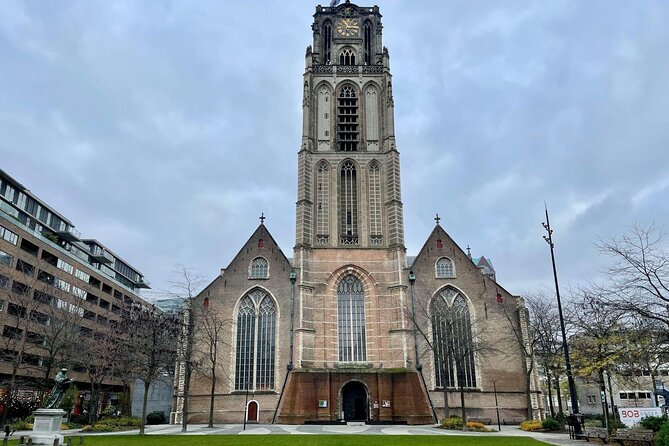
Grote of Sint-Laurenskerk is a late Gothic church dating to 1525 and noted as the oldest building in Rotterdam. The truly compelling detail: it survived Nazi bombing on May 15, 1940, while other major parts of the city didn’t.
If you love architecture that carries evidence, this one lands. If you’re mainly there for interiors, just know the ticket is not included for this stop.
Erasmus Monument: The City’s Brains Behind the Name
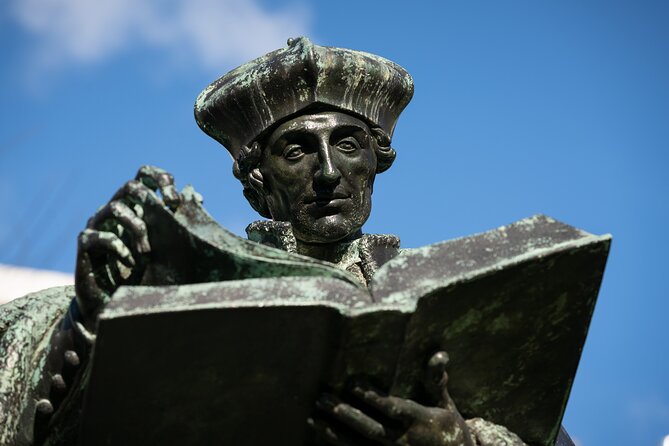
The Erasmus Monument honors Desiderius Erasmus of Rotterdam, a major 16th-century philosopher/theologian/scholar/priest. Many institutions in the city carry his name, so seeing the monument early helps you understand why Rotterdam celebrates him.
This is also one of the quicker stops, so it’s more about context than time inside.
Markthal: The Market Hall Called The Sistine Chapel of Rotterdam
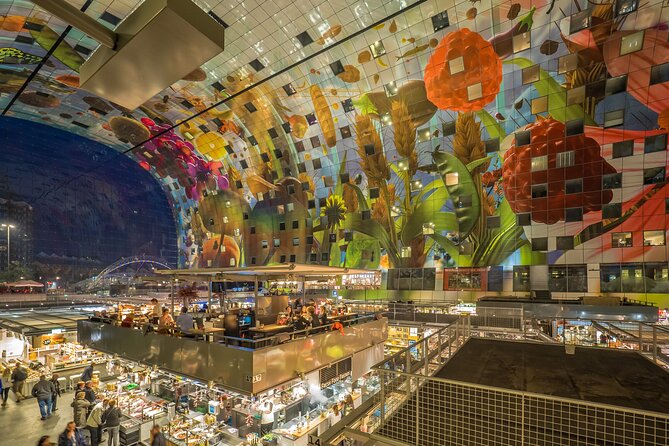
Then you hit Markthal, a horseshoe-shaped market hall that combines food market space with living and facilities. It’s nicknamed The Sistine Chapel of Rotterdam, which usually points to its dramatic interior art style (you’ll see why once you’re there).
Admission is free here, and the stop is long enough to take in the shape and atmosphere.
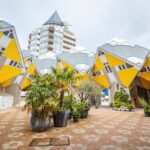
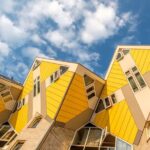
Kijk-Kubus: Cube Apartments on Columns (And Why Only 3/4 Fits)
Kijk-Kubus is one of the most fun “architecture-as-a-conversation” stops on the day. These are cube-shaped apartments on top of supporting columns—almost tree-like in form. The practical detail is key: because of the structure, only 3/4 of the inner space is usable for everyday living.
The ticket here is included. That makes it a worthwhile pause because you’re not just looking; you can experience what the design feels like inside.
Oude Haven: Medieval Port Life Meets Modern Coffee Stops
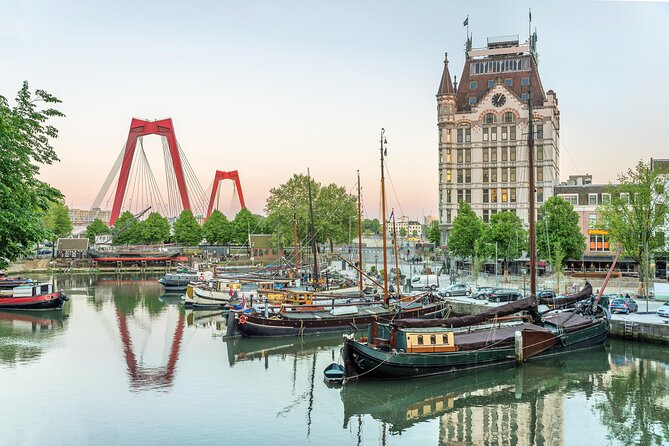
At Oude Haven, you’re in one of the oldest port areas in Rotterdam (not the oldest, but older than most people expect). It was the former river mouth of the Rotte feeding toward the New Meuse. Today it’s a favorite social spot with coffee bars, restaurants, taverns, and disco clubs—so it’s a nice contrast to the heavier monuments earlier.
This is free, and the time is enough for a breather.
Witte Huis: Europe’s Former “Skyscraper” Moment
The Witte Huis was once the highest “skyscraper” in Europe, which is a wild-sounding title until you see how long people have been chasing vertical ambitions. It’s also noted as one of the rare buildings that survived the May 14/15, 1940 Rotterdam bombing sequence.
Again, this is a look-and-learn stop with free viewing.
Willemsbrug and De Hef: Red Bridge and the Steel Lift Bridge
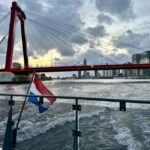
You’ll pass Willemsbrug, also called the Red Bridge, dedicated to Willem III and connecting central/northern Rotterdam to southern districts. Then comes De Hef, a huge steel “lift” structure meaning The Lift, which once carried a rotating/lifting train bridge across the New Meuse. It served before the rail tunnel was built under the river.
If you like industrial structures, this pair is the Rotterdam “wow” section. Both are free viewing stops.
War Memorials and Maritime Tools: de Boeg and Leuvehaven
Next are two strongly related river stops. You’ll see the Monument to the Merchant Navy de Boeg, commemorating 3,500 people lost on Dutch merchant ships during World War II. Then you’ll move to Leuvehaven, an open-air maritime museum with steamships, cargo machinery, ship engines, and equipment from the mid-1800s to the 1970s.
Even with limited time, this is where Rotterdam feels most honest. It’s about trade, repair, and people doing necessary work.
Erasmus Bridge: The Swan/Harp Shape Over the New Meuse
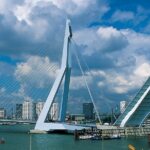
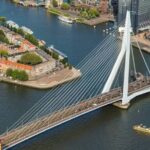
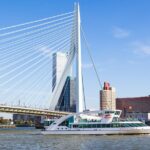
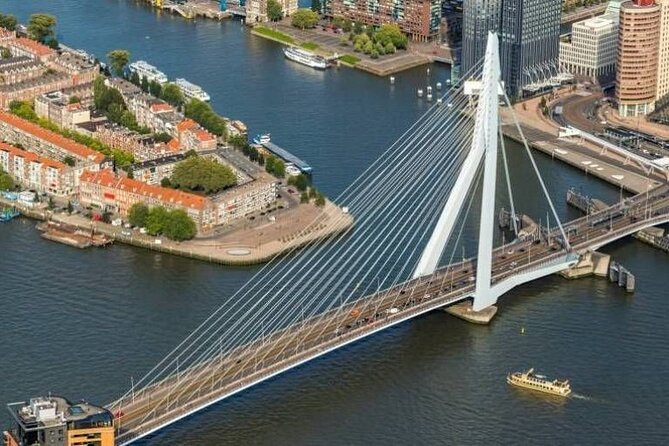
You end the Rotterdam stretch with Erasmus Bridge, also nicknamed The Swan or The Harp. It’s a hanging bridge and described as Rotterdam’s youngest bridge, and it’s one of the city’s most recognizable symbols. The stats are impressive: 139m high with an opening span of 80 m (the biggest and heaviest opening part in Europe, per the tour description).
This stop is free, and it’s a good place for one last photo before you head toward Gouda.
Gouda Highlights: Cheese Time, Stadhuis, Stained Glass, and Old Guild Corners
Once you reach Gouda, the vibe changes. Rotterdam feels like engineered movement. Gouda feels like preserved routine.
Gouda Cheese Experience: The Big Paid Block (Plan for the cost)
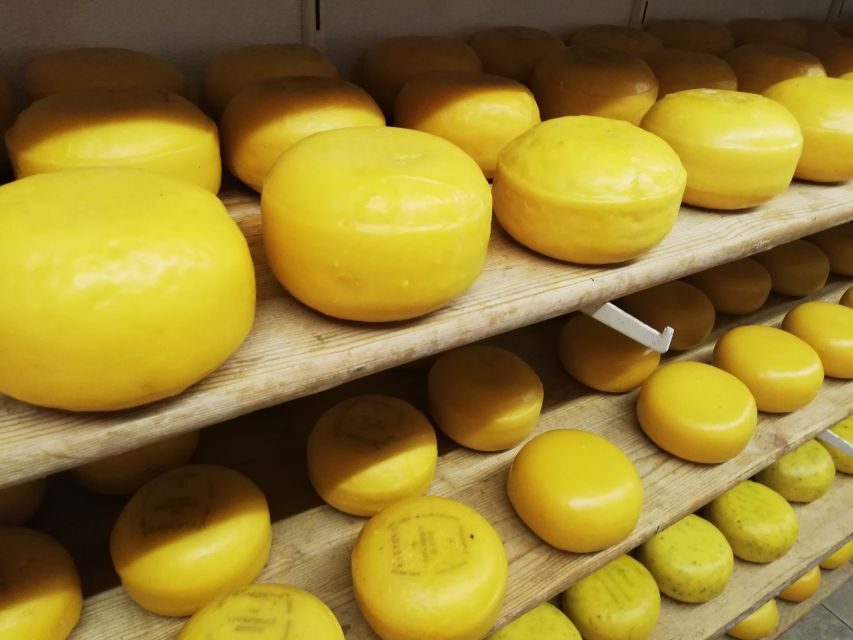
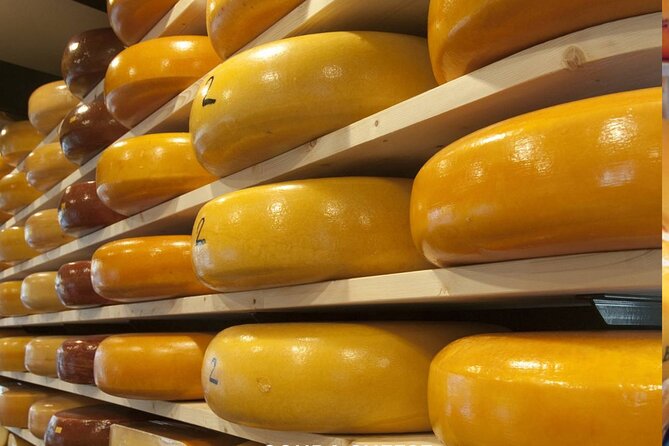
The day gives you a Gouda Cheese Experience, a 3-in-1 setup (entertainment, degustation, education) for about 45 minutes. The admission is not included and is listed at €16 per person.
This is the kind of add-on that can justify the entire day’s pricing if you actually like food history, because it connects the city’s identity to something you can taste. If you’re not a cheese person, you might still enjoy the education angle—but the degustation is part of the deal.
Stadhuis Gouda: The Old City Hall (From 1459)
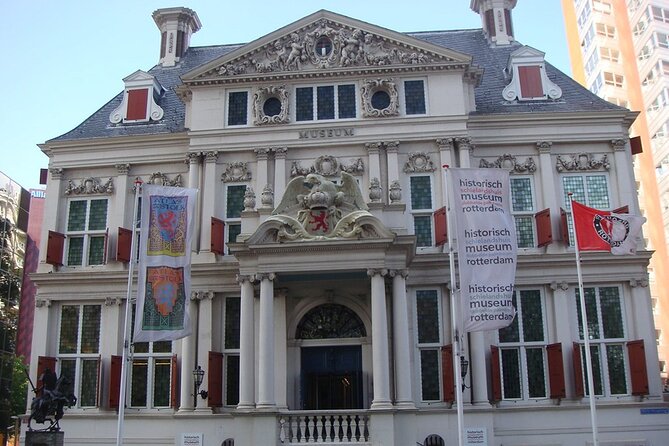
Stadhuis Gouda is the oldest existing city hall building in the Netherlands, dated to 1459. The admission ticket is not included, so you’ll likely be mostly viewing from outside or deciding whether to add the interior time yourself.
This is a must-see exterior stop if you like medieval civic power.
VVV Gouda and Arti Legi: Commerce and Civic Thought in Brick Form
You’ll also pass VVV Gouda, described as a custom house connected with the cheese trade, dating to 1668. Then there’s Arti Legi, a multi-purpose historical building in the city’s life.
These stops are quick, but they’re useful because they show Gouda’s “business brain” wasn’t separate from the rest of city life.
Saint-John Church: The 72 Stained Glass Windows Stop
The Saint-John Church is famous for its 72 stained glass windows. It’s one of the paid admissions listed at €11 per person, and it’s not included.
If stained glass is your thing, this is probably the add-on that feels worth it. If you only care about street scenes, you can treat it as a skip and keep moving.
Museum Gouda: St. Catherine Gasthuis (Former Prison, Hospital, and More)
Next is Museum Gouda (St. Catherine Gasthuis), described as a national monument made from two fused buildings with very mixed past uses: a mentally hospital, prison and torture chamber, and later an art space, even with horse storage mentioned.
Admission is not included. The good news: it’s a strong “why this building survived” moment. The possible drawback: if you prefer lighter topics while on vacation, this one can feel heavy.
Tapijthuis and the Street-Workshop Story
Tapijthuis is a medieval building in the oldest city quarter, tied to Flemish tapestry weavers. It’s also described as a secret Catholic school for children, later a brewery, and then an art studio and gallery.
Admission is free. This stop is ideal if you want local history that’s human-scale and creative, not just political.
Houses With Names: Willem Vroesen, Orphans, and a Yard You Can See
There’s also tuin van het Willem Vroesenhuis, an elderly house with a picturesque backside yard founded by Willem Vroesen. Then Weeshuis, an orphanage founded in 1643 that’s now a high-rated exclusive hotel (admission not included).
Both are quick, and both add texture. Gouda isn’t just big-ticket sights; it’s the small named places that tell you how people lived.
Lazaruspoortje: The Leper Gateway Detail
Lazaruspoortje is a famous landmark gateway tied to a former house that hosted people suffering from leprosy. It’s free viewing.
This is the kind of detail that makes a city feel real. It’s also a reminder: some of the oldest European street patterns were shaped by health, not romance.
De Visbanken and the Fish-Market Foundation
Rijksmonument De Visbanken is a former fish market established in the mid-16th century. It’s free.
If you like tracing how food economy shapes streets, you’ll enjoy noticing the logic from this point forward.
Two More Churches, an Ash Warehouse, and Then the Windmill
You’ll also see Evangelisch Lutherse Gemeente Gouda, a church dedicated to St. Joost (patron of bag carriers and their guild), then Asschuur, a middle-19th-century house once used as an ash warehouse for potash tied to soap and glass production.
Both are free viewing stops. Then comes your included “closer”:
Red Lion Windmill: Molen De Roode Leeuw (Ticket Included)
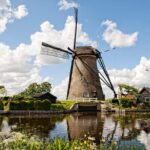
The Red Lion Windmill (Molen De Roode Leeuw) is one of the oldest still-existing flourmills in the Netherlands, and it retains much of its original shape inside and out. Admission is included.
This is one of the smartest included value points on the whole tour because a windmill is easy to treat like a photo moment—but here you’re set up to experience it properly. If you’re the type who likes gears and old industry, this will be a highlight rather than a side stop.
After that, you finish with Remonstrantse kerk (free viewing) and Lazaruspoortje earlier, before the group returns to the meeting point.
Price, Pacing, and Practical Comfort on a Day Like This
This is a private group walking tour with a maximum of 4, about 7 hours long. That has two practical effects.
First, pacing feels more adjustable. You’ll still follow the schedule, but a smaller group makes it easier to pause for a question or a photo without holding everyone hostage.
Second, you’ll want to be honest about your walking tolerance. Many stops are short—10 minutes is common—yet the day includes lots of movement across both cities. This is not the kind of trip where you can arrive late, pop in for an hour, and still see the main story.
What I’d pack:
- comfortable shoes (very important),
- a small snack (coffee/tea is included, but food breaks aren’t built in),
- and a quick-charging power bank for bridge and church photos.
Should You Book This Rotterdam & Gouda Private Walking Tour?
Book it if you want a structured day with real context—Rotterdam’s architecture and war survival details plus Gouda’s cheese identity—without coordinating trains, transfers, and ticket timing yourself.
Skip or downshift if:
- you’re watching costs carefully, since key admissions like the Gouda Cheese Experience (€16) and Saint-John Church (€11) are not included,
- or you prefer fewer stops with longer interior time. This tour is designed for seeing a lot, not lingering.
If you’re a small group (2–4 people) and you like cities that show both beauty and practical history, this one has strong value.
FAQ
How long is the Rotterdam & Gouda Private Daily Walking Tour?
The tour is about 7 hours.
How many people are in the group?
The maximum group size is 4 travelers.
Where does the tour start and end?
It starts at the Port of Rotterdam, Wilhelminakade 909, 3072 AP Rotterdam, Netherlands and ends back at the same meeting point.
Is pickup available?
Yes. You can be picked up at your hotel in Rotterdam or Gouda, or at Amsterdam Central Train Station, Amsterdam Passenger Terminal (APT), or Dam Square.
What’s included in the price?
Coffee and/or tea are included, and there is an entrance ticket included for the windmill called The Red Lion (Molen De Roode Leeuw).
What entrance fees are not included?
Saint-John Church is not included (€11.00 per person), and the Gouda Cheese Experience is not included (€16.00 per person). The tour data also lists some other admissions as not included.
Is public transportation included?
The tour data states transportation is included during the tour duration (7 hours), but it also lists public transportation at €15.00 per person as not included.
What time does the tour start?
The start time is 9:00 am.
What is the cancellation policy?
Free cancellation is available. You can cancel up to 24 hours in advance for a full refund.