REVIEW · THE HAGUE
The Blue’s Clues in Delft Exploration Game and Tour
Book on Viator →Bookable on Viator
Delft, but make it a game. This outdoor escape-style route lets you wander historic streets with an offline smartphone app, solving clues as you go. You’ll hit major landmarks like Nieuwe Kerk, the Vermeer Centrum, the Old Church area, and the final stop at Delft windmill de Roos.
What I like most is how self-paced it feels. You can start any time, pause whenever you want, and keep going when you’re ready. I also like the practical design for groups: group members can play on their own phones without extra charge, which is rare for low-cost activities.
The one thing to consider is tech friction. One booking had trouble getting the game to load on the phone after purchase, so it’s smart to plan a little buffer time before you start.
In This Review
- Key things to know before you go
- Pricing and what $7.53 gets you in Delft
- How the app-guided walk actually feels in the real world
- Oostpoort: start with Delft’s surviving city gate
- Koornmarkt canals and the hunt for city details
- Medisch Farmaceutisch Museum: odd, specific, and worth it
- The Old Church and Gothic Delft: from 1246 to the Rijksmonument
- Nieuwe Kerk surroundings: City Hall and the Markt on higher ground
- Nieuwe Kerk tower details: Jacob van der Borch and the clock’s bells
- Vermeer Centrum Delft: St. Lucasgilde meets painters’ patronage
- Prinsenhof: monastery walls and the William the Silent story
- De Roos windmill: a dramatic finish you can see from far away
- Who this escape game suits best (and who should think twice)
- The main downside: tech access can make or break the day
- Should you book this Delft exploration game?
- FAQ
- How long is the Delft exploration game?
- Do I need internet to play?
- Can I start at any time of day?
- Is there a physical guide with me?
- Where do I start and where do I end?
- Is it free for kids?
- Is it suitable for most travelers, and can I bring a service animal?
Key things to know before you go
- Offline play in Delft means you can keep moving even if your phone signal is shaky.
- Start anytime and play in chunks: stop for coffee, resume later, no problem.
- You’ll follow step-by-step directions to guide you from Oostpoort to Windmill de Roos.
- A landmark-by-landmark puzzle route connects Delft’s gates, churches, canals, and market square.
- Kids play free and it’s set up as a family-friendly escape format.
- Group members can use their own phones without extra per-person hassle.
Pricing and what $7.53 gets you in Delft
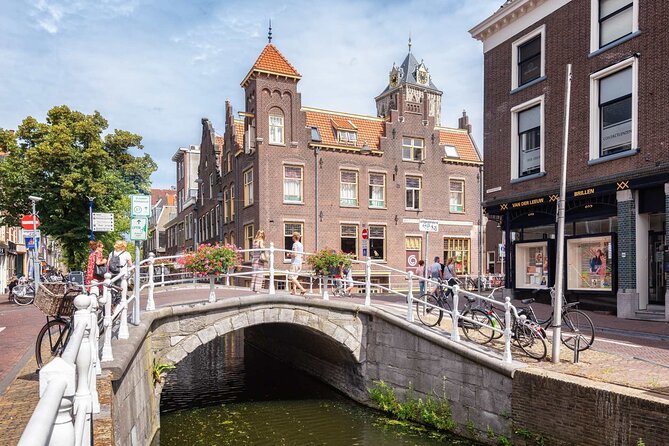
At about $7.53 per person, this is priced like a budget-friendly activity, not a full guided tour. The value comes from two things: time on your feet (about 1 hour 30 minutes), and the fact that you’re getting a structured route with built-in stops at recognizable Delft icons.
Because it’s an app-based experience, you’re paying for the puzzle flow and the information at each location, not for a human guide. That can be great. It also means you get flexibility that classic group tours often can’t offer: you can start midday, late afternoon, or even early evening, and you’re not locked into a strict meeting time.
If you’re touring Delft independently and you want more than just photo stops, this kind of “guided by prompts” approach can feel like a cheat code. You’ll naturally walk between key places like the Markt and the Nieuwe Kerk tower instead of guessing your own route.
You can also read our reviews of more tours and experiences in The Hague.



How the app-guided walk actually feels in the real world
You start at Oostpoort 15, 2611 RZ Delft, and you’ll finish at Delft Windmill de Roos, Phoenixstraat 111/112, 2611 AK Delft. The app gives step-by-step instructions, so you’re not left staring at your map trying to match buildings from memory.
Because the experience is available 24/7 and you can start at any hour, I’d treat it like a self-made tour slot. Choose a time when you want to be outside walking—then let the game handle the pace and the “where to next” pressure.
The biggest practical win is offline play. Delft can be an easy place for Wi‑Fi, but you don’t want to gamble when you’re mid-route. Offline also means you can keep your attention on the streets and canals rather than your phone’s battery life and connectivity.
One more detail worth knowing: the experience is described as playing in the Questo app. If you’re booking through a third-party platform, double-check that you’ll have the code/entry needed to start the game in the app before you head out.
Oostpoort: start with Delft’s surviving city gate
Your first puzzle stop is Oostpoort, a northern European Brick Gothic city gate built around 1400. Around 1510, the towers were upgraded with an extra octagonal floor and high spires. The dramatic part here is historical: this is the only city gate still standing in Delft, while the other gates were demolished in the 19th century.
This kind of opening stop is smart. You get a sense of how Delft was once structured for defense and entry, then the game sends you forward into the heart of the city.
How you’ll use the stop: you’ll look around for a clue tied to the gate’s story, then move on. If you like learning by scanning details—brickwork, tower shape, and architectural features—you’ll enjoy this start. If you prefer minimal “find the answer” tasks, focus on the bigger picture first, then solve the puzzle once you’ve taken a quick look.
Koornmarkt canals and the hunt for city details
Next comes Koornmarkt—a famous street and canal area. Delft’s canals are the obvious draw, but streets like Koornmarkt are where you really feel the city’s rhythm: narrow waterways, old facades, and little sightlines that make you slow down.
In this stop, the game nudges you to look around for the answer to advance. That’s not just a trick. It trains your eyes to spot what you’d otherwise rush past—signs, patterns, and building cues that connect the canal-side view to Delft’s broader history.
A practical tip: when you’re playing, keep your phone in your other hand while walking is calm. Delft sidewalks can be busy at peak times, and you’ll want to scan safely.
Medisch Farmaceutisch Museum: odd, specific, and worth it
The Medisch Farmaceutisch Museum focuses on antique medical and pharmaceutical instruments. That’s a nice change of pace from the usual church-and-canal loop. It’s the kind of niche stop that makes a self-guided route feel genuinely different.
What you’ll likely do here is read a prompt in the app and then look around to find the puzzle answer tied to the museum’s theme. Even if you’re not a museum person, the subject itself tends to pull you in—tools and objects from older healthcare traditions can be surprisingly engaging.
One consideration: if you’re expecting a long museum visit, the route format won’t be a replacement for a dedicated museum day. This stop works as a focused, puzzle-driven introduction.

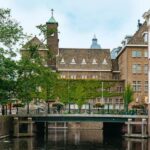




The Old Church and Gothic Delft: from 1246 to the Rijksmonument
You’ll also spend time around the Old Church (Oude Kerk) area, where the story layers are part of the fun.
The church is described as having roots in 1246, when Count William II granted Delft its own charter. At that time, the church was named after St Bartholomew. Later, it developed into an impressive Gothic basilica.
Another part of the route emphasizes that the building was built around 1400 in Gothic style and is located on the east side of Oude Deft. It also notes that since 1967, it has been designated a Rijksmonument.
So what should you do with all that? Use the puzzle moment to slow down and actually compare eras. Look at what you can see—height, style, and the way the church fits into the street. Then let the app connect the timeline.
Why this stop matters for your whole route: churches in Delft aren’t just backdrops. They’re structural landmarks that anchor the city center, including how the Markt is laid out.
Nieuwe Kerk surroundings: City Hall and the Markt on higher ground
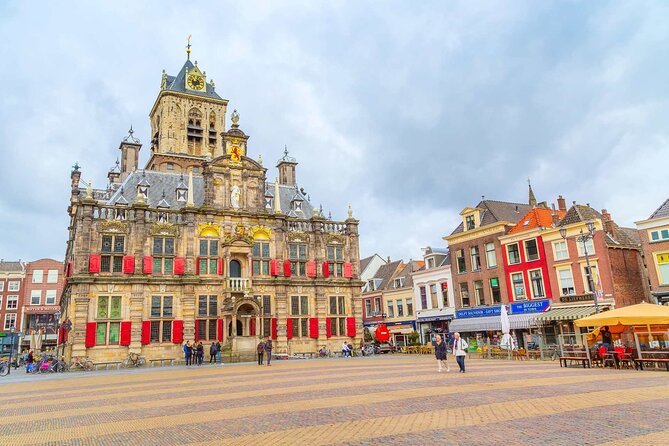
The route brings you to the City Hall across from the Nieuwe Kerk. It’s described as a Renaissance style building on the Markt. This is the seat of city government, and it’s also a popular venue for civic wedding ceremonies. Most administrative functions have been transferred to an office inside the Delft railway station building.
Then you reach the Markt, one of Europe’s largest historic market squares: about 120 by 50 meters. The square is almost rectangular, bordered on the short sides by the Nieuwe Kerk in the east and Delft’s town hall in the west. The connecting side streets also belong to the Markt.
The extra detail that makes the Markt stop more than a wide-open photo area: it was set up on a silted creek ridge, raised by the tidal channel de Gantel. That means you’re standing in one of the higher parts of Delft’s city center—subtle, but cool context when you’re walking around.
How the game fits in: you’ll scan the area to find puzzle answers that connect the architecture and layout to the story. If you like city planning and how places evolved, this will feel rewarding.
Nieuwe Kerk tower details: Jacob van der Borch and the clock’s bells
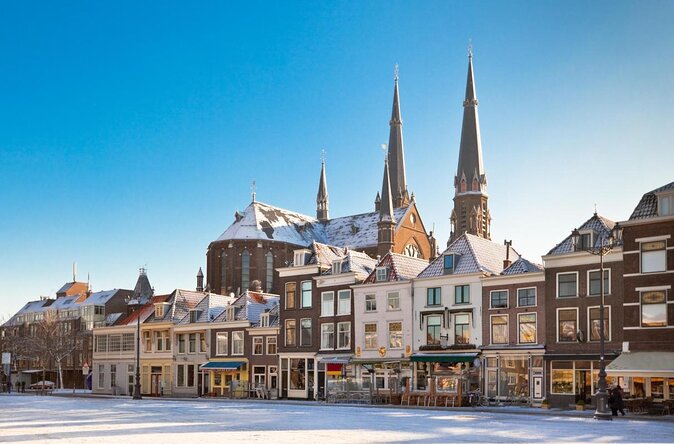
Another key moment on the route focuses on the tower at Nieuwe Kerk. It was built between 1396 and 1496 by Jacob van der Borch, who also built the Dom in Utrecht during 1444–1475.
There’s a specific historical layer too: the monument for Hugo de Groot was made in 1781. And the clock is a story on its own—the mechanical clock has 18 bells by Francois Hemony from 1659 and 30 modern bells.
This is a great example of how an app game can do more than “what building is this?” It pushes you toward details you’d never notice on a casual walk.
A practical note: clocks and bells can be hard to fully appreciate from street level. Let the tower stop be your prompt to look upward longer than you usually would, then solve the puzzle once you’ve taken in the structure.
Vermeer Centrum Delft: St. Lucasgilde meets painters’ patronage
You’ll also visit Vermeer Centrum Delft, noted as an important historical building. It was once home of the St. Lucasgilde, the guild of painters and glass makers in the 17th and 18th centuries. Vermeer joined that guild in 1653. The route also links St. Lucas as the patron saint of painters.
This stop adds a cultural thread that complements the architecture-focused church stops. It helps you understand Delft not just as a pretty city, but as a place tied to real creative communities.
In your play mode, you’ll look around for the clue that advances you. If you’re a museum-leaning traveler, the guild angle can spark interest even beyond Vermeer’s name.
Prinsenhof: monastery walls and the William the Silent story
Next is Prinsenhof, described as an urban palace built in the Middle Ages as a monastery. Later it served as a residence for William the Silent. He was murdered there in 1584, and the holes in the wall made by bullets at the main stairs are still visible.
That bullet-hole detail is the kind of thing that makes a stop feel real, not just educational. When you’re playing a puzzle route, this is where the game’s challenge tends to matter, because the setting itself already pulls your attention—you’re more likely to notice what the clues ask you to notice.
If you prefer to move through dark history quickly, keep your pace steady and use the app prompts to guide your scanning. If you like historical stakes and personal stories, this stop is a highlight.
De Roos windmill: a dramatic finish you can see from far away
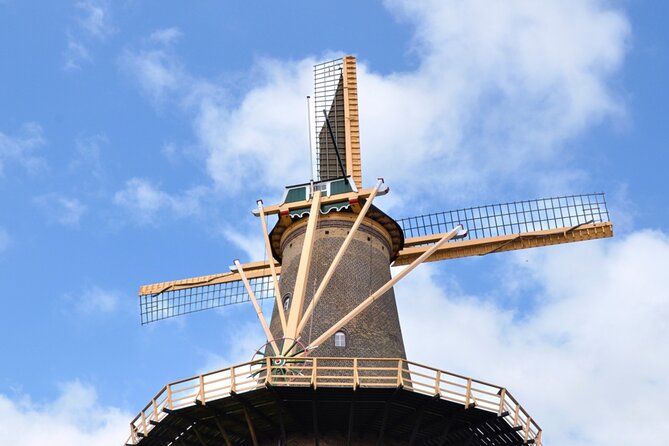
The final stop is Delft Windmill de Roos. It’s the end point of the game, and that’s perfect. You want the last moment to feel like a reward and a clean navigation target.
Here’s what makes it special: de Roos windmill was built in 1679 for grinding corn. But the first mention of a mill at this location dates to 1352. It’s also said to be the only remaining windmill of fifteen mills that once stood in the Delft region.
That’s a satisfying wrap for your route, because it mirrors the day’s theme. You started at a gate that represented Delft’s boundaries; you end at a working mill that represented Delft’s industry. The app turns both into story beats.
When you finish: take a moment to look back across the area. Even if your route was mostly puzzle-focused, the windmill gives you a strong visual anchor for what you accomplished.
Who this escape game suits best (and who should think twice)
This works best for you if:
- you like independent walking and want a ready-made route
- you want an activity that includes famous Delft landmarks plus some more specific stops
- you’re traveling as a small group or family, and you want everyone to use their own phone
It might not fit you as well if:
- you’re the type who hates any phone setup steps before leaving the hotel
- you need a human guide for context and conversation at each location
- you’re hoping for a museum-heavy day. This is a route with short, puzzle-driven stops.
The main downside: tech access can make or break the day
One booking issue described a complicated process where the game never successfully started on the phone after purchase. The support response clarified that the game is meant to be unlocked within the Questo app using a code.
So here’s my advice before you buy: give yourself time. Download the app ahead of your chosen start time, and test access while you’re still near your accommodation or somewhere with reliable Wi‑Fi. That way, you don’t lose the entire walk to setup.
Should you book this Delft exploration game?
I’d book it if you want Delft in a more active format. For roughly $7.53 and about 1.5 hours, you get a structured, landmark-to-landmark walking experience with offline play, pause/resume flexibility, and plenty of built-in reasons to look up, not just straight ahead.
Skip it only if you know you’ll struggle with app-based start-up steps or you hate problem-solving even a little. Delft rewards slow looking, and this route makes you do it without feeling like a homework assignment.
If you’re traveling independently and you want a fun way to connect Oostpoort, the Markt, Nieuwe Kerk details, Vermeer’s world, and the ending at de Roos windmill, this is a solid buy.
FAQ
How long is the Delft exploration game?
It’s approximately 1 hour 30 minutes.
Do I need internet to play?
No. The experience can be played offline, so you do not need an internet connection while exploring.
Can I start at any time of day?
Yes. It’s available 24/7, and you can start at any hour. You can also pause and resume later.
Is there a physical guide with me?
No. It’s an app-led experience with a mobile ticket and step-by-step guidance through the route.
Where do I start and where do I end?
Start at Oostpoort 15, 2611 RZ Delft. End at Delft Windmill de Roos, Phoenixstraat 111/112, 2611 AK Delft.
Is it free for kids?
Yes. The experience is listed as free for kids.
Is it suitable for most travelers, and can I bring a service animal?
The info says most travelers can participate and service animals are allowed. It’s also noted as being near public transportation.