REVIEW · AMSTERDAM
Amsterdam Pedicab City Tour (2 hours)
Book on Viator →Operated by Bram de Haan · Bookable on Viator
Amsterdam on two wheels feels different fast. A private pedicab tour turns key landmarks into an easy-moving story with a local guide like Bram de Haan, plus photo comparisons that make the city’s changes click. I love how the route packs major neighborhoods into just 2 hours, and I really like the way the guide pauses for questions and photos instead of rushing you along.
The big downside to plan for is that many stops are brief, so this is best for seeing and learning from the street level rather than doing long museum time. Also, it’s a good-weather activity, so if the sky opens up at the wrong moment, you’ll want to follow the guide’s lead on timing and comfort.
In This Review
- Key things that make this pedicab tour worth your time
- Two Hours on a Blue Pedicab: What the Ride Feels Like
- Dam Square to Museumplein: How the Route Tells Amsterdam’s Story
- Dam Square: the old center’s heartbeat
- Zeedijk: an old dike and an unsettling story setup
- Chinatown: Europe’s oldest mainland Chinese neighborhood
- Nieuwmarkt: a square built around an old city gate
- Montelbaanstoren: a ship watchtower with a canal view
- Rembrandt House Museum: outside views only
- Jodenbuurt: what survived of the Jewish quarter
- Portuguese Synagogue of Amsterdam: a big building with a 17th-century timeline
- National Holocaust Names Monument: names you can’t ignore
- H’ART Museum: a former widow house turned museum space
- Magere Brug: the Skinny Bridge with a postcard angle
- Canal Ring (Grachtengordel): the 17th-century half-circle design
- Museumplein: Rijksmuseum, Concertgebouw, and a wide-open photo view
- Price and Value: What $237.65 Buys for a Private Tour
- Weather, Photos, and Getting Comfortable in a Pedicab
- Who This Pedicab Tour Fits Best (and Who It Might Not)
- Quick tips for making the most of your 2 hours
- Should you book the Amsterdam Pedicab City Tour?
- FAQ
- How long is the Amsterdam Pedicab City Tour?
- What’s the price for the Amsterdam Pedicab City Tour?
- Is pickup included, and where do we meet?
- Is the tour private?
- What languages is the tour offered in?
- Do we need to use a paper ticket?
- Are museum admissions included?
- Are snacks included?
- Is there a weight limit for the pedicab?
- What happens if weather is poor?
- Can I cancel for a refund?
Key things that make this pedicab tour worth your time
- Private, up-to-two format: you get undivided guide attention on one pedicab.
- A route that mixes old center + canals + Jewish Amsterdam without long walks.
- Photo-and-map storytelling that helps you see what changed over centuries.
- Weather comfort for real life: a waterproof blanket is part of the ride experience.
- Iconic photo stops like Magere Brug and the canal district (Grachtengordel).
Two Hours on a Blue Pedicab: What the Ride Feels Like
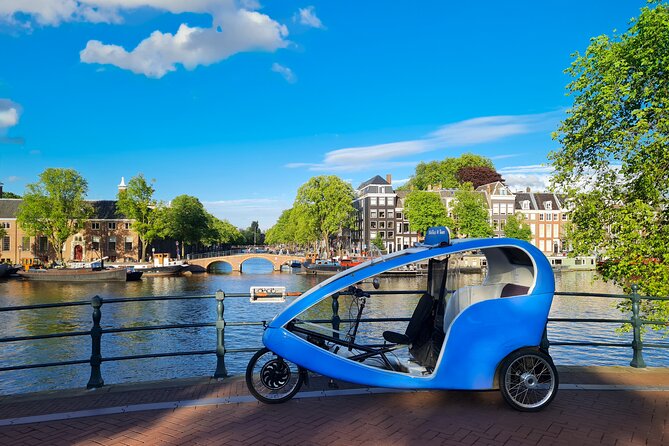
This is a city tour built for momentum. You’re not standing in line, and you’re not doing the stop-and-go shuffle through crowds. Instead, you glide through the center of Amsterdam on an eco-friendly pedicab while your guide steers you toward the places that actually give you a sense of the city’s “why” as well as its “what.”
Pickup is offered, and you’ll wait in front of your hotel looking for the blue pedicab. You’ll get a mobile ticket, and the tour runs in English. The private setup matters here: you aren’t sharing the ride with a big group, which means your questions don’t get cut off every time a driver needs to move.
For comfort, the practical details are solid. The tour uses a single pedicab per timeslot, and there’s a maximum total passenger weight limit of 210 kg. For many couples, this setup is ideal because you can sit back, take photos, and move between areas without your legs doing the heavy lifting.
One of the best parts is how the ride handles weather. Even when it’s cold or rainy, you’re not left to suffer in it. You’ll have a waterproof blanket to pull over yourself, and that makes a surprising difference when you’re trying to keep an enjoyable pace for the full 2 hours.
You can also read our reviews of more tours and experiences in Amsterdam.



Dam Square to Museumplein: How the Route Tells Amsterdam’s Story
The itinerary is designed like a fast orientation, moving from Amsterdam’s original civic core out toward canals, bridges, and the Jewish neighborhoods that shaped the city’s history. Most stops are short, which is the whole point: you get a clean cross-section of the city in one sitting.
Here’s what you’ll see, and what each moment is really for.
Dam Square: the old center’s heartbeat
You start at Dam Square, Amsterdam’s main square and the heart of the old center. This is where the city’s “starting point” feeling comes from, with the Royal Palace, the New Church, and the National Monument in the mix.
Why it’s a great first stop: it gives you a reference point. Once you stand here, the rest of the tour makes more sense, because you can mentally map where you’re going.
Potential drawback: because it’s a central square, you may feel the crowd energy nearby, even though your pedicab ride keeps things calmer than a typical walking loop.
Zeedijk: an old dike and an unsettling story setup
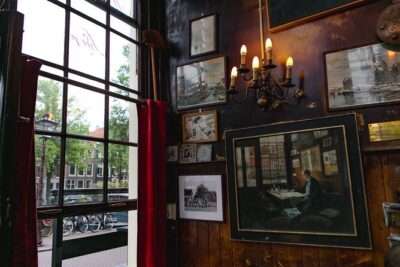
Next up is Zeedijk, one of the oldest dikes around the old center. This area is known for classic Amsterdam character, including an old cafe with an original interior and a kind of ancient vibe.
The tour also builds in a hint of something darker: you’ll get a story connected to the street’s past. It’s the kind of detail that turns a quick stop into a memorable one, even if you only stay a few minutes.
Tip for you: since Zeedijk is narrow and atmospheric, keep your camera ready but don’t overdo it. This is a stop for the guide’s context more than for long photos.
Chinatown: Europe’s oldest mainland Chinese neighborhood
At Chinatown, you’ll pass through Amsterdam’s older Chinese quarter—often described as the oldest on the European mainland. You’ll see restaurants, supermarkets, and a Chinese temple.
What makes this stop useful: it shows Amsterdam isn’t just canal houses and museums. It’s also a living, changing city of communities.
Timing note: you won’t linger forever here, so treat it like a quick orientation window into a neighborhood you can explore later at your own pace.




Nieuwmarkt: a square built around an old city gate
Nieuwmarkt is one of old Amsterdam’s key squares. In the center sits an old city gate, tied to the time when Amsterdam was walled and fortified before its big 17th-century expansion.
This stop works well because it’s not abstract history. You’re standing at the gateway idea—how the city controlled entry—and then watching that concept translate into a modern neighborhood square.
If you like history that feels physical, this is one of the moments you’ll likely remember.
Montelbaanstoren: a ship watchtower with a canal view
At Montelbaanstoren, you’ll see an early 16th-century watch tower that was part of the city’s defense line for ships. From here, you also get a view across de Oude Waal, with houseboats and classic canal houses in the background.
This is one of those “stop-and-look” moments that helps you understand why canals are not just scenery—they’re geography, trade, defense, and living.
Rembrandt House Museum: outside views only
You’ll look at the Rembrandt House Museum from the outside where Rembrandt used to live during his successful years. Entering the museum is possible, but it isn’t included in this tour.
So think of this as a sight checkpoint with context, not a museum visit. If you want to go inside later, you’ll know exactly what building to target.
Jodenbuurt: what survived of the Jewish quarter
Next is Jodenbuurt, the area tied to the old Jewish neighborhood in the city center. A large portion was broken down after World War II, but there are still buildings, synagogues, and streets that remain and reflect what the quarter once was.
This stop can hit harder than the canal-house postcard moments. The short time works, though, because it’s paired with the next sites that make the story clearer.
Portuguese Synagogue of Amsterdam: a big building with a 17th-century timeline
At the Portuguese Synagogue of Amsterdam, you’ll mainly see the building from the outside. It’s described as the largest synagogue and among the first Western European congregations that Jewish people were allowed to build in the latter part of the 17th century (1675).
Your guide will also point out other synagogues opposite the building, which connect to what’s now presented through the Jewish museum area.
Practical reality: even outside, it’s an impressive anchor point for understanding how long the community’s presence spans.
National Holocaust Names Monument: names you can’t ignore
You’ll pass by the National Holocaust Names Monument, where 102,000 brick stones with names are laid out to remind you of Dutch Jewish victims of World War II.
This one is brief—about a couple minutes of passing attention—but it’s not a throwaway stop. When a tour includes something like this, it’s usually because the guide wants the city’s story to include the difficult parts, not just the pretty ones.
H’ART Museum: a former widow house turned museum space
You’ll pass the H’ART Museum, connected to the Hermitage museum in the sense that the tour describes it as part of the Russian Hermitage network. Historically, it was a major 17th-century widow house care facility.
This stop is quick, but it adds texture: it reminds you Amsterdam cared for vulnerable residents long before it became a global tourism headline.
Magere Brug: the Skinny Bridge with a postcard angle
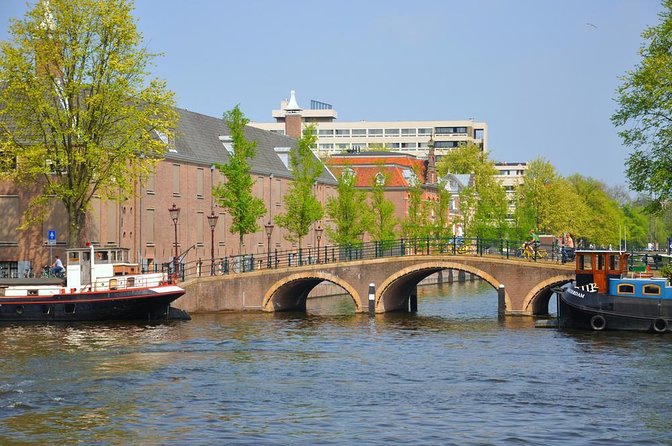
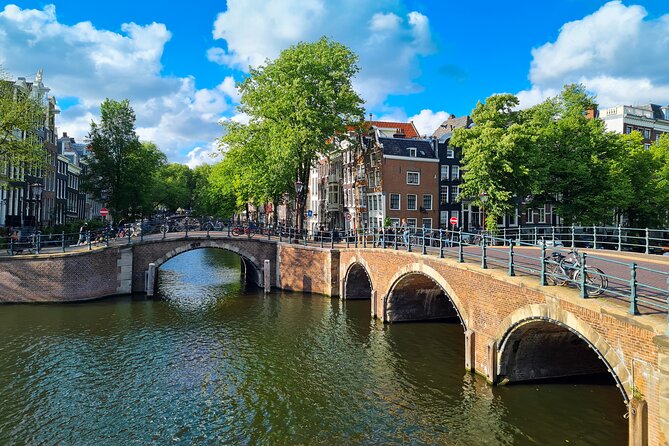
Then comes Magere Brug, the Skinny Bridge, one of Amsterdam’s most iconic bridges. It’s especially famous for lights at night, and from here you get a strong overview of the Amstel, the main and widest canal.
If you care about photos, this is where your camera will earn its keep. The bridge plus canal line gives you an easy composition without you needing to hunt for the perfect angle on your own.
Canal Ring (Grachtengordel): the 17th-century half-circle design
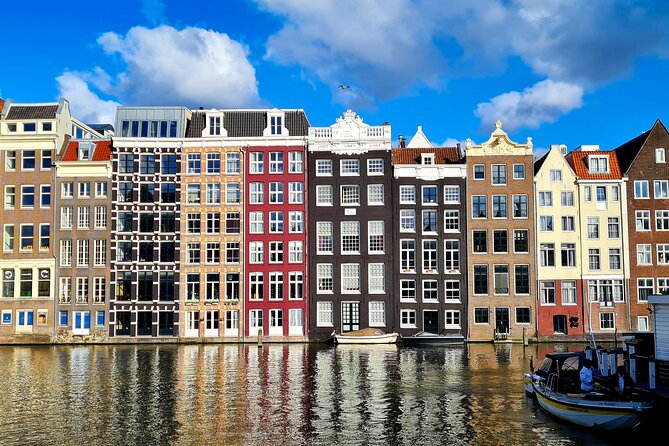
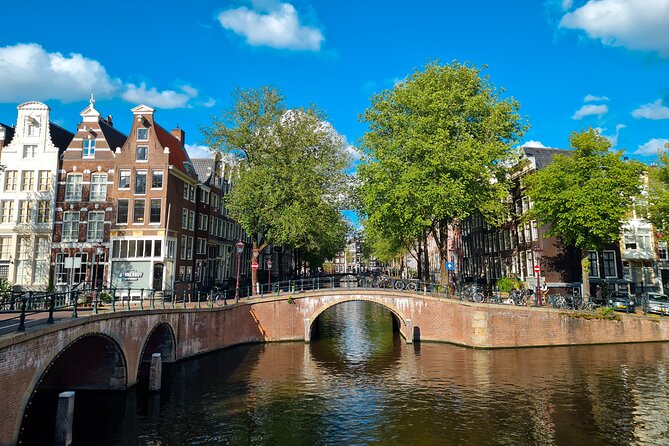
You’ll spend time at the Canal Ring, also known as the Grachtengordel, the 17th-century expansion around the old center. It’s shaped like half-circles on a map, and it’s known for merchant-era canal houses where each building is slightly different while still sharing common design features.
What you get from this stop: a framework for reading the city. After this, canal houses stop looking random. You’ll start noticing how era, trade, and style show up in the façades.
Museumplein: Rijksmuseum, Concertgebouw, and a wide-open photo view
Finally, you reach Museumplein, the biggest and one of the most impressive squares. One side holds the Rijksmuseum, and on the other is the Concertgebouw. Near the square are several other museums you might recognize, including Van Gogh, Stedelijk, Moco, and a Diamond museum.
In the tour, you stop to enjoy the views and learn how the area fits together.
A strong bonus: you pass through the famous bicycle tunnel under the Rijksmuseum. The description notes that street artists’ classical music is often heard there, which adds atmosphere even though you’re just moving through.
Then you’ll head toward a view of the back of the Rijksmuseum, completed in 1885 and designed by the catholic architect Pierre Cuypers. The guide’s perspective helps you notice details you would otherwise walk right past.
Price and Value: What $237.65 Buys for a Private Tour
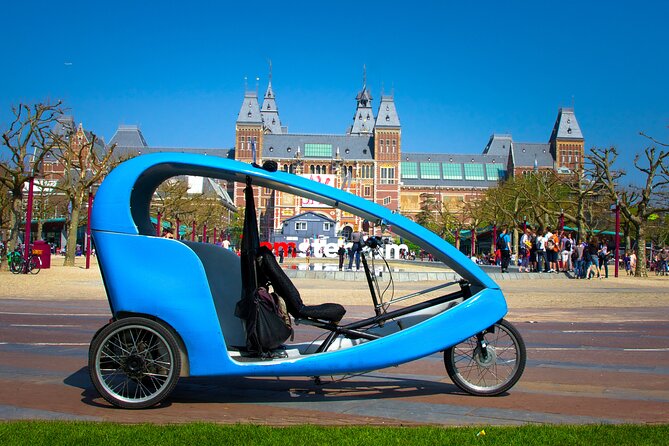
The price is listed as $237.65 per group, up to 2 people, for about 2 hours. That sounds like a lot until you break down what you’re buying: private time, a vehicle that reduces walking, and a guide who can connect places together in a way most self-guided wandering can’t.
Here’s what makes it feel like value:
- You cover more in less time: short stops, strong context, and transport that keeps you moving.
- Private attention: you can ask about the exact things that interest you and still get photo moments without group pressure.
- A guide who uses old maps and photographs: this is the difference between seeing buildings and understanding how Amsterdam changed.
Also, scheduling matters. The tour is often booked in advance (on average 77 days). If your dates are set, I’d treat it like a must-book rather than a last-minute choice, especially for good weather.
One more practical point: snacks aren’t included, so plan a quick drink or light snack before or after your ride. It’s only 2 hours, but Amsterdam walks or rides can still make you hungry.
Weather, Photos, and Getting Comfortable in a Pedicab
This tour is “weather-aware.” It requires good weather, and if it’s canceled due to poor weather, you’ll be offered a different date or a full refund. In practice, that means you should pack like it’s a street-day, not like a museum day.
If rain shows up, you’ll likely be grateful for the waterproof blanket that’s available to pull over you. In cold conditions, you’ll want to dress warmly because the pedicab moves through open streets and you’ll feel wind.
For photos, you should expect a rhythm:
- You’ll mostly see and learn while riding.
- You’ll pause at key places for short photo moments.
- The guide will pull over whenever you ask for a picture or you want to slow down for a story.
In a lot of tours, you’re stuck with the guide’s schedule. Here, you’re on a private ride, so the pacing can bend slightly toward what you want to capture.
Who This Pedicab Tour Fits Best (and Who It Might Not)
This tour is made for people who want a first-time orientation without burning half the day walking between districts.
You’ll likely love it if:
- You want to see canals, bridges, and historic neighborhoods in one go.
- You’re into guided history but don’t want museum lines to eat your time.
- You prefer a quieter format over big coach tours.
- Your group has limited walking energy, or you just want to sit back and watch the city change.
It might be less ideal if:
- You want long, ticketed museum time (for example, Rembrandt House Museum entry isn’t part of this ride).
- You’re looking for a slow, deep neighborhood exploration where you spend 30–60 minutes in one place.
Also, keep in mind the weight limit (210 kg total) and the fact that there’s one pedicab per timeslot. That usually works smoothly for couples and small groups, but it also means you shouldn’t expect last-minute swapping if you have special constraints.
Quick tips for making the most of your 2 hours
Here are a few moves that help you get more out of the ride:
- Bring a charged camera and a bit of patience for changing lighting in the canal areas.
- Have one or two topics ready: canals, Jewish history, architecture, or Amsterdam’s growth story.
- Ask for an extra photo stop if there’s something you want to linger on. On at least one occasion, an extra hour has been allowed, so it’s worth asking if your schedule is flexible.
And yes, if you’re tempted to treat it like a ride-only sightseeing session, don’t. The best part is how the guide connects the places, sometimes using old maps and photos so you can literally compare then vs. now.
Should you book the Amsterdam Pedicab City Tour?
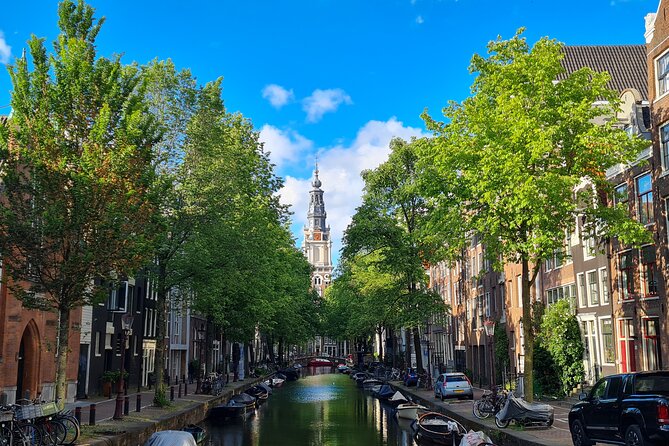
If you’re in Amsterdam for a short stay and you want a clean overview that mixes the major sights with real context, this private pedicab tour is an easy recommendation. The route covers Dam Square, the canal ring, Magere Brug, Museumplein, and the Jewish history corridor, all while keeping walking to a minimum. For the price, you’re really paying for private time plus interpretive storytelling that helps Amsterdam click.
Book it if you like street-level history, want standout photo moments, and appreciate practical comfort (including a waterproof blanket). Skip it if you want museum entrances and long indoor stops as the main event. For most people, though, this is a smart start to your trip.
FAQ

How long is the Amsterdam Pedicab City Tour?
The tour lasts about 2 hours.
What’s the price for the Amsterdam Pedicab City Tour?
The price is $237.65 per group, for up to 2 people.
Is pickup included, and where do we meet?
Pickup is offered. You’ll wait in front of your hotel and look for the blue pedicab.
Is the tour private?
Yes. This is a private tour/activity, and only your group participates.
What languages is the tour offered in?
The tour is offered in English.
Do we need to use a paper ticket?
No. You’ll have a mobile ticket.
Are museum admissions included?
Admission tickets are listed as free for the stops. However, museum entry like the Rembrandt House Museum is not included in this tour.
Are snacks included?
No. Snacks are not included.
Is there a weight limit for the pedicab?
Yes. The maximum total passenger weight is limited to 210 kg.
What happens if weather is poor?
This experience requires good weather. If it’s canceled due to poor weather, you’ll be offered a different date or a full refund.
Can I cancel for a refund?
Yes. You can cancel up to 24 hours in advance for a full refund.
If you want, tell me your travel dates and who’s in your group (ages and walking comfort). I can help you decide if this timing fits your plan, and which stop themes to prioritize.