REVIEW · AMSTERDAM
Amsterdam: World War II Private Walking Tour
Book on Viator →Operated by Slagveldreizen.nl · Bookable on Viator
Nazis changed Amsterdam block by block.
This private 3-hour walk zeroes in on the Dutch capital during the Nazi occupation, guided with real specificity at the Monument to Jewish Resistance. I like that you’re not herded with strangers—you’re with your own group only—and I like that the focus stays on what happened in the streets, not just posters and timelines.
One thing to consider: this is serious subject matter, and it’s not built around the biggest “hits” like the Anne Frank House or the Hollandsche Schouwburg. If those are your must-see stops, you’ll need to plan them separately.
Key highlights worth knowing
- Private group only: up to 4 people, so questions don’t feel rushed
- Two guide styles, one mission: Ben de Jong and Peter Schaapman lead the walk
- Monument-centered route focused on 1940–45 Nazi occupation in Amsterdam
- Off-the-beaten-path streets and alleyways you’d likely miss alone
- Halfway coffee/rest break to reset without losing momentum
- Heavy WWII content with a suggested minimum age of 13
In This Review
- A private 3-hour WWII walk with Ben de Jong and Peter Schaapman
- Meeting at Prinsengracht 263 and starting where the city breathes
- Monument to Jewish Resistance: the core stop and what you’ll actually get
- Walking off the beaten path without losing the thread
- What you skip on purpose: Anne Frank House, Resistance Museum, and Hollandsche Schouwburg
- Timing and pacing: the halfway coffee and rest stop
- Price and value: what $180.04 per group really buys
- Ending at the National Holocaust Names Monument
- Who this WWII Amsterdam private walk suits best
- Should you book this Amsterdam World War II private walking tour?
- FAQ
- What language is the Amsterdam WWII private walking tour offered in?
- How long is the tour?
- Is this a private tour?
- Where do we meet and where does the tour end?
- What stops are not included in this tour?
- Is coffee or tea included?
- Is the tour admission ticket included?
- What is the minimum recommended age?
- What is the cancellation policy?
A private 3-hour WWII walk with Ben de Jong and Peter Schaapman
This is a straightforward deal: pay per group (up to 4), then spend about 2.5–3 hours walking Amsterdam with a guide who can answer the tough questions. The format matters. A private walk is usually where you get the real back-and-forth—details, context, and clarification—without the pacing pressure that comes with larger group tours.
The tour runs in English and German, and you’ll receive a mobile ticket after booking. Starting at 9:30 am also helps. Early tours tend to feel calmer in central Amsterdam, and you have better odds of getting a moment at monuments without competing crowds.
A quick practical note: the walk assumes moderate physical fitness. It’s a walking tour, so plan for time on your feet, and wear shoes you trust on old streets and uneven pavement.
Finally, the guides you should look out for are Ben de Jong and Peter Schaapman. One of the most praised parts of the experience is how the guide brings the history to life at the exact spots where it unfolded—street-level history, not just background reading.
Meeting at Prinsengracht 263 and starting where the city breathes
You meet at Prinsengracht 263, 1016 GV Amsterdam. That’s a smart opening point because it’s not some distant outpost. It’s in the canal ring where Amsterdam feels like Amsterdam—walkable, human-scale, and close to the kind of lanes and alleyways the tour focuses on.
For me, this start gives you an immediate “place” connection. You’re not starting with a museum door and a ticket line. You’re starting in a real neighborhood, then learning how the Nazi occupation touched daily life in the city.
Because the tour is near public transportation, you can usually fold it into a normal day without drama. I’d still suggest arriving a few minutes early. Even a calm morning walk benefits from a smooth start.
You can also read our reviews of more tours and experiences in Amsterdam.
Monument to Jewish Resistance: the core stop and what you’ll actually get
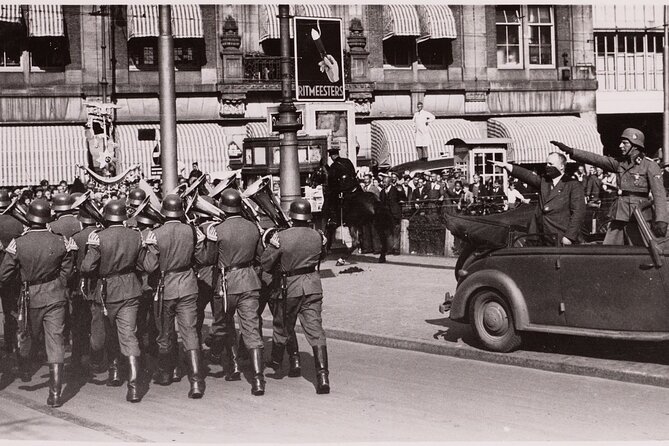
The tour centers on the Monument to Jewish Resistance area, with stops at important sites and monuments tied to the Nazi occupation of Amsterdam from 1940 to 1945. The goal is not to skim. It’s to understand the episode as part of Amsterdam’s long, complicated story—and to understand the ongoing legacy of WWII that still shapes how people remember and respond today.
This is the kind of tour where the wording matters: you’re looking at commemoration in the real world, then hearing how it connects to what happened. You’re also getting guidance on traumatic events, so the tone is serious and the pacing tends to be thoughtful.
One reason this tour gets strong marks is the way it uses the walking element to teach. You’ll visit multiple points around the monument, rather than staying stuck in one spot. The effect is that you begin to “map” the occupation onto the city: the street geometry, the feeling of being near certain locations, and how movement through neighborhoods could carry real consequences.
And you’re doing it with a guide who can answer follow-up questions. People who like history usually love that part: you aren’t forced to accept a single, polished narrative. You can ask how daily life changed, what resistance meant in practice, and how remembrance works on the ground.
Walking off the beaten path without losing the thread
A lot of WWII tours stick to the most obvious sites. This one does something different: it goes into lanes and alleyways that you’d likely miss on your own. That’s not just for atmosphere. It’s practical. Smaller streets change how you understand a city’s layout, distances, and how people moved.
You’ll also get the sense of discovery that comes from being guided. Instead of just reading plaques as you pass, you’re told what to look for and why those locations matter. The experience is designed for people who want the quieter corners of Amsterdam’s past, not just the famous postcard points.
There’s also a cultural layer. The Netherlands’ WWII memory is deeply present in public space—monuments, names, and memorial locations. This walk uses that reality, so you leave with a stronger understanding of how remembrance functions in everyday life.
Just remember the subject matter is heavy. The tour is built for learning and reflection. If you want a light stroll, this isn’t it.
What you skip on purpose: Anne Frank House, Resistance Museum, and Hollandsche Schouwburg
This tour does not include visits to:
- Anne Frank House
- the Resistance Museum
- Hollandsche Schouwburg (the deportation center)
That’s a major planning detail, so you should treat it like a decision point. If your priority is those specific stops, you may feel disappointed here unless you’ve already booked separate tickets or you’re comfortable seeing the broader occupation context elsewhere.
The upside is that you’re not dividing your time among multiple major attractions. Instead, you concentrate on the monument-centered theme and the surrounding occupation sites. You also avoid the chaos that can come with multiple ticketed venues in a short window.
Keep in mind that tickets for museums are not included, and drinks are not included. The tour itself is a walking experience, so you’re not paying for a stacked museum package.
Timing and pacing: the halfway coffee and rest stop
The full walk runs about 2.5 to 3 hours. There’s a short break halfway through for coffee and/or a restroom visit. That timing is smart. It prevents the tour from dragging into an endurance test, especially with emotionally intense content.
This break is also useful for keeping the flow. You don’t lose the storyline to a long stop at a café. You reset, then get back to the next sites while the context is still fresh.
If you’re the type who likes to process while walking, you’ll probably appreciate the pacing. It feels designed for attention and reflection, not speed.

Price and value: what $180.04 per group really buys
At $180.04 per group (up to 4), the headline price might look steep if you’re thinking per person. But you should evaluate it as private access to a guided walk with specific WWII content and a dedicated guide time window.
Here’s what’s included:
- All fees and taxes
- the tour has Admission Ticket Free listed (so you’re not adding a ticket price just to participate)
Here’s what’s not included:
- coffee and/or tea
- museum tickets for places the tour does not visit
So the value equation is pretty clean. You’re paying for:
1) a private, curated walking experience
2) guided interpretation at the Monument to Jewish Resistance and nearby significant sites
3) a guide who can tailor the pace and answer questions within your group
If you’re traveling as a duo or family of four, it becomes much easier to justify. If you’re solo, it’s more expensive per person, but private guides can still be worth it when the topic is sensitive and you want real conversation.
My practical advice: budget for the mid-walk coffee stop, even though it’s optional. It’s the one extra cost you can reasonably plan for.
Ending at the National Holocaust Names Monument
You finish at the National Holocaust Names Monument (1018 DP Amsterdam). Ending here is meaningful because names and remembrance are central to how WWII is honored in public space.
I like end points that don’t just signal the end of a tour. This one encourages a final pause. Take a minute to stand, look, and let the information you just walked through settle. Even if you’ve read a lot before coming, seeing commemorative places in person tends to make the lesson stick in a different way.
Who this WWII Amsterdam private walk suits best
This tour is a strong fit if you:
- care about WWII in Amsterdam and want occupation-era context
- prefer off-the-beaten-path walking over checklist sightseeing
- like history tours where you can ask questions
- want a private experience in a group of your choosing
It also comes with a suggested minimum age of 13. That doesn’t mean every teen will find it easy. It does mean the content is treated as serious and not geared toward small kids.
If you want a lighter, more casual sightseeing day, or if your top goal is the most famous WWII sites, you might be better pairing this with other activities—or choosing a different type of tour entirely.
Should you book this Amsterdam World War II private walking tour?
Book it if you want a focused, guided walk centered on the Monument to Jewish Resistance and the broader story of Amsterdam under Nazi occupation. This is the kind of experience that rewards attention. You get the value of private time, plus a route that takes you into streets you can’t easily find on your own.
Skip or adjust your expectations if the Anne Frank House, Resistance Museum, or Hollandsche Schouwburg are non-negotiable for you. This tour is not set up to deliver those stops. It will, however, give you a tighter occupation-focused lens that many people find more useful for understanding the city as they continue sightseeing afterward.
If your group can handle heavy history with a thoughtful tone, this is a very solid way to spend a morning in Amsterdam.
FAQ
What language is the Amsterdam WWII private walking tour offered in?
The tour is offered in English and German.
How long is the tour?
The tour lasts about 3 hours (roughly 2.5–3 hours).
Is this a private tour?
Yes. It’s a private activity restricted to your own group only (up to 4 people).
Where do we meet and where does the tour end?
You meet at Prinsengracht 263, 1016 GV Amsterdam. The tour ends at the National Holocaust Names Monument, 1018 DP Amsterdam.
What stops are not included in this tour?
The tour does not visit the Anne Frank House, the Resistance Museum, or Hollandsche Schouwburg.
Is coffee or tea included?
No. Coffee and/or tea is not included.
Is the tour admission ticket included?
The experience lists Admission Ticket Free, but museum tickets for places not included in the tour are not provided.
What is the minimum recommended age?
The tour has a suggested minimum age of 13.
What is the cancellation policy?
You can cancel for free up to 24 hours in advance for a full refund. If you cancel less than 24 hours before the start time, you won’t get a refund.