REVIEW · LEIDEN
Historical Leiden: Private Tour with Local Guide
Book on Viator →Operated by Undiscovered Holland · Bookable on Viator
Leiden has stories packed into short streets. A private walk with a local guide turns the city’s big names and old dates into a route you can actually follow, from Leiden Centraal to the hills and churches that shaped Dutch culture. You’re also given time to ask questions about daily Dutch life, not just the past.
I especially like the pace you control. You can linger at the corners that catch your eye, and the guide will shape the explanations around what you’re curious about. The other thing I really enjoy is the tight mix of landmarks tied to Rembrandt van Rijn and the city’s long academic tradition.
One consideration: it’s about 2 hours of walking at a moderate level. If you’re not comfortable with cobbles and steady walking, plan on going slower, bringing supportive shoes, and using the breaks the private format allows.
In This Review
- Key highlights you’ll feel during the walk
- Why this Leiden tour beats the usual checklist walk
- Meeting at Leiden Centraal: getting oriented in minutes
- Morspoort and the first city gate lesson
- Molen de Put: why Leiden’s windmill is more than a postcard
- Rembrandtplaats: connecting Rembrandt to the street level
- Stadsgehoorzaal on the Breestraat: a cultural stop you might enter
- Pieterskerk and the 12th-century backbone of Leiden
- The 1596 town hall: civic power in one iconic building
- Burcht van Leiden: seeing the hilltop defense from the outside
- Haarlemmerstraat: the easy landing back near the station
- Price and value: what you’re really paying for
- Who should book this Leiden walk
- Should you book Historical Leiden: Private Tour with Local Guide?
- FAQ
- How long is the private tour?
- Where does the tour start?
- Does the tour end back at the same meeting point?
- Is this a private tour?
- What’s the group size limit?
- Are admission tickets required for the stops?
- How do I get my ticket?
- What if I need to cancel?
- Can my service animal come with me?
Key highlights you’ll feel during the walk
- Private group, flexible pace so you can ask real questions and not rush through.
- Leiden Centraal start that makes it easy to orient fast.
- Rembrandt-linked stops that connect an artist to the streets he knew.
- Pieterskerk and the 1596 Stadhuis where religion and city power show up in stone.
- Burcht van Leiden hilltop exterior for a classic viewpoint without extra ticket costs.
- Stadsgehoorzaal timing where you might be able to peek inside if it’s open.
Why this Leiden tour beats the usual checklist walk
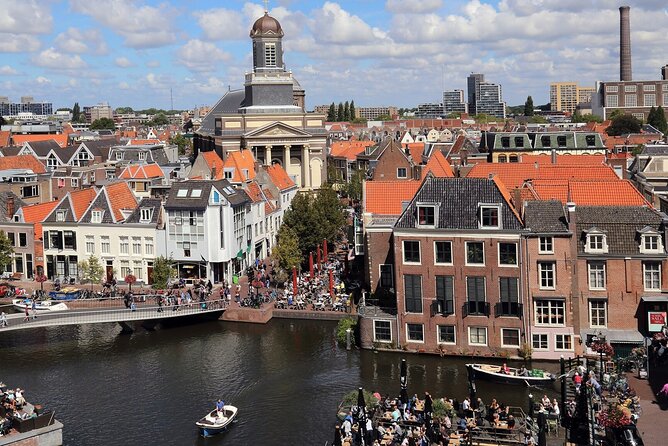
A good city tour does one thing well: it gives you a mental map. This one does that without trying to cram in every single attraction. You cover a classic core of Leiden and, at each point, your guide explains what mattered there and why it mattered.
The private format is the real advantage. You and your group decide how fast you move, and you can steer the questions toward anything that pops up along the way. That matters because Leiden isn’t only monuments. It’s a working city with people moving through daily life, and your guide can connect the past to what you still see today.
You’ll also appreciate the structure. The route flows in a natural loop starting from the main station area, then working through gates, squares, and churches before ending near shopping streets. It’s a walking plan that feels practical, not forced.
Finally, the tour is built around big themes without turning into a lecture. Expect connections between Leiden’s role in the story of the Pilgrim Father, the Dutch Golden Age, and the influence of the Netherlands’ oldest university. You’ll come away with a clearer picture of why this city mattered, beyond just the famous names.
You can also read our reviews of more tours and experiences in Leiden.



Meeting at Leiden Centraal: getting oriented in minutes
You start at Station Leiden Centraal, meeting your guide right in front of the station. It’s a smart choice because the station is easy to reach by public transport, and it gives you a clear starting point. If you’re arriving by train, you’ll already know where you are.
From the start, the tour’s tone is friendly and organized. You get moving right away rather than waiting around. That’s helpful if you’ve been traveling earlier in the day and want something that feels like it begins immediately.
Because the experience is private, your group doesn’t get mixed in with other people’s schedules. That also means if anyone needs a moment to catch their breath or check directions, you can handle it without feeling rushed.
Morspoort and the first city gate lesson
The walk begins with Morspoort, one of Leiden’s older entrances to the city. A gate might sound minor compared with churches and town halls, but your guide treats it like a clue. Gates reveal how a city controlled movement, defended itself, and managed who came in and out.
You’ll likely notice how these older entrances shape the feel of the surrounding streets. The lesson here is that the city’s layout isn’t random. Even when streets look calm today, the pattern tells you what mattered historically.
Also, because this is a guided walk, you’re not just looking at a photo spot. You’re learning how the gate fits into the larger story of Leiden’s growth and security.
Good to know: the first stop is short, around 15 minutes, so it’s more about context than a long pause for photos.
Molen de Put: why Leiden’s windmill is more than a postcard
Next up is Molen de Put, the iconic 17th-century windmill that locals use as a landmark. Windmills are common in the Netherlands, but Leiden’s version is tied to the city’s history in a specific way that your guide can explain in plain terms.
This is the kind of stop that often works better when you understand the function. Instead of treating the windmill like decor, you’ll learn what it represented for the city at the time and why it still matters as a symbol.
You’ll also get a sense of how Leiden balances old infrastructure with modern city life. That balance is one reason the walk feels grounded. You’re not traveling through a themed zone. You’re moving through a real city.
The stop is brief, around 15 minutes, which keeps the momentum going.
Rembrandtplaats: connecting Rembrandt to the street level
Then you reach Rembrandtplaats, a square named for Rembrandt van Rijn, who used to live in Leiden. This is where the tour starts turning from architecture to people and ideas.
The best part of this kind of stop is the scale. Seeing Rembrandt’s name on a square sign gives you an entry point, but the guide’s job is to make that name mean something. You’ll get the connection between the artist and the city, rather than just a quick fact.
This is also a great place to ask questions. If you’re a fan of art, you can steer toward what Leiden offered artists and how the city environment supported creative work. If art isn’t your main interest, you can shift toward the social side: who lived where, and what kinds of communities shaped the city.
You’ll spend about 15 minutes here, enough time for context and a few photos without turning the day into a long stop-and-go schedule.



Stadsgehoorzaal on the Breestraat: a cultural stop you might enter
Walking along Breestraat, you’ll pass Stadsgehoorzaal, a well-used concert hall. The nice touch: if it’s open, you can visit the inside after. Even if you don’t go in, the building still tells a story about Leiden’s cultural life.
This is where the tour helps you see Leiden as more than “old buildings.” It shows how culture lives in the present. A concert hall isn’t just a venue. It’s a reminder that cities keep building on their identity.
One practical note: whether you can actually visit inside depends on opening status at the time you’re there. Your guide can tell you what’s possible once you arrive.
This segment is also about 15 minutes on the walk, which keeps it moving.
Pieterskerk and the 12th-century backbone of Leiden
You can’t do Leiden without Pieterskerk Leiden, and this stop is treated as a key anchor. It’s described as the most famous church in Leiden, with history reaching back to the 12th century, and it’s also used today.
This is one of the best-value stops on any walking tour because it gives you a living contrast. You’ll be standing in a space tied to medieval roots, yet it’s not only a museum piece. Your guide will explain how it has continued in the life of the city.
In plain terms: you’re not only learning what it was. You’re learning what it became, and why that matters when you look at the city’s evolution.
Expect around 15 minutes here. If you love churches, you may want to linger—this is where the private format helps you not feel chained to a group.
The 1596 town hall: civic power in one iconic building
Next comes the Stadhuis van Leiden (1596), the old town hall and an iconic building you can’t miss. Town halls are always more than government offices. They’re where civic identity and local authority were displayed in stone.
Your guide will connect the building to what Leiden was becoming at the time. And even without a long interior visit, the exterior and setting give you a lot to work with: scale, design choices, and how it fits into the surrounding streets.
This is a strong stop if you want to understand the Dutch Golden Age beyond paintings and stories. The Golden Age also meant institutions, administration, and city pride.
This part of the walk is brief, about 15 minutes, so focus on what your guide is saying rather than trying to take in every architectural detail at once.
Burcht van Leiden: seeing the hilltop defense from the outside
Then you reach Burcht van Leiden, a defensive castle structure located on a hill. Here you’ll visit the exterior, and that choice is smart. The viewpoint and setting show you why defense mattered in the first place.
A hilltop site instantly changes the way you read a city. Even from the outside, you can imagine how people would watch for trouble and how the city’s shape would look from above. Your guide will help you connect that defensive purpose to Leiden’s wider story.
The stop is about 15 minutes. If weather or lighting makes photos tricky, the private pace helps you spend a little extra time without derailing the entire route.
Haarlemmerstraat: the easy landing back near the station
The walk ends near the station on Haarlemmerstraat, a popular shopping street. This is a practical finale because you’re positioned to keep moving—either back to Leiden Centraal or onward to explore more.
Ending near shopping streets also gives you a built-in “what now?” moment. If you found a snack you want, or you want to browse, you’re set up to do it right away.
It’s only about five minutes as you reach the conclusion point, and the tour ends back at the meeting area.
Price and value: what you’re really paying for
The price is $347.91 per group (up to 15) for about 2 hours. That sounds like a lot until you translate it into the group format.
Because it’s per group, the value depends on how many people are in your party. If you fill more of that up-to-15 capacity, the cost per person drops fast. If it’s just a small family or a couple, you’ll feel the price more. So I’d treat this as a “pay for control and quality” option: you’re paying to have a guide focus only on your group and tailor pacing to you.
What supports that cost is the structure: you get a Dutch guide, a set route of key sites, and the ability to ask questions about Leiden and life in the Netherlands. The tour is also set up with mobile ticketing and the stops are listed as admission ticket free, which helps avoid surprise costs.
One more small value point: the tour is typically booked around 51 days in advance on average. That doesn’t mean it’s impossible to find a slot later, but it does suggest the good times go first.
Who should book this Leiden walk
This is a great fit if you want history that you can see on foot, without feeling like you’re herding people through a museum circuit. It’s especially appealing if you care about Rembrandt’s connection to Leiden, the city’s role in the Pilgrim Father story, or the influence of the Netherlands’ oldest university.
It’s also a solid option if you like asking questions. The tour explicitly encourages you to ask about life in the Netherlands in general, not only about buildings.
You’ll want moderate physical fitness, since it’s a walking tour lasting about two hours. And if you’re traveling with a service animal, the experience allows them.
If you’re the kind of person who likes to wander on your own time, this tour can also work well. You can take what you learn and then explore further after the walk ends.
Should you book Historical Leiden: Private Tour with Local Guide?
Yes, if your goal is to leave Leiden with a clearer story than you started with. This tour gives you a tight, high-impact route through the key spots that explain how Leiden grew into a city that mattered for art, religion, civic life, and learning.
I’d especially book it if you’re visiting with people who want structure but still want flexibility. The private format and question-friendly pacing make it feel less like a schedule and more like a conversation with the city.
Book it with shoes you trust, and don’t rush yourself at the church and town hall stops. If you do that, you’ll walk away feeling like you can read Leiden’s streets with confidence.
FAQ
How long is the private tour?
It lasts about 2 hours.
Where does the tour start?
The guide meets you in front of Leiden Centraal.
Does the tour end back at the same meeting point?
Yes, it ends back at the meeting point.
Is this a private tour?
Yes. Only your group participates.
What’s the group size limit?
It’s up to 15 people per group.
Are admission tickets required for the stops?
The stops listed are described as admission ticket free.
How do I get my ticket?
You receive a mobile ticket.
What if I need to cancel?
You can cancel for free up to 24 hours before the experience starts for a full refund.
Can my service animal come with me?
Yes, service animals are allowed.