REVIEW · AMSTERDAM
Historical Walking Tour, private with local Dutch guide
Book on Viator →Operated by Artsy Tours · Bookable on Viator
Amsterdam makes sense faster with a good guide. This private historic walk is a smart first-trip move, built around Amsterdam’s medieval leftovers and the stories behind the city’s Golden Age canals—told by a local who has lived here for 25 years. I also love how it gives you a clear sense of place fast, moving from the Weeping Tower area all the way through Dam Square, the canal ring, and the Jordaan.
One consideration: this is still a 2-hour standing-and-walking experience, and there are no mobility aids available. If your legs aren’t happy with that, or if you use a walker, you’ll want to look for a more accessible option.
In This Review
- Key things that make this tour worth your time
- Start at the Schreiertoren: medieval Amsterdam, right where you land
- Zeedijk and the Waag: how Amsterdam stayed alive through water and walls
- Oostindisch Huis and the spice trade: where business history gets real
- Het Kleinste Huis: the smallest house, and why it’s more than a gimmick
- Dam Square to the canal ring: the heart of the city, then the Golden Age nerve center
- Jordaan and Westerkerk: local-feeling streets to close the circle
- How the guide style changes the whole experience
- Price and value: is $96.02 worth it for two hours?
- Practical tips before you go
- Should you book this Amsterdam historical walking tour?
- FAQ
- How long is the tour?
- Is this tour private?
- What language is the tour offered in?
- Where do I meet the guide, and where does it end?
- Are admission tickets included?
- Is bottled water included?
- Are service animals allowed?
- Is the tour suitable if I use a walker?
- What’s the cancellation rule for a full refund?
Key things that make this tour worth your time
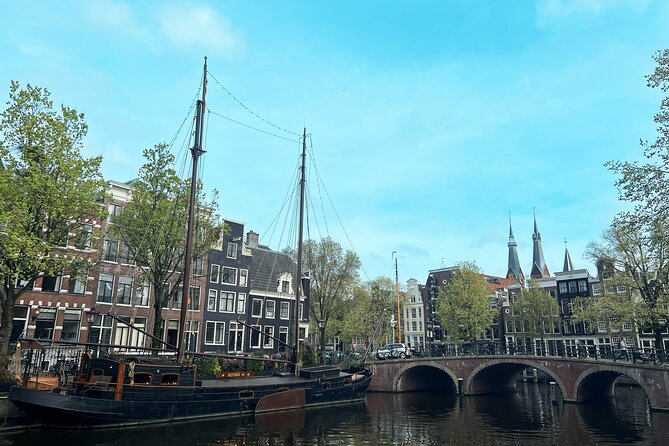
- A local guide with 25 years in Amsterdam who knows what matters day-to-day, not just what shows up in a guidebook
- A very practical route for first-timers, from medieval watchtower to Dam Square to the canal ring and Jordaan
- Free admission at every listed stop, so you’re not stuck budgeting time for tickets
- Canal Ring and Jordaan time on foot, including a long stretch through the Grachtengordel area
- A humor-and-story style that makes architecture and trade history easier to remember
- Service animals welcome, and the meeting point is close to public transport
Start at the Schreiertoren: medieval Amsterdam, right where you land
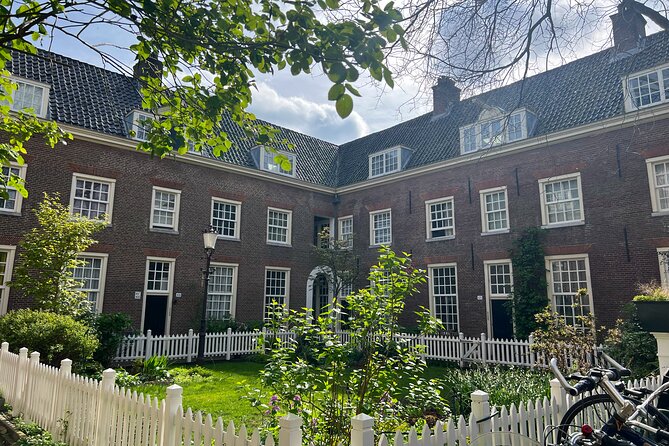
You begin at Café the Schreiertower on Prins Hendrikkade (Prins Hendrikkade 95). It’s a helpful starting spot because it puts you near the oldest layers of the city, before you get pulled into the postcard zones.
The first stop is the Weeping Tower, one of Amsterdam’s rare medieval remnants. From here, your guide sets the stage with how Amsterdam got its start and why this area mattered long before the canal belt became the iconic symbol most people come for. This opening matters because it turns later sights into a connected story—rather than a list of buildings you’ve already seen in photos.
Expect a short orientation before you move on—just enough time to understand what you’re looking at and why it’s different from the newer parts of town.
You can also read our reviews of more tours and experiences in Amsterdam.



Zeedijk and the Waag: how Amsterdam stayed alive through water and walls
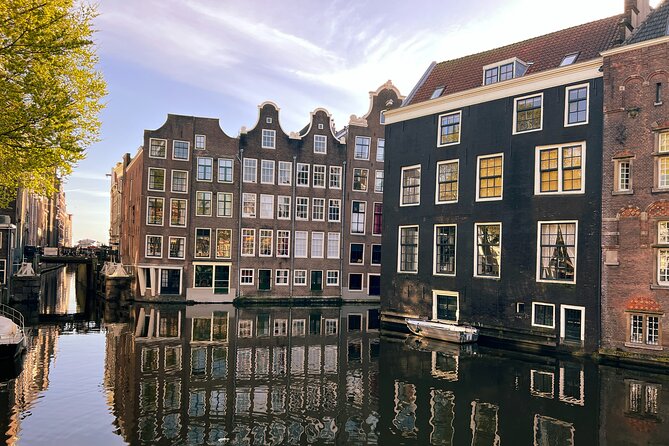
Next comes Zeedijk, one of the city’s oldest streets—and also a reminder that Amsterdam is a water-management project as much as it is a city. The key detail is that Zeedijk once functioned as a dike with locks, designed to protect the city from flooding. That single idea changes the way you read the streets: you start noticing the city as engineering, not just architecture.
From Zeedijk, you move to the Waag, the medieval city gate that used to be part of a defensive wall and a mote system. Your guide uses this kind of placement—gate, wall, water defenses—to explain how Amsterdam thought about security. It’s the sort of context that helps you understand why gates, roads, and canals line up the way they do.
Small heads-up: this stretch is short, so your best move is to listen closely while you’re walking and stop for questions when your guide pauses. The pace is designed to keep the flow, not to linger at every corner.
Oostindisch Huis and the spice trade: where business history gets real
The Oostindisch Huis is where the tour shifts from medieval city survival to global commerce. This building served as the former office and warehouse of the Dutch East India Company, founded in 1602.
The most practical value here is what your guide connects: spice trade history and the invention of the modern corporation and stock market. That’s a big claim, but it’s exactly the kind of connection that helps Amsterdam history feel relevant, even if you’re not a finance person. You’ll leave with a clearer sense of how trade routes translated into power, wealth, and the buildings that still shape the city center.
If you like history that links to real-world systems—trade, money, institutions—this stop tends to be a highlight.
Het Kleinste Huis: the smallest house, and why it’s more than a gimmick
You’ll then visit Het Kleinste Huis van Amsterdam, the smallest house in the city. It’s an easy stop to dismiss if you think it’s only a quirky photo moment, but the point is broader: it stood next to a gate decorated with Amsterdam’s famous crest and other symbolic decorations.
Your guide uses that crest and symbolism to show how cities advertised identity. In other words, you’re looking at civic branding before the term existed. Even in a small structure, you can see how Amsterdam wanted to present itself—proud, coded, and carefully designed.
This is a quick moment, so again: take it in as a theme rather than trying to absorb every detail at once.
Dam Square to the canal ring: the heart of the city, then the Golden Age nerve center
Dam Square is your next anchor, the old market square that’s still the city’s heartbeat. Today it’s known for the Royal Palace and the national Second World War monument. This is a good place to pause because it forces the tour to balance everyday life, power, and remembrance in one open space.
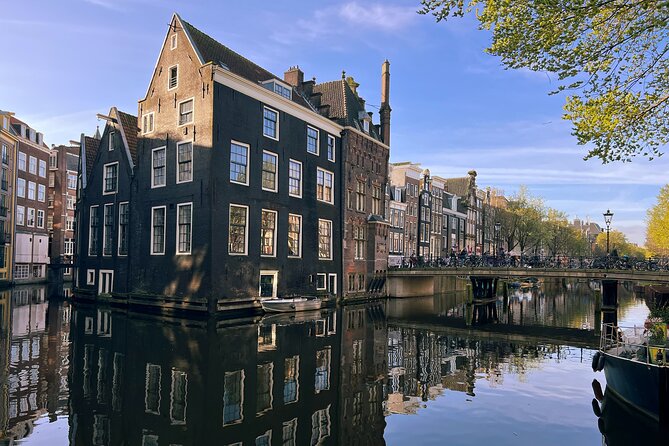
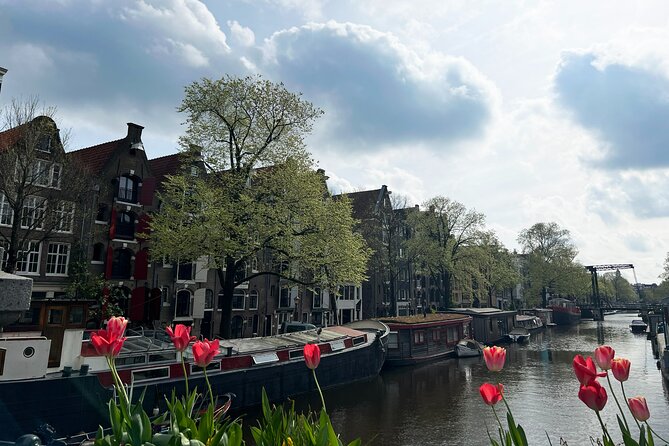
Then you head into the Canal Ring area (Grachtengordel), where you spend the most time on foot—about 30 minutes. This section is built for the wealthy merchants of the Golden Age, and you’ll spot fine canal houses in northern baroque style along with a variety of houseboats. The canals here aren’t just scenery; they’re the physical footprint of money, status, and city planning at its height.
Practical tip: canal streets and crossings involve bikes and pedestrians sharing tight space. Keep your eyes up, walk at a steady pace, and let your guide lead you across the most sensible routes.
If your goal is to leave Amsterdam with a mental map of how the city is organized around canals, this is the part that really clicks.





Jordaan and Westerkerk: local-feeling streets to close the circle
After the canal ring, the route turns toward the Jordaan, a popular and charming neighborhood known for picturesque streets, traditional brown cafes, and unique boutiques. Your guide’s storytelling here tends to slow down the mind. Instead of only explaining old structures, you get a sense of how the city actually feels on a human scale—street corners, neighborhood character, and what people likely notice while walking their own daily routes.
The final stop is Westerkerk, a Dutch Protestant church known for its stylish design and iconic spire. It’s the kind of landmark locals love, which is exactly what you want at the end of a first walking tour: something you can easily find again later.
Your tour finishes near the Anne Frank House and Westerkerk church (Prinsengracht 279, 1016 DL). That ending location is handy because it gives you options right away—either continue exploring nearby streets or use the area as your starting point for a museum day.
How the guide style changes the whole experience
A big reason this tour gets high praise is the way it stays personal. Guides on this route are described as confident, easy to communicate with in English, and willing to adjust to your interests.
I especially like the idea of a guide who can answer questions on the fly, not just recite facts from a script. Reviews also highlight dry wit, humor, and a strong ability to connect with different personalities in the group. That kind of guide energy matters in Amsterdam because the city is dense—good timing and good explanations keep you from getting overwhelmed.
There’s also a practical human touch: the guide may make time for snacks and small breaks along the way. That’s not just comfort—it helps you remember what you saw right before the pause.
Price and value: is $96.02 worth it for two hours?
At $96.02 per person, this tour sits in the mid-to-upper range for a walking experience. The value comes from what’s included and how the time is used.
You get:
- Private touring with only your group
- All fees and taxes included
- Free admission at each listed stop
- A mobile ticket (so you’re not scrambling for paperwork)
- English service
That free-admission angle is more meaningful than it sounds. When entry costs and time windows pop up at key sites, walking tours can lose their momentum. Here, the structure is set so you spend your energy on learning and looking, not on ticket logistics.
One more value point: the route is designed to help first-time visitors get their bearings. If you’re only in central Amsterdam briefly, spending your first day learning what connects the medieval watchtower, the defensive gates, the trade warehouses, and the canal ring can save you hours later.
If you want to see Amsterdam in a way that feels organized, $96.02 can make sense.
Practical tips before you go
This is a walking tour, even though each stop is brief. Wear shoes you’re comfortable in for city sidewalks and short crossings.
Bring or plan for water: bottled water isn’t included. Also, if you get cold easily, consider layers—Amsterdam weather can shift quickly.
Accessibility is the main caution. The tour isn’t recommended for people who have trouble walking and standing for the full two hours, and mobility aids aren’t available. It also isn’t recommended for participants who use a walker. If that’s your situation, ask before booking or consider a different format.
Good news on transport: the tour is near public transportation, so it’s easy to reach the start point without a long commute across town.
Should you book this Amsterdam historical walking tour?
Book it if you want a first-time-friendly Amsterdam orientation that still feels specific and story-driven, not generic. The route covers the medieval core, the water-and-defense logic, the Dutch East India Company era, the canal ring, and the Jordaan neighborhood feel—all in about two hours.
Skip it if you need a low-movement experience or if you rely on mobility aids you can’t get support for. Also, if you already know Amsterdam deeply and want museum-level time, this may feel short because it’s built as a walking primer.
FAQ
How long is the tour?
It runs for about 2 hours.
Is this tour private?
Yes. It’s a private tour/activity, and only your group participates.
What language is the tour offered in?
The tour is offered in English.
Where do I meet the guide, and where does it end?
You meet at Café the Schreiertower, Prins Hendrikkade 95, 1012 AE Amsterdam. The tour ends near Westerkerk at Prinsengracht 279, 1016 DL Amsterdam, close to the Anne Frank House area.
Are admission tickets included?
Yes. Admission tickets are listed as free at each of the tour’s listed stops.
Is bottled water included?
No. Bottled water isn’t included.
Are service animals allowed?
Yes. Service animals are allowed.
Is the tour suitable if I use a walker?
It isn’t recommended for participants who use a walker, and mobility aids aren’t available.
What’s the cancellation rule for a full refund?
You can cancel for a full refund up to 24 hours before the experience starts. Canceling within 24 hours won’t be refunded.