Jewish Amsterdam hits different when it is quiet. This private, small-group walk threads Jewish life and the dark history of WWII through real streets, real buildings, and stops you might otherwise miss. It is designed to be crowd-free and paced for a group of up to 4, with pickup offered if you need it.
What I like most is how the tour moves between everyday culture and hard history without letting either one feel like an afterthought. You’ll get a clear sequence of memorials, then shift to lived-in places like the Portuguese Synagogue and other landmarks tied to Amsterdam’s Jewish community.
One thing to consider: several of the most meaningful museum interiors rely on tickets you handle separately, and two major Holocaust-related buildings are under construction (so you’ll focus on story, context, and exterior views). Also, the Anne Frank House visit is optional and not automatically included.
In This Review
- Key Points You’ll Care About
- A Jewish Quarter Walk That Starts With Names, Not Facts
- Holocaust Namenmonument and the Auschwitz Monument: Learning the Scene
- Hollandsche Schouwburg: The Stop That Explains When You Can’t Go Inside
- Jewish Historical Museum and the Portuguese Synagogue (Snoge/Esnoga)
- Dockworker Statue and the Story of Resistance
- Spinoza in Stone and Brick: Catholic Church and Monument Stops
- Diamonds at GASSAN, Then Uilenburger Synagogue (Ro c o c o c k Style)
- Huis de Pinto and the Rembrandt Link You Might Miss
- Waterlooplein Market, Deaf Memorial, and the Spreading of Remembrance
- Ending Near Anne Frank House: Optional, Not Automatically Included
- Price and Value: Paying for a Small Group and a Coherent Route
- Who This Tour Fits Best
- Should You Book This Jewish Amsterdam Private Walking Tour?
- FAQ
- Is Anne Frank House included in the tour?
- Does the tour include museum and synagogue entry fees?
- What happens at Hollandsche Schouwburg if the museums are under construction?
- How long is the tour, and will there be breaks?
- How many people are in a group?
- Where do the tour start and end?
Key Points You’ll Care About
- Small group (max 4) keeps questions easy and the pace humane
- WWII story arc starts at the Holocaust Namenmonument and keeps going through resistance and memorials
- Construction affects museum interiors at Hollandsche Schouwburg, but the guide still gives the background
- Synagogues are time-and-ticket dependent (Portuguese Synagogue and the Jewish Historical Museum have ticket needs)
- Anne Frank House is optional and needs a ticket plan you confirm ahead
- Spinoza and Jewish Amsterdam connect the dots in a way many history walks skip
A Jewish Quarter Walk That Starts With Names, Not Facts
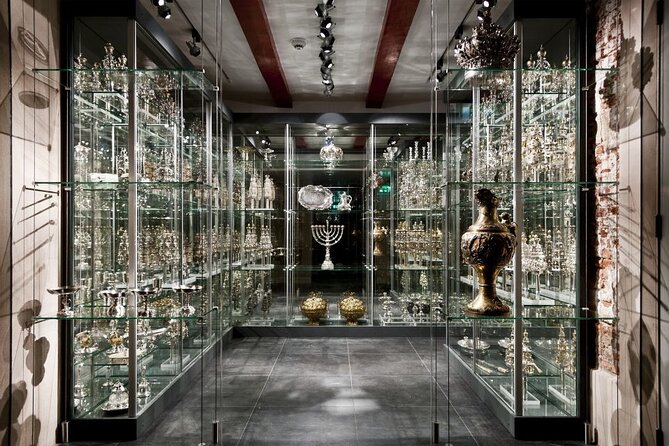
This tour has a strong emotional logic. It begins with a memorial built around names and loss, then follows the physical traces of Jewish Amsterdam through the centuries. That matters because Amsterdam’s Jewish story is not just one chapter. It is Sephardic and Ashkenazi communities, merchant families, artists, protests, and resistance—plus the brutal rupture of Nazi occupation.
The private setup changes the whole feel. With only a handful of people, you can ask why a monument is shaped a certain way, or why one building became a turning point. If you want to go slower, this kind of format makes it easier to build in pauses.
Timing is also realistic. Expect about 3.5 hours of walking. That is enough time to cover a meaningful stretch of central Amsterdam, but not so long that you feel like you are marching from stop to stop. Just plan for a decent walking day.
You can also read our reviews of more tours and experiences in Amsterdam.

Holocaust Namenmonument and the Auschwitz Monument: Learning the Scene
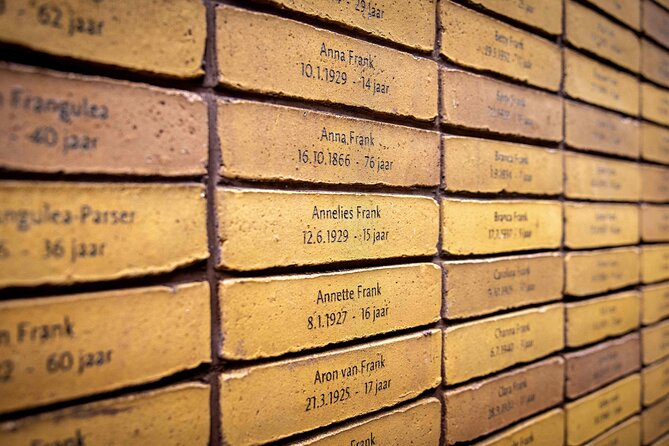
The route kicks off at the Holocaust Namenmonument. This memorial bears the names of 102,000 people who died in Nazi camps of death and were not given a proper burial. It is only a short stop, but it sets a tone: you are not just reading about history—you are confronting the human scale.
Next comes the Auschwitz Monument, marked by broken glass and honoring approximately a million victims of Auschwitz. The broken-glass element matters. It’s a visual reminder that Nazi violence was not only about death; it was also about shattering identity, families, and normal life.
A practical note: these stops are about reflection more than museum browsing. If you tend to do better with quiet, take a breath before you move on. And if you want context, this is a good time to ask your guide a question about how these memorials fit into Amsterdam’s broader remembrance culture.
Hollandsche Schouwburg: The Stop That Explains When You Can’t Go Inside
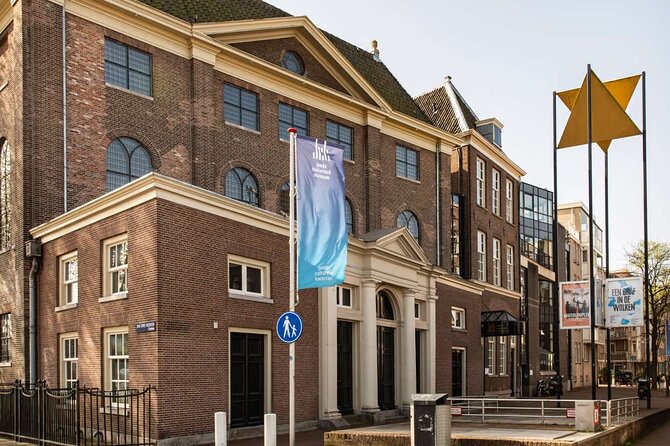
Hollandsche Schouwburg (the Dutch Theater area and related Holocaust Memorial buildings) is a powerful exterior stop, even when interiors are not accessible. Right now, the buildings are under construction until 2024, and that means you cannot count on visiting the museums inside.
So what do you do? You focus on what the guide brings: history, meaning, and background tied directly to why these buildings matter. Since you cannot see inside, you’ll want the explanation. Having the guide show photos from their own collection is part of how this stop stays worthwhile even with construction.
This is also a good moment to manage expectations. If you are hoping for museum galleries, this particular stop will feel more like an interpretive walk-by. Still, it can be meaningful because it connects suffering, disaster, and genocide to specific Amsterdam realities—and also to the courage and selflessness shown by people caught in that machinery of persecution.
Jewish Historical Museum and the Portuguese Synagogue (Snoge/Esnoga)
From the WWII memorial trail, the tour shifts toward Jewish life—past and present—through synagogue-based history.
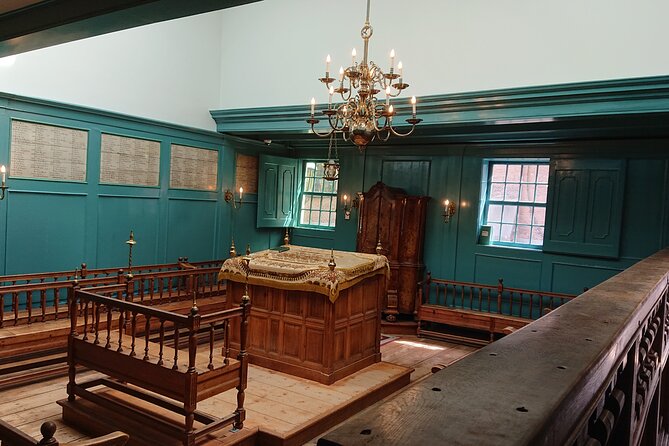
The Jewish Historical Museum (including a children’s museum) is housed in a group of four historical Ashkenazi synagogues. That setup alone is a clue to what makes this stop different: you’re not just viewing objects in one room, you’re in a building cluster tied to how a community worshipped and lived.
Then you move to the Portuguese Synagogue—also called Snoge / Esnoga—from 1675. It’s one of the oldest Sephardic synagogues still in use in Europe, with a famous comparison to the Great Synagogue in Prague. This is the kind of stop where the building itself carries weight. Even if you’re outside, the guide’s framing helps you understand what “still in use” really means in terms of continuity.
Ticket budgeting matters here. The provided tour information flags that admission for these museum/synagogue interiors is not included. That means you should treat these as ticket-dependent stops. If you care deeply about seeing inside, consider aligning your day so you’re not rushed for entry times.
Dockworker Statue and the Story of Resistance
Amsterdam remembers more than just victims. A key stop here is Dokwerker, a statue honoring dockworkers who protested Nazi anti-Semitic policies and the first deportations of Jews to the concentration camp at Mauthausen on February 24, 1941.
This stop gives you something the earlier memorial stops may not: a thread of resistance right in the urban fabric. It also prevents the story from becoming one-note. You’re still learning about brutality, but you’re also seeing that people reacted, argued, and tried to stop what was happening.
If you want to get the most out of it, ask your guide to explain the chain of events that made dockworkers’ actions matter. You’ll probably walk away with a clearer sense of how occupation-era policies played out in ordinary workplaces.



Spinoza in Stone and Brick: Catholic Church and Monument Stops
One of the more interesting elements of the route is how it ties Amsterdam’s Jewish story to philosopher Baruch Spinoza—and it does it in two different ways.
First, you’ll pass a 19th-century Catholic church that was once the residence of Spinoza and his family. That kind of building shift is exactly why walking tours can work better than a museum visit: you see how identities and spaces overlap over time.
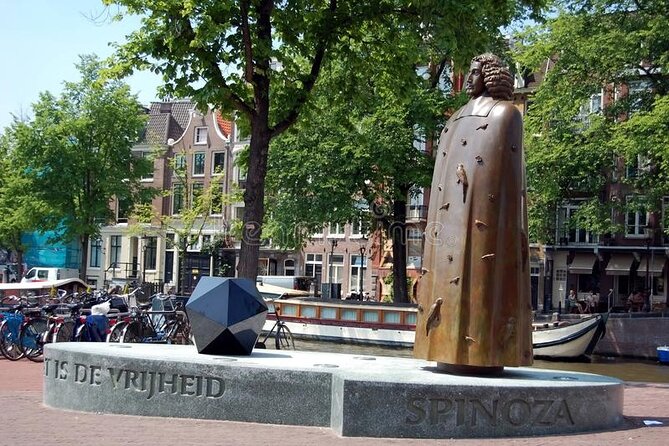
Second, you stop at the Spinoza Monument. It highlights him as an Amsterdammer from a prominent Portuguese Jewish family and links him to his role in European philosophy. The tour frames him as a forerunner of pantheism and also points out that he was relatively unknown in his own time—but influential later.
If you’re the type who loves a good intellectual detour, this part of the walk can be a welcome change of pace. It helps you remember that Jewish Amsterdam wasn’t only about conflict. It was also about thinkers, ideas, and networks.
Diamonds at GASSAN, Then Uilenburger Synagogue (Ro c o c o c k Style)
In the middle of a history-heavy day, you get a practical cultural stop: GASSAN, a museum/workshop/store tied to the diamond family company. The entry is free, and the information says you can join free tours with a local company guide for about 20 minutes.
You should not expect this to replace museum learning. Think of it as a window into Amsterdam’s craftsmanship and commercial heritage—and a reminder that Jewish families were part of the city’s wider economy and skills, not only its persecution story.
Then you head to Uilenburgersjoel, a historic synagogue monument built in rococo style in 1766 for Ashkenazi Jews. Even when the architecture is the headline, the guide’s job is to connect design choices to community identity and to explain the significance of having these houses of worship in a lived city.
If your brain starts to feel overloaded from the WWII memorials, this section provides a different kind of clarity: beauty, style, and the evidence that a community built lasting places.
Huis de Pinto and the Rembrandt Link You Might Miss
A quiet but meaningful stop is Huis De Pinto, built in 1603, once belonging to the wealthy Jewish merchant Isaac de Pinto. This is a great place to reset your thinking. You’re not only learning about Holocaust history; you are also seeing how prosperity, trade, and social status played roles in Jewish life in Amsterdam.
Next is Rembrandt House Museum. The tour data indicates admission is not included, but the stop matters because Rembrandt’s life and work were connected to Amsterdam’s Jewish community in the 17th century. Even if you only see the exterior and get the background explanation, it’s useful. It anchors Jewish history in the same time period as one of the city’s best-known artists.
If you want the full Rembrandt experience, you might consider adding an extra ticketed visit on another day. Otherwise, treat this stop as a narrative bridge—one that shows the city’s cultural ecosystem, not just its war memories.
Waterlooplein Market, Deaf Memorial, and the Spreading of Remembrance
The tour also includes Waterlooplein Market, described as the oldest flea market in Amsterdam (and in the Netherlands) until WWII, and a center of social life for more than 150 years. Even as you walk past it, the guide can help you visualize how markets anchored daily routines—before the occupation fractured normal life.
Then you visit the Deaf Memorial, in memory of Jewish deaf victims of the Nazi regime from 1940 to 1945. A lot of Holocaust remembrance focuses on broad categories, so a memorial like this makes the details matter. It also honors people often left out of mainstream narratives.
Finally, you reach Monument vor Joods verzet, built to remember Jewish resistance fighters who died in World War II. Combined with Dokwerker, it gives you a fuller view of how resistance took multiple forms and how remembrance can spread across different kinds of public spaces.
Ending Near Anne Frank House: Optional, Not Automatically Included
The tour ends near Anne Frank House at Westermarkt 20 (building beside Western Church at Prinsengracht). But here is the key point: the Anne Frank House visit is not included. The tour information makes it clear the admission is not included, and your guide can assist regarding availability and tickets, but they cannot obtain the ticket personally.
That nuance is important because Anne Frank House is a high-demand museum. The practical play is to plan for your entry time rather than assuming the tour will automatically handle everything.
The guide assistance can vary by situation. In one account, the guide helped purchase Anne Frank House tickets and met the group outside after the visit. In another situation, the outcome was different and the ticket didn’t get delivered as expected. That difference is exactly why you should confirm your Anne Frank House ticket plan before you start the walk—especially if you are traveling with limited flexibility.
If Anne Frank House is a top priority for you, consider treating this tour as the prelude. Do the walking portion first for context, then use your Anne Frank House entry slot as the emotional climax.
Price and Value: Paying for a Small Group and a Coherent Route
The price is $540.69 per group (up to 4) for about 3 hours 30 minutes, with pickup offered. That can sound steep until you translate it into what you actually buy.
You’re not paying for lots of separate admissions bundled into the price. You’re paying for guide time, a curated route across major Jewish landmarks, and the advantage of a private, crowd-free pace. When you only share the walk with up to four people, the guide can adjust pace and answer questions without the usual group herding.
Value also depends on your ticket plan. Several stops involve free exterior viewing, while museum/synagogue interiors like the Jewish Historical Museum and Portuguese Synagogue, plus Rembrandt House Museum, have admission not included. If you want to add those interiors, you should budget separately.
If you are traveling solo, this price per person can feel like a lot. If you are traveling as a family or small group who can share the cost, it can be a strong deal—especially if you care about a guided interpretation rather than a self-guided route.
Who This Tour Fits Best
This is a strong fit for you if:
- You want a private Jewish Quarter walk with less foot-traffic pressure
- You care about WWII context but also want stops connected to culture, philosophy, and daily life
- You like asking questions and want more back-and-forth than a big-group tour allows
It may be less ideal if:
- You need guaranteed museum interior access at Hollandsche Schouwburg due to construction
- You want everything included in one fixed ticket price
- You have very limited mobility and cannot comfortably do at least 3.5 hours of walking (the pace can be adjusted and breaks added by agreement, but it is still a walking-focused tour)
If you’re unsure, pick your priorities. If Anne Frank House is your must-see, plan tickets and use the walk to set the historical context first.
Should You Book This Jewish Amsterdam Private Walking Tour?
I’d book it if you want a coherent, story-driven route through Jewish Amsterdam—starting with memorials, then moving into synagogues, named places tied to Spinoza and merchant life, and ending near Anne Frank House for optional follow-up. The small group size and the crowd-free format make it feel more personal and less rushed.
Just go in with two clear expectations. First, some interiors need separate tickets and Hollandsche Schouwburg is under construction. Second, the Anne Frank House visit is optional and requires your own ticket plan even if the guide helps with guidance.
If those points fit your style, you’ll likely find this one of the more thoughtful ways to see the Jewish Quarter without turning it into a checklist.
FAQ
Is Anne Frank House included in the tour?
No. Anne Frank House museum entry is not included. The guide can assist with ticket availability and help with information, but tickets are not automatically included in the tour price.
Does the tour include museum and synagogue entry fees?
Not consistently. Several stops have free admission (especially exterior memorials), while others specify admission tickets are not included, including stops like the Jewish Historical Museum/Portuguese Synagogue group and Rembrandt House Museum.
What happens at Hollandsche Schouwburg if the museums are under construction?
The Hollandsche Schouwburg-related buildings are under construction until 2024, and interior visits are not possible. The stop is still part of the tour, and the guide provides the history and meaning, including via personal photo materials.
How long is the tour, and will there be breaks?
The duration is about 3 hours 30 minutes. The tour can adjust the walking speed and can include more frequent breaks if you agree with the guide, but it still involves a solid walking time.
How many people are in a group?
The tour has a maximum of 4 travelers, which keeps it private and makes it easier to ask questions and adjust pace.
Where do the tour start and end?
It starts at Passenger Terminal Amsterdam Piet Heinkade 27, 1019 BR Amsterdam, and it ends at Anne Frank House area near Westermarkt 20, 1016 GV (beside the Western Church at Prinsengracht).