REVIEW · THE HAGUE
Get the best out of Delft by creating memories during our private walking tour!
Book on Viator →Operated by Explore Delft · Bookable on Viator
Delft feels like a postcard until you walk it. This private tour is a smart way to turn Delft’s big-name sights—like the Nieuwe Kerk and the Old Church—into real, memorable moments, with a guide who keeps the pace human. I especially like the private feel and the chance to pause for complimentary coffee or tea while you learn how Dutch culture shaped daily life. One thing to consider: church and museum entry is generally on you, so you’ll want to plan for a little extra spending if you add indoor visits.
You’ll cover the core of Delft on foot in about 2 hours 30 minutes, with stops that connect famous figures to the streets you’re standing on. I also like that the route mixes landmark architecture (orange family monuments and civic buildings) with quieter spots like hofjes—those tucked-away courtyards that feel like time travel. The tour runs in English, uses a mobile ticket, and is set up for a single private group.
The only real drawback is the weather requirement. This experience depends on good weather, and if conditions aren’t right you’ll be offered a different date or a full refund. If you’re the umbrella type, you’ll be fine; if not, bring a plan B mindset.
In This Review
- Key points to know before you go
- Private in Delft: coffee, pace, and a guide you can actually talk to
- Nieuwe Kerk: William of Orange’s mausoleum and stained-glass calm
- Vermeer Centrum Delft: where the painter worked, not just his paintings
- Museum Prinsenhof Delft and the Orange statue in the courtyard
- Markt square: Delft Blue craft, medieval trading buildings, and a good place to slow down
- Hofje van Pauw and courtyard-to-courtyard Delft quiet
- Old Church and Leijnging Jan: the oldest church plus Vermeer’s final page
- Stadhuis Delft (neo-Renaissance) and Het Steen’s prison-story edge
- A cozy terrace square and a pause that feels earned
- Oostpoort photo spot: Delft’s last city gate
- Klaeuwshofje: the courtyard oasis behind the gate
- Price and what you’re really paying for (and what you’re not)
- Timing, pace, and logistics that affect your day
- Who this tour fits best
- Should you book this private Delft walking tour?
- FAQ
- Is this tour private or shared?
- How long is the Delft private walking tour?
- What language is the tour offered in?
- What’s included in the price?
- Are church and museum entrances included?
- Where does the tour start and end?
- Is there a weather requirement?
Key points to know before you go
- A private walking tour so you can ask questions and move at your group’s pace
- Coffee or tea included, a small perk that makes the walk feel easy
- Vermeer + William of Orange framing, with sights tied to real locations in Delft
- Markt square focus, including Delft Blue production spots and historic trading-area buildings
- Hofjes and gates, like Hofje van Pauw, Klaeuwshofje, and Oostpoort for quiet moments and photos
Private in Delft: coffee, pace, and a guide you can actually talk to
A private tour changes the whole mood. Instead of rushing with a crowd, you get a real conversation style of sightseeing. The guide can slow down when you want more detail, or speed up when you’re mainly hunting great photos and street atmosphere.
One of the nicest touches is the complimentary coffee or tea. It’s not a huge “event,” but it matters. After a couple of hours of walking in Dutch weather, it’s a quick reset that keeps energy up.
From the feedback I’ve seen, strong guides make this tour work—people mention guides like Niels, praised as the best among a long string of European tours for being accommodating and spot-on with details. Another name that came up is Yvette, with comments highlighting warmth, friendliness, and that Delft felt like more than buildings. That’s what you’re really buying: a human who helps you read the city.
You can also read our reviews of more tours and experiences in The Hague.


Nieuwe Kerk: William of Orange’s mausoleum and stained-glass calm
You start at the Nieuwe Kerk area on Markt, which is a smart launch point because it sets the tone: Delft is about more than art. It’s also about state power and family legacies.
At the Nieuwe Kerk, you’ll see where William of Orange is connected to Delft through the mausoleum, plus the royal family crypt. The church has been renovated recently and now looks wonderfully cared for. Even if you don’t go inside for a formal guided church visit, it’s worth taking time to notice the stained glass windows—that’s where the place really starts to glow.
A practical note: a guided tour of the church is available on request, but admission isn’t included. So you’ll want to decide ahead of time if you want only the exterior and orientation, or if you’re willing to pay for deeper indoor time.
Vermeer Centrum Delft: where the painter worked, not just his paintings
Johannes Vermeer is Delft’s celebrity artist, but the best way to understand him is to see the city context. This stop is short—about ten minutes—but it’s placed for maximum meaning: you’ll walk through Delft’s atmospheric center and visit places associated with where Vermeer lived and worked.
Because the time is limited, think of this segment as a compass. You’ll come away with a sense of which lanes and corners connect to Vermeer’s world, and that helps you later when you wander on your own. If you try to see everything independently on day one, Vermeer can feel like trivia. With this approach, he feels grounded.
Museum Prinsenhof Delft and the Orange statue in the courtyard
Next up is the Prinsenhof area. You don’t need to treat it like a museum sprint; the tour uses the building’s courtyard setting to tell a story. You’ll walk along the Prinsenhof and see the statue of William of Orange in the courtyard.
This stop is brief—around ten minutes—but it works because it ties the city’s biggest political figure to an actual place you can point at. If you like history that sticks, the guide’s framing here helps you remember what you’re seeing.
Again, admission to any indoor museum time isn’t included, so you’re mostly there for orientation and exterior context.
Markt square: Delft Blue craft, medieval trading buildings, and a good place to slow down
Markt is the heart of Delft. It’s lively, photogenic, and historically important, so it makes sense as a mid-tour anchor.
This is also where you get a Delft Blue angle. The tour points out how Delft Blue is made and where you might see the master painter at work. Even if you only catch a quick moment, you’ll leave understanding that Delft Blue isn’t just a style on souvenirs—it’s tied to local production and craft traditions.
You’ll also recognize the medieval trading center buildings around here, including things like the weigh house, the butter house, the meat hall, and fish banks. Those names sound quaint, but they tell you how money and food moved through town. Delft’s canals and warehouses make more sense when you see the trading geography.
Markt itself is a welcome break because admission isn’t required for the tour stops there. You can relax your brain a bit and just watch city life.





Hofje van Pauw and courtyard-to-courtyard Delft quiet
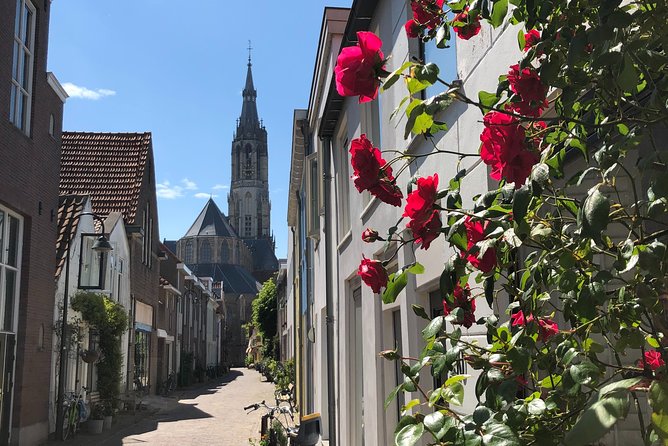
If Markt is your downtown stage, the hofjes are where Delft whispers. The tour takes you via the courtyard of Grace to the Horse Market and then into the courtyard of Pauw.
Hofjes are those tucked-away housing courtyards—often calm, sometimes surprising, and almost always photogenic. You’re walking into spaces that feel like a pause button, even though Delft is active outside the gates.
This stop runs about fifteen minutes. It’s long enough to notice the layout and atmosphere, but short enough that you won’t feel stuck. If you like architecture details, you’ll enjoy paying attention to gates, walls, and how light falls inside the courtyards.
Old Church and Leijnging Jan: the oldest church plus Vermeer’s final page
Then you head to the Old Church, dated to the 13th century, which makes it the oldest church in Delft. The nickname Leaning Jan (for the leaning tower) is instantly memorable. It’s one of those features you can spot and never unsee.
This stop is also special because it connects Delft’s famous people to the city in a very direct way. You’ll learn about burials here, including Johannes Vermeer, Piet Hein, and Anthonie van Leeuwenhoek. That trio makes the church feel like a crossroads between art, exploration, and science.
As with other church moments: a guided tour is available on request, but admission isn’t included. Plan your expectations. If you’re mainly there for the outdoor exterior experience plus guided orientation, you’ll still get plenty. If you want a longer indoor look, budget for tickets.
This stop is the longest of the non-Markt segments—around thirty minutes—so it gives you time to actually absorb the scale and atmosphere instead of just passing through.
Stadhuis Delft (neo-Renaissance) and Het Steen’s prison-story edge
From the Old Church area, the tour continues to the Stadhuis Delft, the town hall opposite the Nieuwe Kerk. It’s a beautiful building in neo-Renaissance style, and you’ll get a quick explanation of why it looks the way it does—plus an important connection to the mausoleum work.
The town hall was renovated by Hendrick de Keyser, who also worked on the mausoleum of William of Orange. The guide may try to take a look at the entrance hall where you can still see how earlier judiciary took place.
If you like the darker side of history, this is where it gets interesting. The oldest tower in Delft, Het Steen, is also located here. Het Steen served as a prison, and the murderer of William of Orange was locked up here. Even if you don’t love heavy stories, this gives you context for why Delft’s civic buildings aren’t just pretty—they’re power made physical.
Entrance to specific areas inside can vary, but the tour frames what you can see from the outside and what to look for.
A cozy terrace square and a pause that feels earned
Midway through, there’s time for a cozy square with many terraces where you can relax. This is a small segment, but it’s a useful one. After churches, towers, and courtyard details, it’s good to drop your shoulders and let Delft’s street life land.
If you’re choosing what to buy along the route, this is a nice moment to do it—snack, drink, or just people-watch. Delft rewards calm observation.
Oostpoort photo spot: Delft’s last city gate
Next comes the Oostpoort, the only remaining city gate of Delft. It’s short—about ten minutes—but it’s ideal for photos because it looks like a real threshold between old city defenses and later growth.
This gate is the kind of stop that gives you a “how did people protect this place?” feeling. You don’t need a long lecture. The structure tells enough once your guide points out what makes it special.
Klaeuwshofje: the courtyard oasis behind the gate
Finally, you’ll reach Klaeuwshofje (also called Hof van Klaeuw). It was founded by the owners of the brewery de Klaeuw back in 1605.
The houses inside were inhabited by unmarried Roman Catholic women. That detail matters because it shows how Delft’s social systems shaped everyday life—not just politics and art. The courtyard itself is described as an oasis of peace, and it really is the kind of place you don’t notice unless someone brings you there. The gate is the whole point: the best parts often live out of sight.
This stop is about ten minutes, and it ends up feeling like a perfect final note: quiet, reflective, and a little surprising.
Price and what you’re really paying for (and what you’re not)
At $162.21 per person for about 2 hours 30 minutes, the value depends on how you like to travel.
If you enjoy structure—knowing where to go, what to look at, and how to connect the dots—this price starts to make sense quickly. You’re paying for a private guide, a guided walking flow, and included extras like coffee or tea and covered fees and taxes.
What’s not included is the part that can add up if you want everything indoors. Entrance to churches and museums isn’t included. You may also have the option for guided tours inside certain churches on request, but admission is still not included.
One more practical point: the tour requires good weather. If rain hits, plans can change. You won’t feel trapped either way, since you’d be offered a different date or a full refund if canceled due to weather.
Timing, pace, and logistics that affect your day
The tour ends back at the meeting point, which is convenient. It starts at Nieuwe Kerk, Markt 80, Delft (so you’re right in the city center the whole time). That location also helps if you’re combining this day with independent wandering.
You should expect plenty of walking, but it’s positioned as a “main attractions” loop rather than a grinding hike. Most people can participate, and service animals are allowed. The meeting point is also near public transportation, which is useful if your train/bus timing doesn’t match your ideal walking schedule.
The tour is offered in English, and you’ll receive a confirmation at booking. It’s also set up with a mobile ticket.
Who this tour fits best
This private Delft walking tour is a great match if:
- You want a guided path through Delft’s key sites without spending the day figuring it out yourself
- You care about the link between art, politics, and everyday spaces (Vermeer and William of Orange both show up in a street-level way)
- You like variety: big monuments, historic squares, and quiet hofjes
- You appreciate a guide who can adapt, since it’s private
If you’re the kind of traveler who loves to wander with no plan, you might find some parts feel scheduled. But if you want the city to click in your head faster, this route helps.
Should you book this private Delft walking tour?
I’d book it if you want Delft to feel personal instead of like a checklist. The private format plus the included coffee/tea make it feel more like a day with a great local guide than a timed sightseeing product. The route hits the right mix: Nieuwe Kerk, Vermeer-linked streets, the Markt, the Old Church with its leaning tower, civic buildings with Het Steen, and the quiet hofjes like Klaeuwshofje.
I’d think twice if you’re hoping for a full museum-champion day with most indoor ticketing included, because entrances aren’t part of the price. Still, even with that caveat, you’ll get strong orientation and memorable context that helps you enjoy Delft long after the tour ends.
FAQ
Is this tour private or shared?
This is a private walking tour. Only your group participates.
How long is the Delft private walking tour?
The duration is about 2 hours 30 minutes.
What language is the tour offered in?
The tour is offered in English.
What’s included in the price?
The tour includes all fees and taxes, plus a complimentary coffee or tea during the tour.
Are church and museum entrances included?
No. Entrance to churches and museums is not included.
Where does the tour start and end?
It starts at Nieuwe Kerk, Markt 80, 2611 GX Delft, Netherlands, and ends back at the same meeting point.
Is there a weather requirement?
Yes. The experience requires good weather. If it’s canceled due to poor weather, you’ll be offered a different date or a full refund.