REVIEW · AMSTERDAM
Amsterdam City Center Guided Walking Tour – 12 guests 2,5h
Book on GetYourGuide →Operated by Babylon Tours Amsterdam · Bookable on GetYourGuide
Amsterdam is beautiful, then immediately confusing. This 2.5-hour walk helps you get your bearings with a private guide and a route that hits Dam Square, the Canal Belt, and the bridges you’ll keep seeing after. I like the way it turns big landmarks into simple context, and I especially like the focus on mercantile Amsterdam and leaning houses along the canals. One thing to consider: it’s not a wheelchair-friendly tour.
This is built for a small group size (it’s offered as either a private tour or a semi-private tour), so you’re not stuck listening to the loudest person in the group. The guide I heard about by name, Monique, was friendly and answered questions on art, history, architecture, and even food in a way that made the walk click. Wear comfortable shoes, because photo stops still turn into real walking.
In This Review
- Key things I’d bank on before you go
- Why this Amsterdam orientation walk works
- Getting started near Central Station and Prins Hendrikkade
- Dam Square to the Canal Belt: Royal Palace, Nieuwe Kirk, and bridges you’ll recognize
- Oude Kerk, Onze Lieve Heer op Solder, and other stops with a wow-factor twist
- Nieuwmarkt, De Waag, and the Jewish Quarter: history you can walk through
- East-side icons: Rembrandt House, opera, Zuiderkerk, and the Amstel
- Magere Brug, Blauwbrug, Begijnhof, and Amsterdam Museum: turning scenes into a mental map
- Westerkerk, Prinsengracht, and ending around Dam Square again
- Price and logistics: does $61 for 2.5 hours make sense?
- Who should book this walk
- Should you book this Amsterdam City Center guided walking tour?
- FAQ
- How long is the Amsterdam city center guided walking tour?
- How much does the tour cost?
- Where do I meet the guide?
- Is a private guide included?
- What languages are available for the live tour guide?
- What are some of the main sights you’ll see?
- Are food and drinks included?
- Do I need to bring an ID?
- Is the tour wheelchair accessible?
- What is the cancellation policy?
Key things I’d bank on before you go
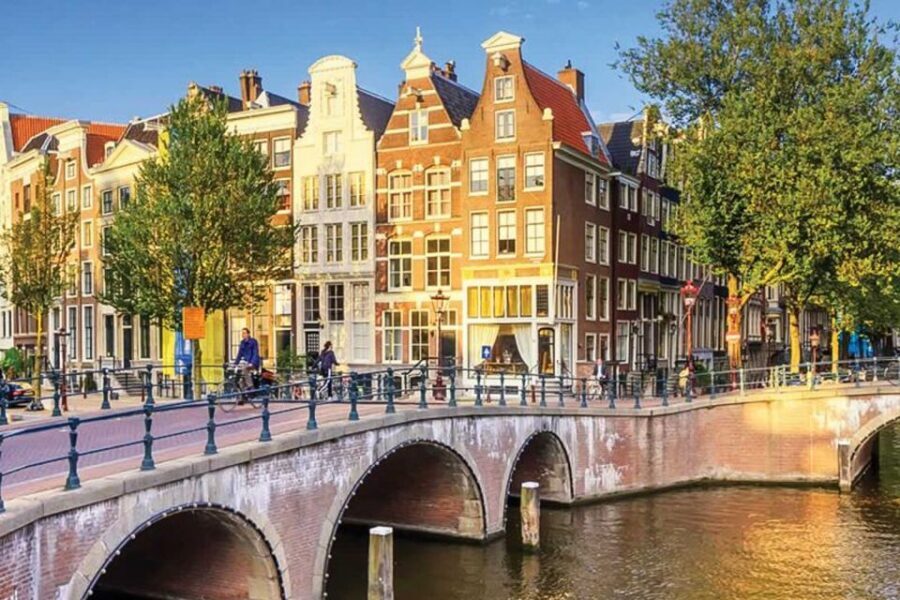
- Fast orientation around Dam Square, the Canal Belt, and the river bridges so the city feels less like a maze
- Smarter stop-by-stop context, including how Amsterdam grew from the Amstel River in the 12th century
- Iconic churches and squares like Royal Palace and Nieuwe Kirk on Dam Square, plus Oude Kerk
- Canal charm with specific spots such as Magere Brug and Blauwbrug, not just generic “look at the canals”
- Mercantile details and leaning merchant houses, tied to the city’s trade past
- A guide who adjusts to questions, with Monique noted for attentive, friendly explanations
Why this Amsterdam orientation walk works
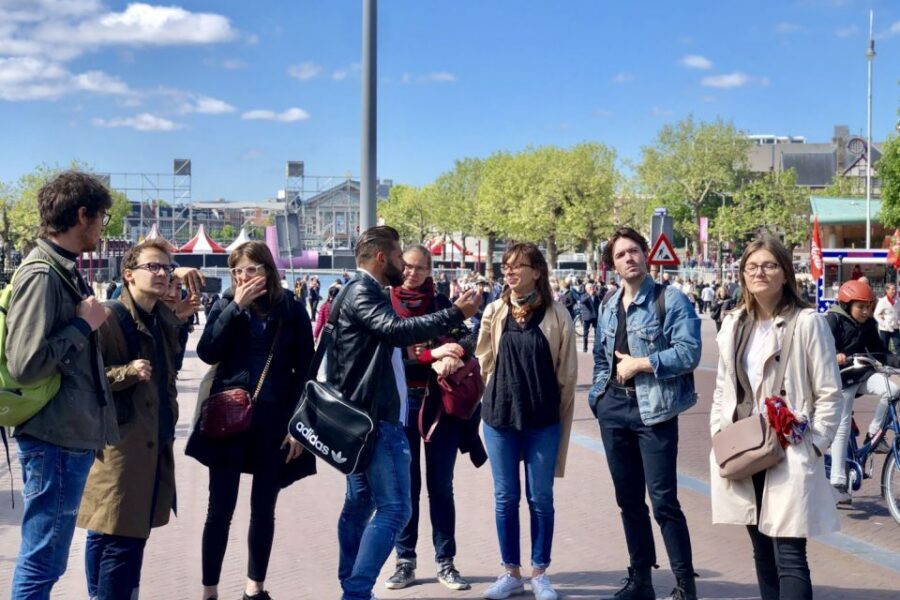
Amsterdam center can feel like it’s designed to slow you down: canals split directions, bridges appear like traps, and every block looks postcard-perfect. What makes this tour useful is that it’s not just a highlight reel. It’s an order-of-operations walk—build the mental map first, then enjoy everything you’ll see afterward.
I like that the guide spends real time helping you understand why these places matter. You’re not left with vague facts like “Amsterdam is old.” You get the thread from the Amstel River era into how the city grew into a trading power, plus why the Canal Belt looks the way it does. If you care about architecture, you’ll also like how the tour points out the little oddities, including leaning merchant houses and the logic behind the canal streets.
The other big win is pacing. With a small group and a guided walking format, you can actually ask questions and get answers that fit what you’re standing next to. A guide named Monique was highlighted for being attentive and friendly, and for answering questions on art, history, architecture, and food. That kind of responsiveness turns a “walk and look” tour into something closer to a conversation.
You can also read our reviews of more walking tours in Amsterdam



Getting started near Central Station and Prins Hendrikkade
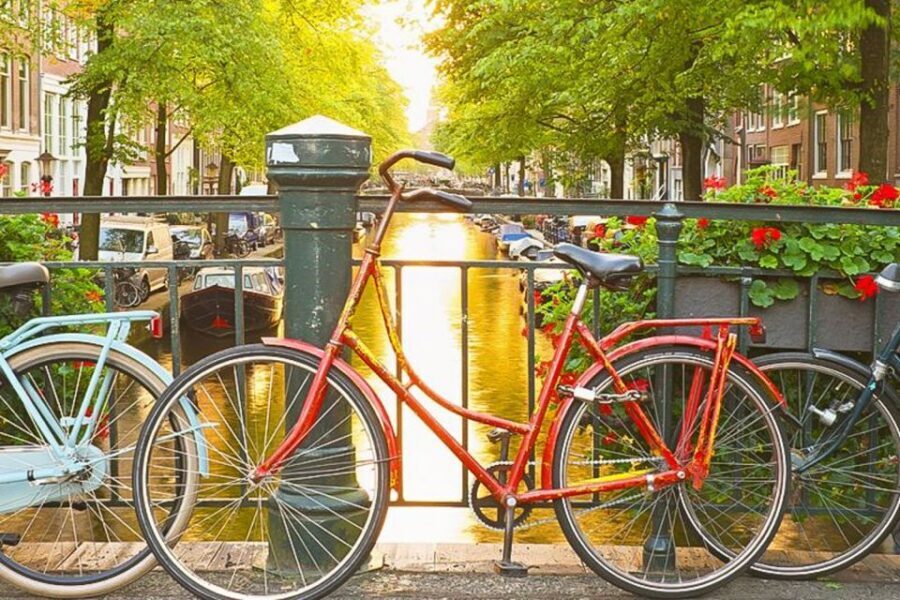
Your meeting point is outside the entrance of St Nicholas Church, on the opposite side of Central Station. That’s convenient if you’re arriving from anywhere else in the Netherlands, and it’s a clear landmark to aim for when streets get busy.
Once you’re together, the tour begins with a quick setup—then you move on to the heart of the walking route. The tour notes a starting location around Prins Hendrikkade 73, and it also mentions meeting by the statue of the bull on Beursplein. In practice, expect a short initial approach and then the guide gets you oriented fast with a clear storyline of how Amsterdam developed.
This is also a practical moment to reset expectations:
- You’ll get photo stops, guided explanation, and short walking stretches.
- You’ll likely spend most of the time outdoors, so bring weather-appropriate clothes.
- You should plan on no luggage or large bags.
If you like to wander on your own, you’ll still benefit from this opening phase. Even after the tour ends, you’ll know which way is north-south-ish in your head, which bridges are “the one you’ll want later,” and which canal streets are the ones you’ll revisit.
Dam Square to the Canal Belt: Royal Palace, Nieuwe Kirk, and bridges you’ll recognize
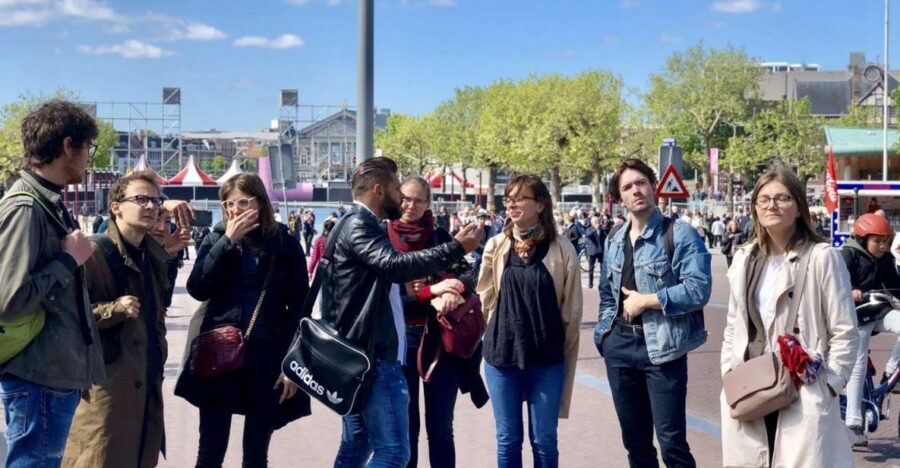
The route builds toward Dam Square, where the concentration of major sights is intense. You’ll do a photo stop and get guided context around monuments there, including the Royal Palace and Nieuwe Kirk. This matters because Dam Square can look like just a grand open space. With context, you start seeing it as a stage where power, religion, and city life all line up.
From there, you keep moving through the center with a strong canal focus. You’ll head toward the Jordaan area and walk along key waterways, including Prinsengracht and stops near the canal edge. One of the best ways to understand the Canal Belt is to see it from multiple angles. Even though Amsterdam is “flat on a map,” the canal streets create different rhythms in real life, and a guided route helps you feel that.
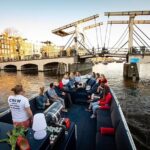
Two bridge moments are worth mentally earmarking. You’ll see Magere Brug (often called the Skinny Bridge) and later Blauwbrug. Bridges in Amsterdam are more than views. They’re direction changes, meeting points, and sometimes clues to how neighborhoods connect. Standing on the right side with the right explanation makes it easier to navigate afterward.
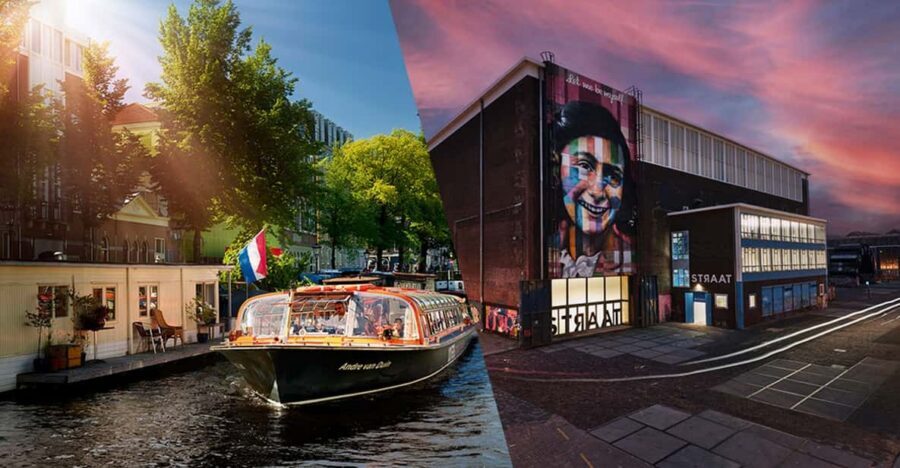
Also, the tour explicitly includes “enchanting bridges, barges, houseboats, and mercantile houses” along the way. That combination is smart: it mixes the scenic postcard Amsterdam with the trade-era buildings that explain why the city looks the way it does.
Oude Kerk, Onze Lieve Heer op Solder, and other stops with a wow-factor twist
Along the first stretch, you pass through a sequence of stops where Amsterdam’s layers show up quickly.
You start with Basilica of Saint Nicholas for a brief photo stop, guided look, and a short walk segment. Then you move to the Weeping Tower, another photo stop that’s there for a reason: it helps you notice that the city’s religious and civic buildings don’t all fit one single “Amsterdam look.” They vary, and a guide helps you spot the differences.
One of the most distinctive stops is Ons’ Lieve Heer op Solder (Our Lord in the Attic Museum). You’ll have a photo stop plus a guided visit. The tour frames it as a key part of the city’s character rather than a random museum detour, which is what you want when you’re only out for 2.5 hours.
Then you’ll hit Oude Kerk, a guided visit and photo stop. Old churches work best when the guide ties them to the neighborhood around them, because otherwise you’re just reading dates off a plaque. With this format, the buildings become anchors that help you remember the route.
This part of the itinerary is also timed well for first-time orientation. It gives you a mix of architecture, atmosphere, and neighborhood feel before you start chasing the more modern edges of the center.
Nieuwmarkt, De Waag, and the Jewish Quarter: history you can walk through
The itinerary brings you to Nieuwmarkt Square, including a photo stop and guided context. It’s a smart stop because Nieuwmarkt functions as a crossroads. The tour also points you toward an area you’ll likely recognize as Chinatown, so you get a sense of how Amsterdam absorbs different cultures into its existing street grid.
You’ll also see De Waag Restaurant. The name is familiar, but what’s useful here is the guided framing: it turns the building into part of Amsterdam’s old trade system. Even if you’re not obsessed with business history, the “mercantile Amsterdam” angle helps explain why certain streets and structures exist where they do.
After Nieuwmarkt, you move through the Jewish Quarter, Amsterdam, again with photo stop plus guided sightseeing. This isn’t only about one building; it’s about orientation through the streets so you can later connect what you saw on the tour with what you might read or notice in museums and neighborhoods.
A quick practical note: stops like these can involve more walking than you expect because the city blocks are narrow and you’ll want to keep moving. That’s another reason the 2.5-hour length works for most first-timers. You get a guided path without getting stuck for the rest of your day.
You can also read our reviews of more guided tours in Amsterdam




East-side icons: Rembrandt House, opera, Zuiderkerk, and the Amstel
Next, you’ll walk through the area around the museum Rembrandthuis (Rembrandt House). There’s a photo stop and guided sightseeing here, which is perfect if you want the vibe without committing to extra museum time. It also helps connect Amsterdam to the idea of art and how the city’s identity isn’t only about trading ships and canals.
Then the tour includes the Dutch National Opera & Ballet, again with a photo stop and guided look. This is a useful “now you’re here” marker. Amsterdam center isn’t frozen in the past; you’re seeing how important cultural institutions sit right alongside older architecture.
You’ll also stop at Zuiderkerk with a photo stop and guided visit. Churches often feel similar if you only glance quickly. With a guide, you start noticing why each one matters to its own neighborhood story.
Then you reach the Amstel for a photo stop and guided sightseeing. Seeing the river itself is key to understanding Amsterdam’s origin story from the tour’s opening explanation. When you’ve stood near the Amstel after hearing about the city’s early growth, it becomes harder to view the city as random geometry. The water explains the direction.
Magere Brug, Blauwbrug, Begijnhof, and Amsterdam Museum: turning scenes into a mental map
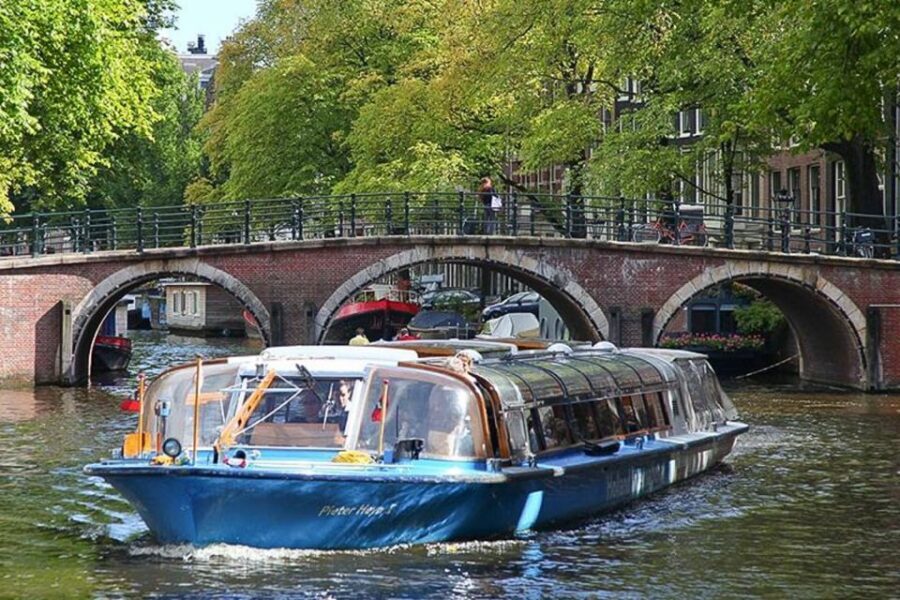
After the Amstel, you see Magere Brug and Blauwbrug, which is where canal-view Amsterdam really starts to feel real. These stops aren’t just about photos. They help you memorize the shape of the canal network. After that, you can glance at a map and actually picture where you are.
Then you go to the Begijnhof. You’ll do a photo stop plus guided sightseeing. This is one of the places Amsterdam works best as a quieter pause. The tour describes it as one of the oldest inner courts, and that fits the mood: you walk in, and the city noise doesn’t control the space. The guide also points out “little-known secrets,” including tree-lined squares and private courtyards—Begijnhof is where that theme pays off.
Later you’ll see Amsterdam Museum, again with guided sightseeing. With limited time, it’s not about spending hours inside. It’s about understanding that the city has a habit of protecting its past in plain view—on facades, in courtyards, and in street layouts.
Westerkerk, Prinsengracht, and ending around Dam Square again
Near the end, you’ll spend time around the Prinsengracht canal and the Westerkerk. You’ll see Westerkerk with a photo stop and guided sightseeing. Both are key “orientation” canals and church landmarks. They help you remember where the Jordaan and Canal Belt sit relative to the rest of the center.
Then the tour returns you to Dam Square for a photo stop and guided sightseeing. This creates a loop in your head. You don’t just see Dam Square once—you see it after you’ve learned the surrounding street logic. That repetition makes the map stick.
If you want to keep exploring afterward, this ending pattern is useful. You’ll know which direction to head for canals, where to look for another viewpoint, and how to avoid spending the rest of the day wandering without a plan.
Price and logistics: does $61 for 2.5 hours make sense?
At $61 per person for about 2.5 hours, this is priced like a focused orientation walk, not a long museum day. You’re paying for a private guide (so you’re not sharing commentary with dozens of people), plus a route that strings together major sights with meaningful explanations.
Value comes from the structure:
- You hit big anchors (Dam Square, major churches, key canals).
- You also hit “middle stops” that explain the city’s mercantile trade story.
- You get tips on how to spend your time in Amsterdam, which can save you from doing the wrong thing with your limited hours.
The group-size detail matters too. The tour is offered as private or semi-private, with a semi-private maximum of 8 and a minimum of 2 for that format to run. Since your header mentions up to 12 guests, you should treat group size as something you confirm at booking. Either way, the goal stays the same: enough people to keep it lively, small enough for you to ask questions.
A few logistics that affect comfort more than budget:
- Bring passport or ID card.
- Wear comfortable, weather-appropriate clothes.
- No luggage or large bags.
- Wheelchair access is only available by request, and it’s stated as not suitable for wheelchair users, so you should confirm carefully before booking if mobility is an issue.
Who should book this walk
Book this if you:
- Are visiting Amsterdam center for the first time and want a route you can repeat on your own after
- Like history that ties into buildings and streets, not only museum rooms
- Want canal views that come with practical navigation help
It may not be the best choice if you:
- Want a mostly relaxing sightseeing cruise with minimal walking
- Need full wheelchair accessibility on the day (the info provided signals this tour is not suited for that)
Should you book this Amsterdam City Center guided walking tour?
If your main goal is to understand the city quickly and move through it confidently later, I think it’s a strong pick. At $61 for 2.5 hours with a private guide, you’re buying orientation plus context, and that tends to pay off for the rest of your trip.
My decision checklist for you is simple:
- If you’re the type who likes asking questions and connecting landmarks to stories, yes.
- If you’re mostly here for long museum hours and slow wandering, you might prefer a different format.
If you do book, aim to show up on time at St Nicholas Church across from Central Station, wear shoes you can walk in without thinking, and bring your curiosity. A guide like Monique (friendly, attentive, and strong on art/history/architecture/food questions) is exactly the kind of person who turns a 2.5-hour walk into a week of easier sightseeing.
FAQ
How long is the Amsterdam city center guided walking tour?
It lasts about 2.5 hours.
How much does the tour cost?
The price is listed as $61 per person.
Where do I meet the guide?
Meet outside the entrance of St Nicholas Church on the opposite side of Central Station.
Is a private guide included?
Yes. A private guide is included.
What languages are available for the live tour guide?
The tour is offered in Portuguese, Spanish, Dutch, French, English, and Italian.
What are some of the main sights you’ll see?
You’ll visit major center landmarks including Dam Square (Royal Palace and Nieuwe Kirk), Oude Kerk, Nieuwmarkt Square, Magere Brug, Blauwbrug, Begijnhof, Westerkerk, and more.
Are food and drinks included?
No. Food and drinks are not included.
Do I need to bring an ID?
Yes. You should bring a passport or ID card.
Is the tour wheelchair accessible?
Wheelchair accessible tours are only available by request, and the tour information also states it is not suitable for wheelchair users, so you should confirm availability before booking.
What is the cancellation policy?
You can cancel up to 24 hours in advance for a full refund.